How to Do the Walk Out Exercise for Micro-Workouts
 15 min
The 2018 Physical Activity Guidelines established that activity bouts of any length count toward your daily total, so a walk out can contribute to a legitimate exercise routine even when you only have a brief window. You still need to work toward the weekly target of 150 minutes of moderate activity or 75 minutes of vigorous activity, but those minutes no longer have to come in long, uninterrupted sessions.
That change reshaped how coaches should think about short movement breaks. A walk out exercise isn't merely a warm-up before a “real” workout. Performed with control, it combines a hip hinge, shoulder loading, trunk stability, hamstring mobility, and a return to standing in one compact movement. The bigger opportunity is programming it repeatedly, between calls, after long periods of sitting, or during transitions that already exist in your day.
For busy professionals, the limiting factor usually isn't knowledge. It's friction. A floor-based walk out requires no equipment, little space, and no change of clothes, but it still demands enough technical discipline to avoid turning every repetition into a rushed forward fold. The practical question is not whether one repetition transforms fitness. It's whether you can perform good repetitions often enough to build a dependable movement habit.
Table of Contents
- Why This Movement Matters Now
- Walk Out Exercise Step by Step
- What the Evidence Says About Benefits
- Regressions and Progressions to Match Your Level
- Programming Walk Outs into Micro-Workouts
- Putting It All Together for Sustainable Practice
Why This Movement Matters Now
In 2018, the U.S. Physical Activity Guidelines removed the earlier requirement that moderate-to-vigorous activity accumulate in bouts of at least 10 minutes. The current guidance says that any duration of moderate-to-vigorous physical activity contributes toward the weekly target, as explained in the 2018 Physical Activity Guidelines from the CDC. That policy shift gave short walks, stair bursts, and bodyweight intervals a clearer place in everyday planning.
Consider a consultant who spends most of the day moving between video calls. A conventional workout may be realistic on some mornings, but not on a day filled with deadlines, commuting, and family responsibilities. A controlled walk out between meetings won't replace every form of training, but it can interrupt sitting, expose the shoulders and trunk to useful loading, and add movement to a day that might otherwise contain very little.
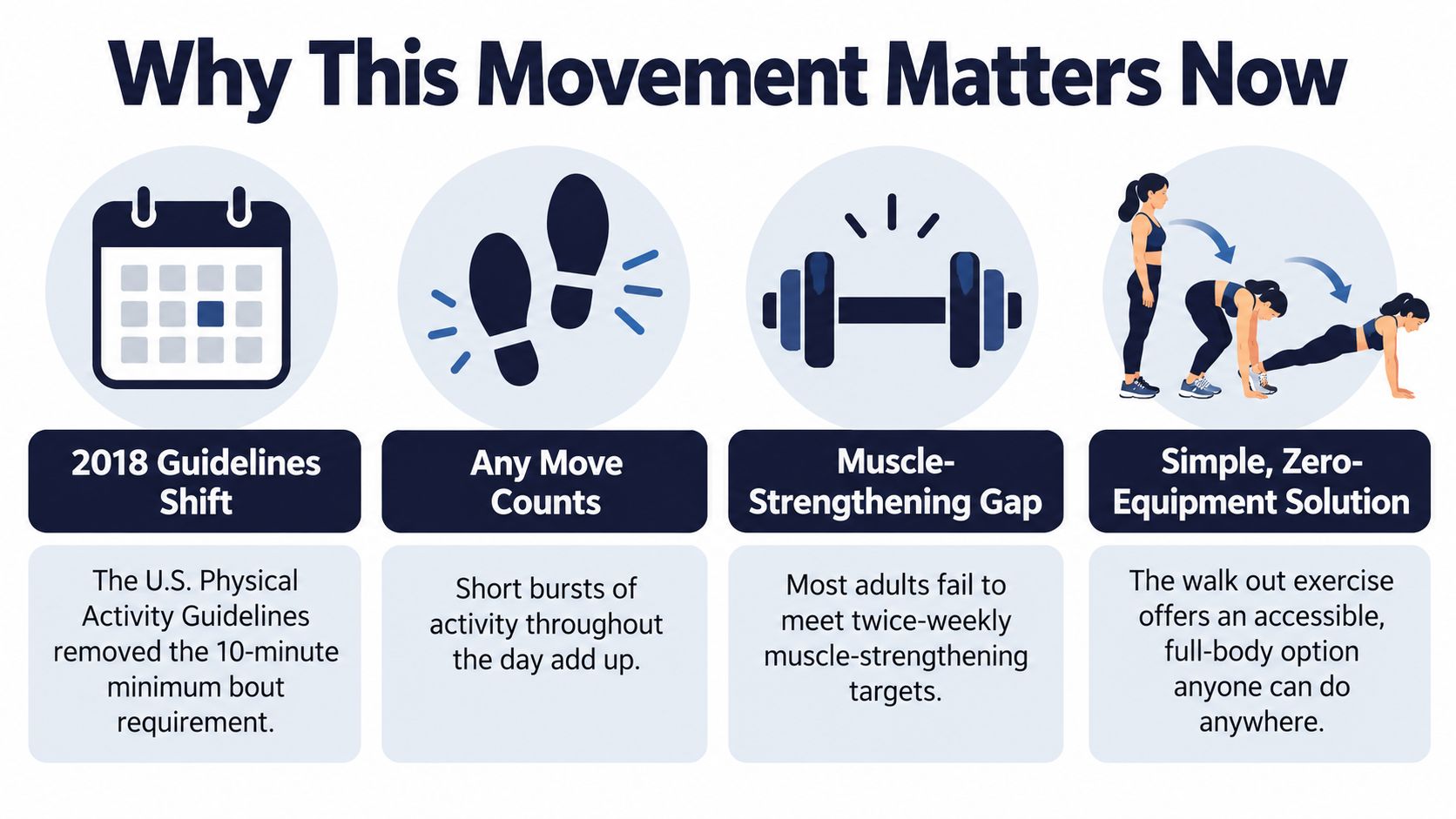
The modern exercise-snack model builds on this same logic. A major 2024 scientific review found that brief intermittent bouts appeared feasible and safe, while epidemiological evidence showed steep, near-linear associations between very short, vigorous activity and lower risks of all-cause, cardiovascular, and cancer mortality. The review also reported lower incidence of major adverse cardiovascular events and cancer, but it emphasized that trial evidence remains limited and findings for fitness and quality of life are mixed. You can read the full review of exercise snacks and intermittent physical activity.
The adherence problem is the real target
The walk out is useful partly because it lowers the starting cost of exercise. You don't need to travel to a gym, set up equipment, or protect a long calendar block. You do need enough floor space to reach a plank and enough patience to keep each repetition controlled.
That makes it a strong candidate for people who repeatedly postpone longer sessions. The movement is accessible, but accessibility doesn't make it complete. A sustainable exercise snack should support a broader routine that includes walking, resistance training, and more continuous cardiovascular work when those options fit your goals.
Practical rule: Use the walk out to make movement easier to start, not to pretend that every training need has disappeared.
Walk Out Exercise Step by Step
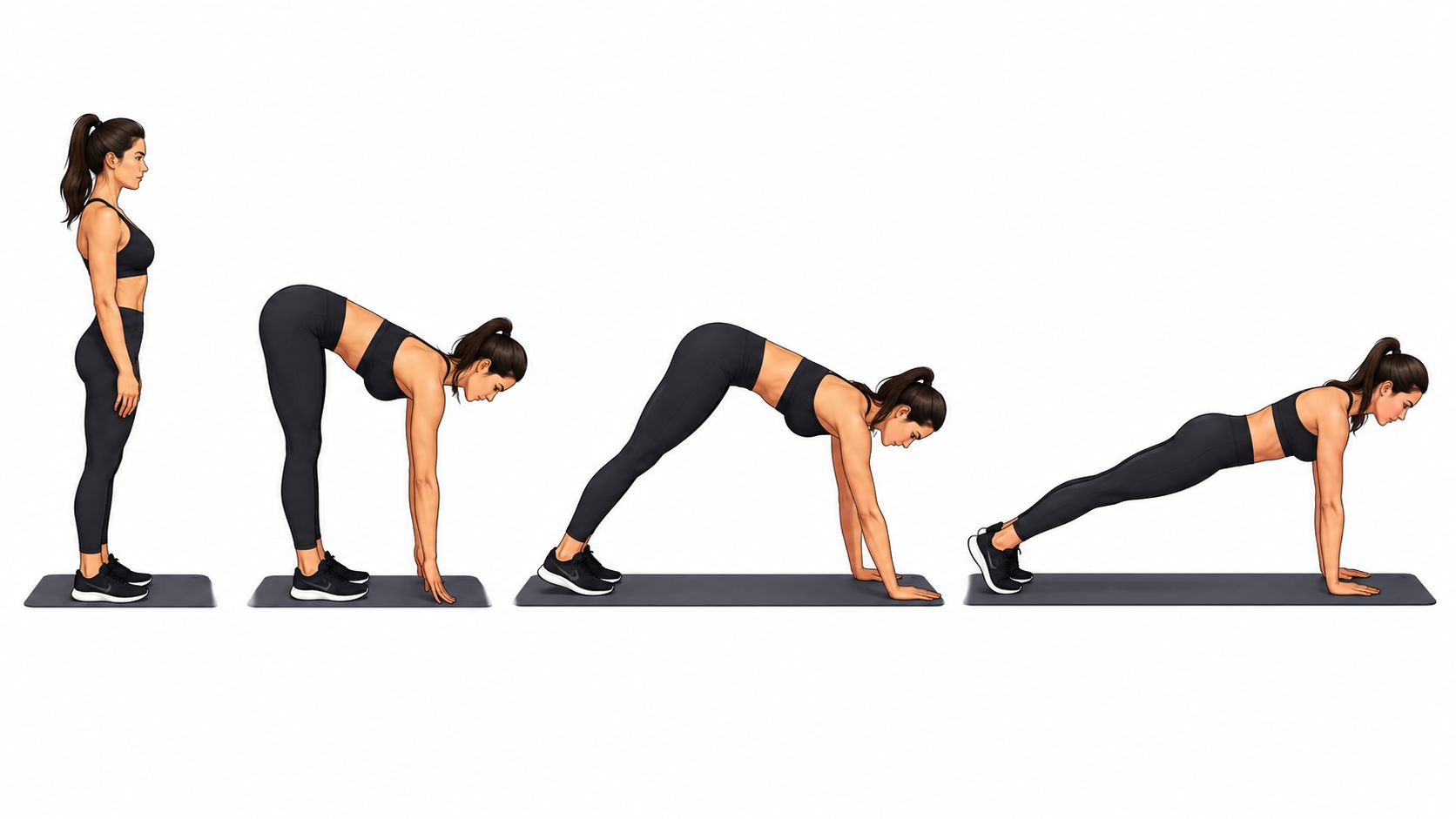
Start by treating the first half of the repetition as a hinge, not a squat. Stand with your feet about hip-width apart, keep your ribs stacked over your pelvis, and brace your core lightly before sending your hips backward. The walk-out form guide from The Workout Magazine recommends controlled hand steps of roughly 15 to 20 centimeters, a one-to-three-second pause in the plank, and a smooth return to standing.
Build the repetition from the hips
-
Set your stance. Place your feet under your hips, soften your knees, and lengthen through the crown of your head. Keep your weight balanced across the feet rather than shifting onto the toes.
-
Hinge backward. Push your hips behind you as though you're closing a drawer with them. Your torso will lean forward because of the hinge, but your knees shouldn't travel forward into a deep squat. Maintain a long spine and keep your abdominal wall gently active.
-
Reach the floor. Place your palms down in front of your feet. If your hamstrings are tight, bend your knees enough to reach the floor without rounding aggressively through the lower back. Don't force your fingertips to touch the ground with locked knees.
-
Walk the hands forward. Move one hand at a time in small, deliberate steps. Avoid jumping the hands or taking oversized reaches, because large steps often cause the pelvis to sway and the shoulders to lose control.
-
Own the plank. Finish with your shoulders stacked over your wrists, legs active, and hips roughly level with your shoulders. Pause for one to three seconds while keeping your glutes and core engaged. Your lower back shouldn't sag, and your hips shouldn't lift into a pike.
-
Return under control. Walk the hands back toward your feet using the same small steps. Keep your hips moving backward as the hands approach the floor, then unfold to standing without snapping the knees or rolling up through a loose spine.
The two common technical errors are easy to recognize. Squatting down first reduces the hamstring demand and can make the movement feel easier, but it also changes the intended pattern. Rushing the return creates momentum and encourages lumbar compensation, especially when fatigue makes you eager to finish the set.
Watch the demonstration below for the full sequence, then practice slowly enough to identify where your hips, shoulders, and hands are positioned.
Use a shorter range of motion if your wrists, shoulders, hamstrings, or lower back can't maintain a comfortable position. A good repetition is one you can repeat without losing the hinge, plank pause, or controlled return.
What the Evidence Says About Benefits
The most defensible claim is that walk outs belong to the broader category of intermittent physical activity. They aren't magic repetitions, and research on the exact walk out exercise is more limited than research on exercise snacks as a wider concept.
The 2024 review described brief intermittent bouts as feasible and apparently safe. Its epidemiological findings linked very short, vigorous activity with lower risks of all-cause, cardiovascular, and cancer mortality, along with lower incidence of major adverse cardiovascular events and cancer. Those are meaningful associations, but they don't prove that a particular number of walk outs caused those outcomes, and they shouldn't be presented as a guaranteed result of a home routine.
What short bouts can realistically provide
A well-executed walk out gives you several training exposures at once:
- Movement interruption: It breaks up long periods of sitting with active shoulder, hip, and trunk movement.
- Strength practice: The plank position challenges the shoulders and trunk, while the return to standing asks the hips and hamstrings to work.
- Habit reinforcement: A brief set can fit into a transition that would otherwise be inactive.
- Intensity flexibility: You can make the movement easier with a wall or incline, or more demanding by adding controlled repetitions and a longer plank pause.
The exercise-snack literature supports the value of brief, repeated movement, but the same review noted that trial evidence is still limited. Effects on fitness and quality of life remain mixed, so it would be inaccurate to promise that walk outs alone will produce the same adaptation as a structured strength or endurance program.
Where the trade-off appears
A 2026 meta-analysis found that exercise snacks improved cardiorespiratory fitness and peak power output, while effects on body composition and blood lipids were inconsistent. The evidence was low-certainty for some outcomes, and the authors identified a need for more age-specific confirmation in the published analysis of exercise-snack outcomes.
That distinction matters for programming. If your goal is to move more consistently, a walk out may be an excellent entry point. If your goal is to build substantial muscle, improve a specific sport performance quality, or develop long-duration aerobic capacity, you'll need additional training that supplies enough volume and specificity.
Light walking breaks may also help some people feel less stiff after sitting, but that evidence is not settled. A 2026 review found possible reductions in musculoskeletal discomfort, yet five of the six included trials had high risk of bias, as reported in the review of exercise snacks and postprandial responses. Treat comfort as a useful personal response to monitor, not as a universal promise.
Regressions and Progressions to Match Your Level
Choose the version that lets you practice the hinge and plank without pain or compensation. Difficulty should rise because you can control the current variation, not because you feel pressured to perform the floor version immediately.
Wall-supported walk outs
Stand facing a wall with your hands at about chest height. Hinge slightly through the hips, place your palms on the wall, and walk your hands upward or downward through a controlled range while keeping your ribs and pelvis organized. This version removes much of the load from the wrists and shoulders, making it useful when you're learning the sequence or returning after time away from exercise.
The wall variation is also a practical assessment. If you can't keep your back comfortable while moving the hands, the floor version is premature. Adjust your distance from the wall until the angle feels challenging but stable.
Incline walk outs
Use a sturdy counter, bench, or other fixed surface that won't slide. Place your hands on the raised edge and walk them away from your feet until your body forms a straight line, then pause briefly before returning. An incline reduces the amount of bodyweight supported by the arms while preserving the basic relationship between the hinge, hand walk, and plank.
An incline is often the right bridge for someone who can manage the wall but doesn't yet feel secure on the floor. It also gives experienced exercisers a lower-load option for a recovery day or a workplace movement break.
Floor walk outs
The standard variation requires more wrist, shoulder, and core control. Use the floor only when you can reach the plank without discomfort, keep your hips level during the pause, and walk the hands back without collapsing through the lower spine. If you're interested in related crawling patterns, the bear crawl exercise guide offers another bodyweight option, but it shouldn't replace the basic walk-out practice while you're still learning the hinge.
Use this decision rule:
| Your current response | Appropriate variation |
|---|---|
| You can't hold a comfortable plank for two seconds with stable shoulders and hips | Start at the wall and practice the hinge |
| You can manage that brief plank but the floor feels too demanding | Try an incline |
| The wall and incline cause no wrist or lower-back discomfort | Practice the floor version |
Move up only when the easier version looks the same at the end of a set as it did at the beginning. A regression isn't a failure. It gives you a way to accumulate high-quality practice without letting fatigue dictate your mechanics.
Programming Walk Outs into Micro-Workouts
A walk out earns its place in a micro-workout when it is easy to repeat, technically controlled, and tied to a reliable part of the day. A 12-week randomized trial in sedentary office workers found that three-minute micro-exercise breaks performed hourly were feasible in a real-world work setting, according to the trial report on micro-exercise breaks. This supports the 2018 physical activity guideline shift toward valuing activity accumulated in shorter bouts. The practical takeaway is simple: schedule small doses around events already present in the workday.
Three useful templates
The transition snack suits people who do not want another reminder competing for attention. Perform a small set after the first morning call, before lunch, and at the end of work. Keep each repetition crisp, pause in the plank while your shoulders and hips stay controlled, and stop before fatigue changes your return. The event provides the cue, so the routine does not depend on finding extra motivation.
The hourly office break uses a short movement window between tasks. Complete a few walk outs, then spend the remaining break standing or walking around the room. Keep the effort moderate. Alternating a wall or incline variation with the floor version can limit wrist and shoulder fatigue, especially when the same pattern appears several times during the day.
The compact circuit places the walk out beside other movement patterns. Perform a controlled walk out, follow it with squats or push-ups, rest as needed, and repeat for a short period. The walk out supplies hinge, shoulder, and plank exposure, but it should not carry the entire session. Use an incline or knee-supported push-up when needed rather than adding fatigue through poor pressing mechanics.
A survey of 351 adults found that 22.8% met WHO muscle-strengthening guidance, while 68.9% reported some muscle-strengthening activity, as described in the cited research. The gap shows why a vague intention to exercise is weaker than a scheduled, repeatable plan. Occasional strengthening does not automatically become an organized routine.
Build a week you can repeat
Choose one template first. Set the walk out at a difficulty that allows clean repetitions, then pair it with complementary movements such as glute bridges, rows, bird dogs, squats, or push-ups. For a broader structure, use this at-home no-equipment workout guide to organize short sessions around movement categories.
Track whether you completed the planned snack and whether the final repetition remained technically sound. Increase repetitions, extend the plank pause, or select a harder variation only after the habit feels automatic and your joints remain comfortable. If the last repetition looks rushed, keep the same dose for the next week.
For people who want a visible record of short bodyweight sets, SuperStrong offers an iPhone app with a shared wall for groups of up to four friends, training-day goals, and tiles representing logged effort. It can sit beside a timer, notes app, or paper checklist. The recording method matters less than making the next planned snack easy to remember.
Putting It All Together for Sustainable Practice
A useful walk out has four checkpoints: hinge first, use small controlled hand steps, hold a stable plank briefly, and return without rushing. If any checkpoint breaks down, switch to a wall or incline rather than forcing more floor repetitions.
The evidence supports brief movement as a practical addition to an active lifestyle, but it doesn't turn the exercise into a complete training plan. Use walk outs to interrupt sitting and build consistency, then add walking, resistance work, or longer cardio sessions when your schedule and goals allow.
Record the accumulation in a bodyweight workout journal, and judge progress by repeatability rather than by one exhausting session. Your first goal is simple: choose a variation you can perform well, place it beside a daily transition, and complete the next planned snack with the same control.
SuperStrong organizes short, at-home bodyweight sets into a shared visual wall, helping you record walk outs alongside movements such as squats, push-ups, and glute bridges. If you want a simple accountability structure for brief training sessions with friends, visit SuperStrong and see whether its iPhone-based format fits your routine.