Bodyweight Training for Beginners: Your First 30 Days
 15 min
You're between meetings, your gym bag is still by the door, and the idea of “working out” already feels like another decision you don't have time to make. That's exactly where bodyweight training for beginners earns its place, because you can start in a hallway, beside a kitchen counter, or in the same room where you answer emails. The win isn't looking athletic in 30 days, it's building a repeatable habit that fits a normal week and doesn't collapse the moment life gets busy.
Table of Contents
- Why Bodyweight Training Is Having a Moment
- The Two Rules Behind Every Beginner Program
- The Seven Movements Worth Learning First
- A Realistic 3 Day Weekly Plan You Can Actually Keep
- How to Make a Movement Harder Without a Gym
- What Micro Sets Can and Cannot Do for You
- Why a Tiny Group Changes Everything
- Your First 30 Day Checklist and Common Questions
Why Bodyweight Training Is Having a Moment
The bigger win is not looking athletic in 30 days. It is building a repeatable habit that fits a normal week and does not fall apart when life gets busy. Bodyweight work fits that idea because you can do it in a hallway, by a kitchen counter, or in the same room where you answer emails. The barrier is often not effort. It is how easy it is to start again tomorrow.
WHO guidance treats muscle-strengthening work as part of a normal adult activity pattern, and bodyweight movements can fill that role when they are done with moderate effort and progressed over time WHO physical activity guidance. The same guidance also reports that approximately 1 in 4 adults worldwide are insufficiently active and 4 in 5 adolescents do not meet recommended activity levels WHO physical activity guidance.
A 2023 review of 3,346,723 adults across 32 countries found only 17.12% met both aerobic and muscle-strengthening guidelines. That is one reason a beginner plan has to be practical before it can be ambitious.
The useful shift is to stop treating exercise like one long event. Short exercise snacks spread through the day can turn a few minutes at home into a real routine, the same way small practice sessions help a new driver get smoother over time. That makes the first month less about proving toughness and more about proving consistency.
Practical rule: if you can repeat it on ordinary weekdays, it is a program. If it only works on a perfect Saturday, it is a wish.
The Two Rules Behind Every Beginner Program
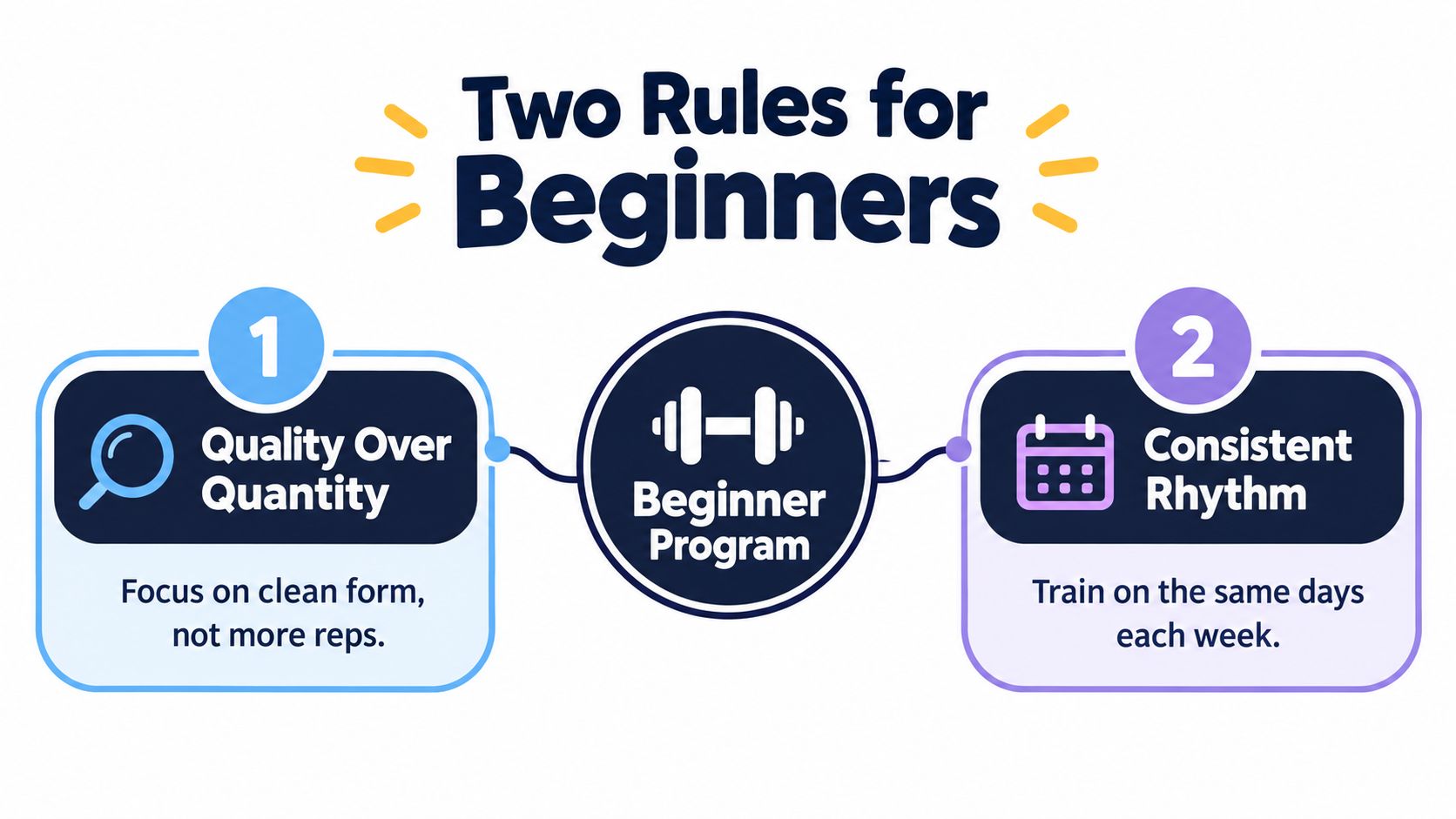
The first rule is simple, quality beats quantity. A clean rep teaches your body what to do, while a sloppy rep mostly teaches it how to cheat. Learning bodyweight training for beginners is a lot like learning to drive a manual car, because pressing the pedals harder doesn't help if your timing is off.
What quality looks like
A good rep feels controlled from start to finish. Your joints stay lined up, your movement looks smooth, and you stop before form falls apart. In practice, that means you leave a couple of repetitions in reserve, the same way a cook tastes the sauce before dumping in more salt.
The second rule is rhythm beats heroics. Three short sessions across a week usually beat one exhausting attempt, because the body adapts to repeated exposure, not one dramatic event. A recipe improves when you make it, adjust it, and make it again, not when you cook once and hope memory carries the flavor.
Use this mental checklist on every set:
- Controlled start and finish: no dropping into the bottom of a squat or bouncing out of a push-up.
- Stable positions: hips, shoulders, and knees stay organized instead of wobbling everywhere.
- Breathing stays usable: if you're holding your breath the whole time, the set is probably too hard right now.
- A little left in the tank: finish with enough reserve that you could repeat the movement with decent form.
Train the rep you can repeat, not the rep you can survive.
The Seven Movements Worth Learning First
Start with the movements that show up in real homes, not the ones that need a special setup. A doorway, a chair, a counter, and the floor can cover most of what a beginner needs, which is why this list stays practical instead of flashy.
Stand, push, pull, and brace
Squat. Stand with feet about shoulder width, sit your hips back, and lower under control. If a full squat feels like too much, use a chair behind you and stand up from a seated position. As that gets easier, move to deeper bodyweight squats, then pause at the bottom for a second before standing.
Push-up. A wall or kitchen counter is a perfectly valid starting point. Pressing from an incline lets you learn body position without collapsing at the shoulders or lower back. If you can do that well, move closer to the floor, then progress to a standard floor push-up.
Row. Rows balance all the pushing you'll do, and they're easier to forget because they need a setup. A sturdy doorway or table edge can give you a starting angle, and a towel or sheet can help in some homes if the surface is safe. For a deeper upper-body progression, this guide on how to build upper body strength at home fits naturally after you've learned the pattern.
Glute bridge. Lie on your back with knees bent and drive through the heels to lift the hips. This is a friendly entry point for the back side of the body, and it teaches hip extension without loading the spine heavily. Make it harder by pausing at the top or lifting one leg at a time.
The smaller movements that make the bigger ones work
Bird dog. Hands and knees on the floor, extend one arm and the opposite leg, then switch sides slowly. It looks simple, but it teaches control, balance, and trunk stiffness. That matters when squats and push-ups start demanding better coordination.
Dip. A chair or bench can help you start with a shortened range. Keep the shoulders comfortable and the motion controlled, because this one punishes rushing more than most movements.
Pull-up. Most beginners won't do a clean pull-up on day one, and that's normal. Use a doorway bar, assisted holds, or slow negatives if you have the setup, then treat the full pull-up as a longer-term project rather than a day-one test.
Video guidance can help the setup click faster, especially for people who learn by watching.
Breathing matters more than beginners expect. Exhale on the hard part of the rep, keep the lowering phase slow enough to control, and think about moving like you're descending stairs, not jumping off a curb.
A Realistic 3 Day Weekly Plan You Can Actually Keep
A good beginner week feels almost boring on purpose. That's a strength, not a weakness, because boring is what makes it repeatable when work runs long or your energy dips.
The rhythm
Train on three nonconsecutive days, then use the other four days for brief exercise snacks or complete rest. The movement order can stay simple, squat first, push next, then a pull or bridge, then a stability movement. The goal is not to empty the tank, it's to practice the pattern often enough that your body remembers it.
| Day | Focus | Movements | Starting Sets |
|---|---|---|---|
| Monday | Full body practice | Squat, incline push-up, row, glute bridge | 2 sets each |
| Wednesday | Repeat and refine | Squat, push-up variation, bird dog, dip or bridge | 2 sets each |
| Friday | Control and confidence | Squat, row, push-up variation, pull-up progression | 2 sets each |
On training days, start with 2 sets of each movement and stop before form breaks down. If that feels too easy after a couple of weeks, add a third set to one movement, not every movement at once. That keeps fatigue manageable and makes it obvious what changed.
The other days are for tiny, easy wins. Two or three short sets spread across the day can happen while coffee brews, between calls, or before dinner. You're not trying to recreate the full workout, just keep the habit alive and give your muscles another low-friction reminder.
Simple target: leave the gym mindset behind and think like someone watering a plant. A little, often, beats a flood once a week.
How to Make a Movement Harder Without a Gym
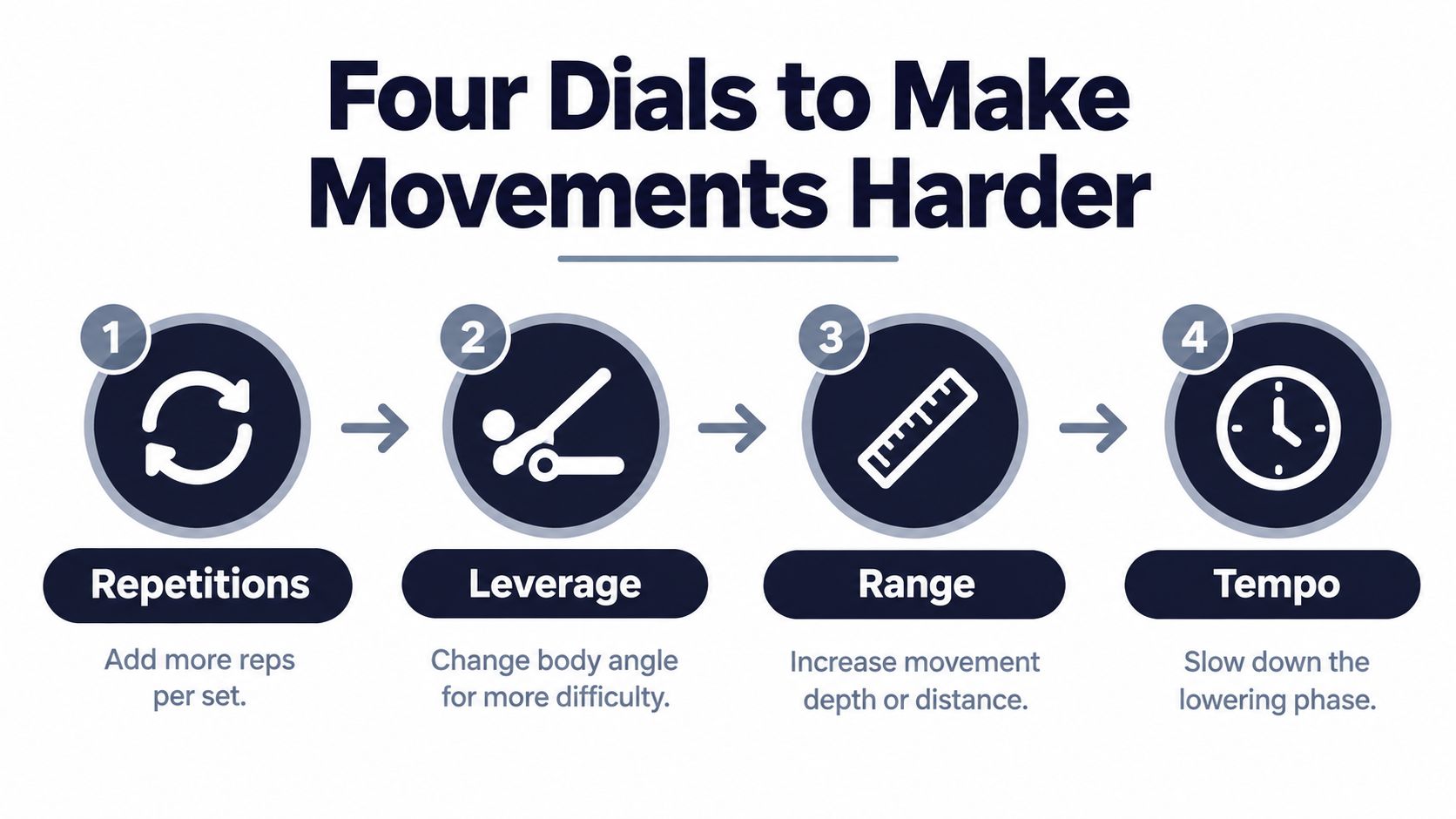
When a movement starts to feel easy, the answer isn't automatically more reps. Think of progression like a volume knob and an equalizer, because you can turn one dial at a time without wrecking the whole sound.
Four dials you can turn
Repetitions. Add a rep or two to each set when the current number feels smooth. This is the easiest dial to change, and it works best when technique already looks solid.
Body angle. Change your body angle to make the movement harder. A wall push-up is easier than a counter push-up, which is easier than a floor push-up, and a feet-raised push-up comes later.
Range of motion. Go deeper or travel farther. A squat to a chair becomes a deeper squat, then a deeper squat with a pause. More range usually means more work, but only if the position stays clean.
Tempo. Slow the lowering phase. That turns one smooth rep into a more demanding one without needing extra equipment, and it helps you feel where control is slipping.
Push-up example
A practical push-up progression looks like this. Start at the wall if you need to, then move to a counter or table, then the floor. Once floor push-ups feel steady, experiment with slower lowers or feet elevation, but only change one thing at a time so you can tell what helped.
That one-change rule keeps progress legible. If you add reps, deepen range, and slow the tempo all at once, you won't know whether the next step is working or whether you just made the set messy. Beginners stall most often when they turn every knob at once.
What Micro Sets Can and Cannot Do for You
Short sets spread across the day are a good way to build the habit itself. They support adherence, movement confidence, and some cardio fitness, which is why the exercise-snack approach helps people who cannot set aside long workout blocks. A 2024 exercise-snack scoping review found the approach feasible and apparently safe, with modest gains in cardiorespiratory fitness, although the wider effects were mixed.
The honest part matters more than the catchy part. Micro sets are not a complete strength program, and they are not a shortcut to obvious muscle gain or major body-composition change. A 2025 summary of exercise-snack trials found improvements in fitness-related outcomes but no clear improvement in muscular strength or body mass in the outcomes examined exercise snacks review.
That means the tool has a clear job:
- For habit building: micro sets work very well.
- For confidence and technique: micro sets work well.
- For strength and muscle: micro sets help, but they still need progression.
- For major body-composition change: training alone will not carry the whole load.
Use the same honesty with discomfort. Normal muscle fatigue feels different from sharp joint pain, dizziness, or symptoms that linger after you stop. If a movement hurts in a bad way, regress it, swap it, or pause it instead of pushing through.
If you want a movement that scales from a standing reach to a fuller body pattern, see the walk-out exercise guide for a concrete progression. If you want a simple logging habit that keeps the work visible, a tool like SuperStrong stores short bodyweight sets on a shared wall and makes each set easier to review later. The point is not a bigger routine, it is clearer follow-through.
Why a Tiny Group Changes Everything
Week three is where solo plans often start leaking. You miss one session, then another, and nobody notices except you, which makes it too easy to fade from view.
A small group changes the pressure without turning your routine into a public performance. With up to four friends on one shared wall, every set becomes visible, and a skipped day is visible too. That matters because people are better at returning to a plan when someone else can see the pattern.
On a normal week, the wall fills with short tiles from quick push-up sets, squats before dinner, or a bridge session before bed. If one person does more reps, the tile is bigger, so the effort is obvious at a glance. If someone misses a day, the empty space is harder to ignore than a forgotten note in a phone app.
A private group works better than a public feed for most beginners. It feels less performative, less crowded, and less like you're posting for strangers. The social effect is still there, just tighter and more useful, the way a small study group keeps you accountable without turning class into a show.
A tiny audience is often enough. You don't need a crowd, you need people who notice.
Your First 30 Day Checklist and Common Questions
Month one checklist
- Week 1: show up on the three training days, even if the sessions feel very easy.
- Week 2: log each set cleanly so you can see what you did instead of guessing later.
- Week 3: choose one movement and make it slightly harder by using one dial, not four.
- Week 4: review your wall, notice what you repeated most, and keep the pattern that felt sustainable.
Keep the two rules in front of you, clean movement first and steady weekly rhythm second. Then use the four dials only when a movement starts to feel too easy. If pain shows up, back off quickly and adjust the movement instead of forcing a bad rep.
A simple journal helps here too, because memory gets fuzzy fast once the week gets crowded. A format like a bodyweight workout journal keeps your reps, variations, and effort visible without turning logging into homework.
Common questions
How long until I notice changes?
Most beginners notice better coordination and less awkwardness first. Visible physique changes usually take longer and depend on consistency, recovery, and what happens outside training.
Is it safe to do bodyweight work every day?
Light movement can happen often, but hard strength work needs recovery. Keep the three main sessions separated and make the in-between work easy enough that it doesn't beat up the same muscles again.
What if a movement hurts my lower back?
Stop that version and scale it down. A wall push-up, chair squat, or glute bridge often gives you a cleaner entry point while you rebuild control.
How do I bring a hesitant friend into this?
Make the first week tiny and private. A short shared routine feels much less intimidating than a full fitness commitment, especially when the goal is just to show up and log something.
If you want a simpler way to keep beginner bodyweight training for beginners visible day after day, SuperStrong turns short at-home sets into a shared wall you can check at a glance. It's built for small groups, quick logging, and the kind of snack-sized routine that fits between real life moments. Visit SuperStrong and see how a few honest reps can become a habit you'll keep.