How to Build Upper Body Strength at Home Without Weights
 13 min
It's 9 p.m., dinner's cleared, and the gym is closed anyway. The upper body still needs work, so the question isn't whether you have a perfect setup, it's whether a floor, a sturdy chair, and a doorframe can become a real training space. They can, if you treat them like one.
How to build upper body strength at home comes down to the same thing that drives any good resistance program: tension, recovery, and progression. The difference is that at home you're creating that tension with bodyweight, tempo, angles, and a few household anchors, then making the work visible so it gets done.
Table of Contents
- Why a Home Upper-Body Plan Can Actually Work
- The Foundation Before Any Movement
- Push, Press, and Dip for Chest, Shoulders, and Triceps
- Pull, Row, and Hang for Back and Biceps
- A Three-Day Weekly Schedule You Can Actually Finish
- When More Reps Stop Being Enough
- Your Starting Checklist for Tonight
Why a Home Upper-Body Plan Can Actually Work
A lot of people think a home routine is a fallback. In practice, it can be the only plan that survives a weekday. I've seen the same pattern over and over, someone gets home, sits down for ten minutes, and by the time they stand up again, the “real workout” is gone.
That's why short sessions matter. The World Health Organization recommends muscle-strengthening activity for all major muscle groups on at least 2 days per week WHO guidance summarized in the British Journal of Sports Medicine, and the ACSM resistance-training model supports a practical schedule of two or three short weekly sessions for beginners when each major muscle group is trained 2 to 3 days per week ACSM position stand. A home plan built around that cadence isn't “less serious,” it's just more realistic.
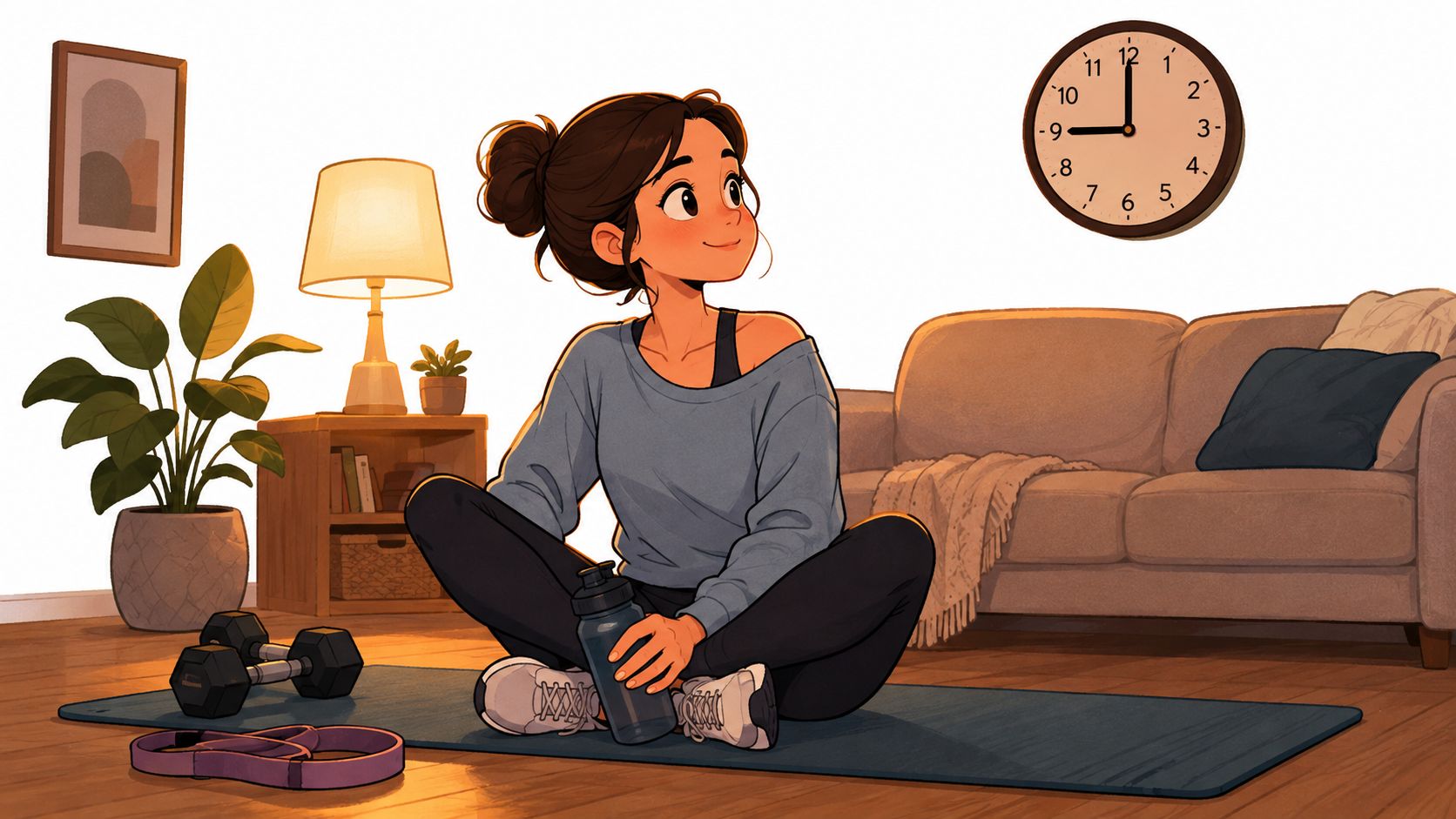
Practical rule: if a session can fit between dinner and dishes, it can still count as training, provided the set is hard enough to matter.
The other piece is logging. A shared wall with a small group turns scattered effort into a pattern you can see. When each set lands as a tile, skipped sessions stop being invisible, and progress stops feeling vague.
If you want a quick sanity check on whether bodyweight-only training can stand on its own, this overview of bodyweight training gives the right context: the method works when the movements are hard enough and the progression is deliberate.
The Foundation Before Any Movement
Before anyone chases harder push-up variations, the base rules need to be clear. Train the major muscle groups at least 2 days per week, then increase difficulty in a planned way instead of testing max effort every session. That is the part most home plans skip, and it is usually why they stall. The ACSM position stand supports that basic setup.
For beginners and recent returners, a useful target is roughly an 8 to 12 repetition maximum, meaning a load or variation that allows about 8 to 12 challenging reps with good technique. At home, that does not mean you need plates or a bench. It means the first version of each movement should be hard enough to make the last few reps slow, controlled, and honest.
How Progression Works Without Weights
Progress comes from changing the exercise, not just repeating it forever. Add reps when the set still feels crisp. Slow the lowering phase when the movement gets too easy. Increase the range of motion when your position stays stable. Move from incline push-ups to floor push-ups when the angle stops challenging you.
Useful rule: if you clear your target by two clean reps in two consecutive sessions, move to the next variation rather than adding a max-effort set.
The same ACSM model also describes increasing load by about 2 to 10% when a person exceeds the target workload by one or two reps. At home, that usually means a small change in body angle, a longer lowering phase, a deeper range, or a slightly harder household anchor, not a random all-out day.
| Bodyweight Progression Variables | How to change it | When to use it |
|---|---|---|
| Repetitions | Add one or two reps per set | When form stays clean and the set finishes too comfortably |
| Tempo | Slow the lowering phase | When the movement feels too fast to challenge the muscles |
| Range of motion | Go deeper or use a fuller stretch | When you can keep control through the entire path |
| Body angle | Move from incline to floor, or raise the feet | When the current version no longer feels demanding |
| Exercise choice | Swap to a harder variation | When the same setup stops producing a hard set |
Push, Press, and Dip for Chest, Shoulders, and Triceps
The front of the upper body needs three things, a horizontal push, an overhead press, and a triceps-heavy dip pattern. Push-ups get most of the attention, but if that is the only movement you use, your shoulders and triceps do all the work while your program stays lopsided.
Start with incline push-ups if the floor version is too much. A countertop, sturdy table, or secure bench angle lets beginners learn good trunk tension before gravity gets brutal. From there, move to floor push-ups, then slow-tempo push-ups with a controlled lowering phase, then feet-raised push-ups on a stable couch or stair, and later harder unilateral variations like archer push-ups.
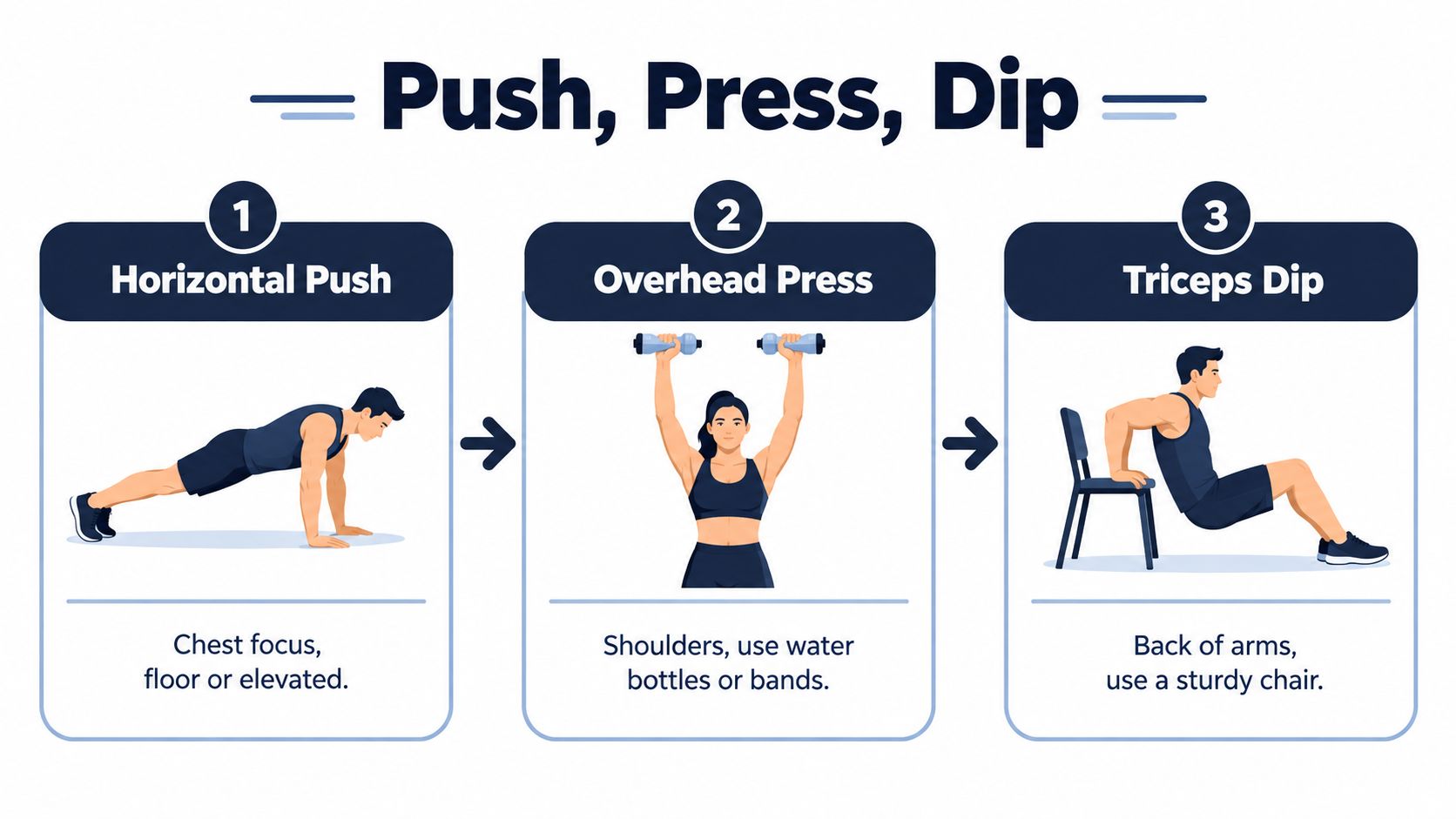
For chair dips, the goal is triceps loading without sloppy shoulder position. Use a sturdy chair, keep your hands planted, and let the feet stay on the floor at first so the movement stays controlled. As you get stronger, progress to dips with your feet raised and then straighter-body dip work only if the setup is stable and the shoulders tolerate it.
The Pressing Order I'd Use
- Incline push-ups first. They teach you how to own the bodyline without collapsing at the hips.
- Floor push-ups next. Once you can hit clean reps near fatigue, the floor becomes the standard.
- Tempo push-ups after that. A slower lowering phase makes the same movement harder without extra equipment.
- Feet-elevated push-ups when the floor version feels too easy. This shifts more demand to the chest and shoulders.
- Chair dips and overhead pressing fill the gaps. Dips bias the triceps, while a backpack press or band press keeps the shoulders from being an afterthought.
A practical overhead press pattern can come from a heavy backpack or resistance band. You do not need to pretend it is a barbell press. You need a vertical press that challenges the shoulders with enough control to stay inside your rep target. If a set gets easy, change the angle, slow the lowering phase, or move to a harder setup. Small changes in body position matter more than piling on busy work.
Pull, Row, and Hang for Back and Biceps
Most home guides dodge pulling because it's harder to set up than push-ups. That's the core issue. People don't lack motivation to train their back, they lack a safe place to do it.
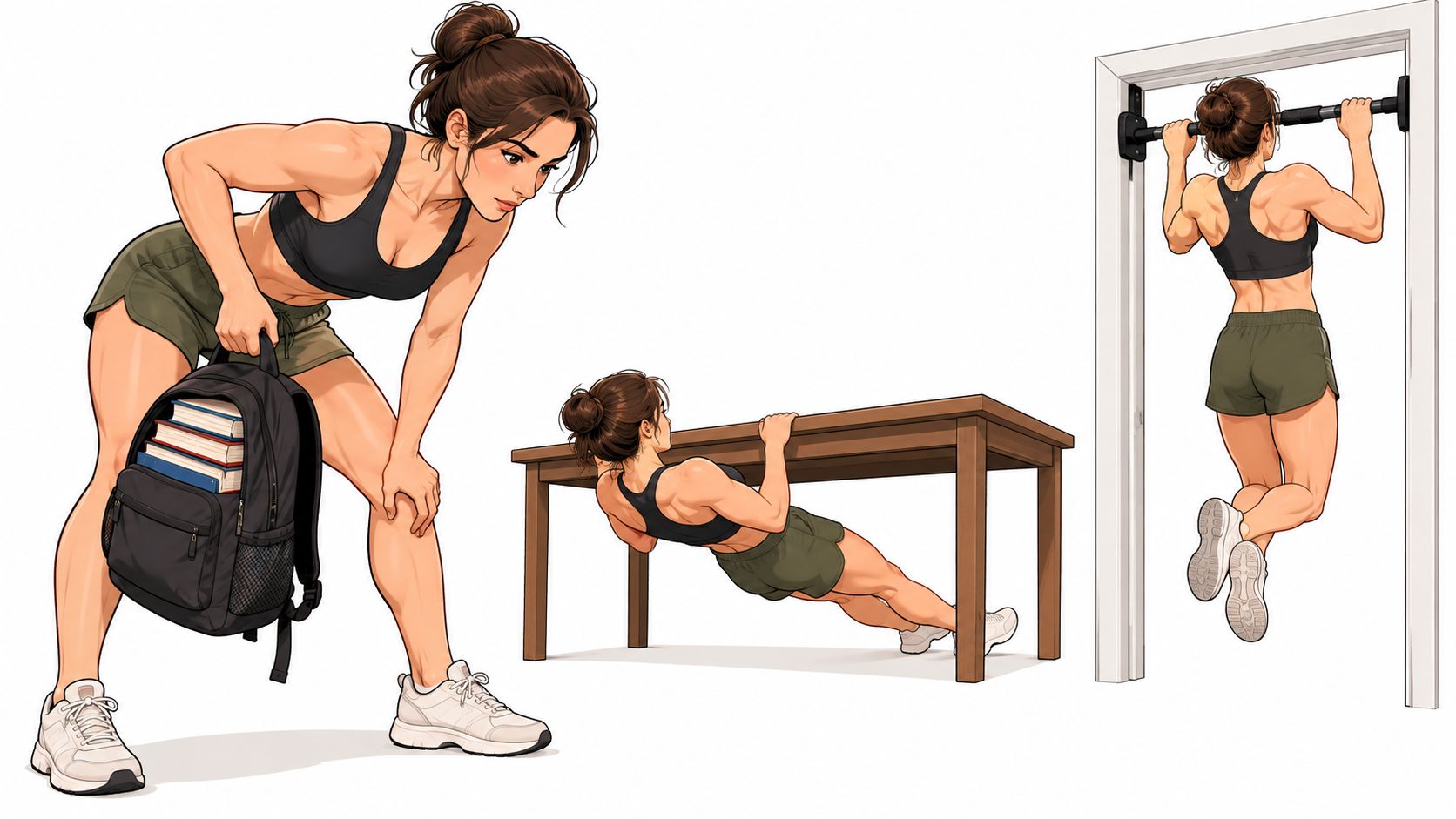
The cleanest answer is to treat pulling like a skill with levels. If you have a secure anchor, towel-isometric rows can work, but only when the setup is completely solid. If you've got a sturdy table, backpack rows underneath it give you a real horizontal pull. If you've got bands, anchor them to a heavy, immovable setup or a closed door that's appropriate for band use, and keep the force line predictable. For floor-based work, prone reverse snow angels hit the rear delts and lower trap without needing a hanging setup.
The bad answer is to improvise with weak doors, unstable chairs, or anything that shifts under load. That isn't hard training, it's a trip hazard. A pushing-only routine can also hide the problem for a while, but it doesn't build balanced pulling capacity.
Pulling strength should feel like a skill you can repeat, not a stunt you hope survives contact with the furniture.
If a pull-up bar is available, negatives are the bridge. Step onto a chair, start above the bar, and lower slowly under control. If you don't have that option, keep the focus on rows until the row pattern feels strong enough to carry over.
A good first back session can be surprisingly simple. Do backpack rows, prone reverse snow angels, and a row variation you can repeat safely next week. That's enough to start building the pulling side without pretending every home has a pull-up rig.
A Three-Day Weekly Schedule You Can Actually Finish
A home upper-body plan works best when it removes decisions, not when it asks for more of them. Three training days with rest between sessions gives you recovery time and keeps the habit intact, which matches the beginner structure already supported by the guidance cited earlier. If the week gets messy, this setup is still easy to restart.
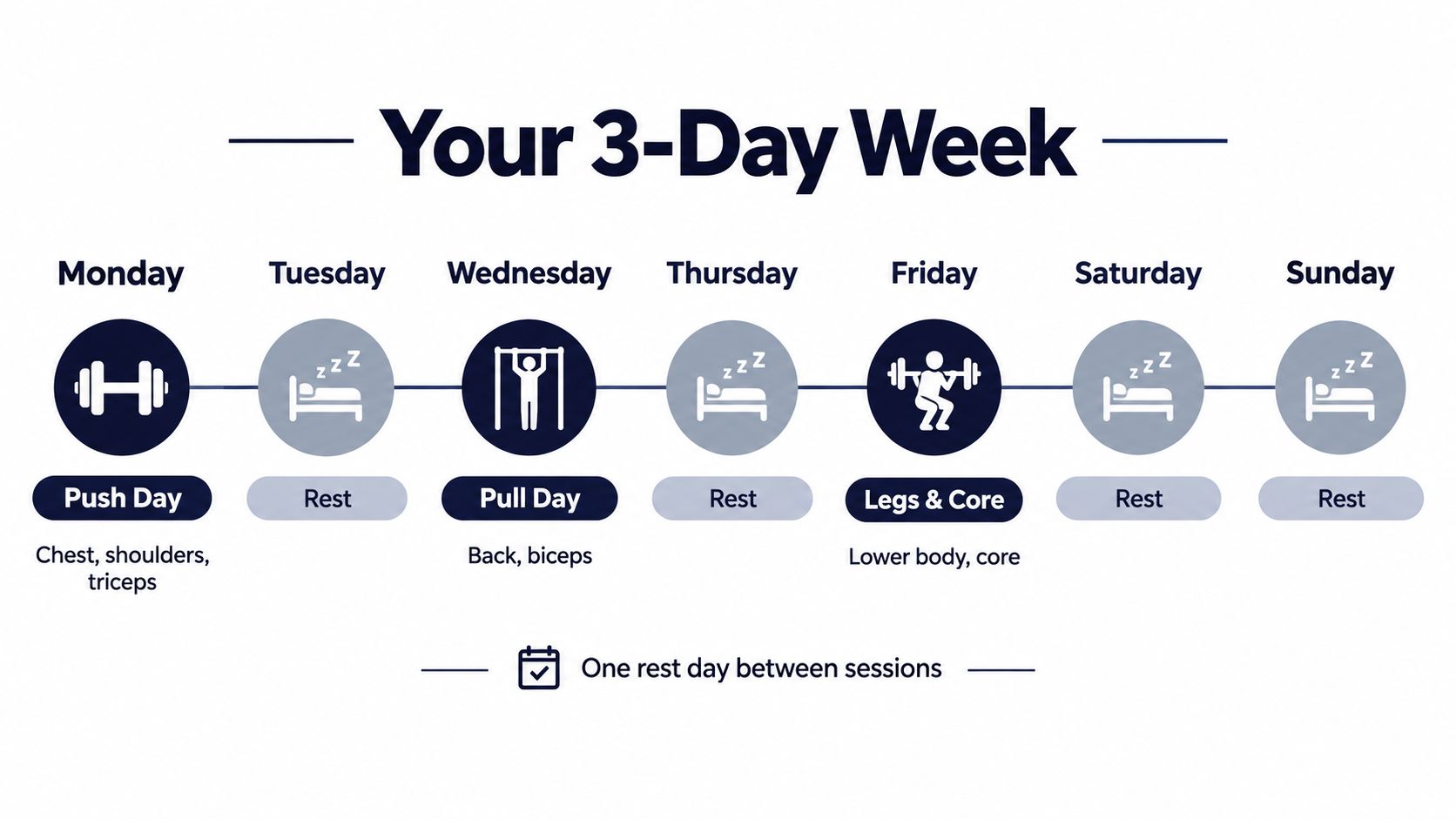
A simple weekly structure
- Monday, Push day. Push-ups, chair dips, and a backpack or band press.
- Tuesday, Rest. Walk, move, or do nothing demanding.
- Wednesday, Pull day. Rows, pull-up negatives if available, and prone reverse snow angels.
- Thursday, Rest. Keep it light.
- Friday, Mixed upper body. One push, one pull, and one shoulder-focused movement.
- Saturday, Rest. Let the work settle.
- Sunday, Rest. Reset for the next week.
Keep the daily target small enough that you can finish it cleanly, then raise it only when it stops feeling hard. Consistency is the bottleneck, and the participation gap is still large. In a large review, only 17.12% of adults across 3,346,723 adults in 32 countries met both the aerobic and muscle-strengthening guidelines, as reported in WHO summary in BJSM. A routine you log beats a perfect plan you never start.
I'd keep each session under twenty minutes and log every set on a shared wall. this no-equipment workout guide is one companion if you want more movement ideas for the same home setup. SuperStrong is one iPhone app built around that same idea, with sets recorded into a shared visual wall.
You do not need a long workout to make the habit stick. You need sessions that are short enough to repeat, balanced enough to cover pushing and pulling, and visible enough that missed work is hard to ignore.
When More Reps Stop Being Enough
More reps only help until they don't. A set of easy push-ups that never gets harder is busy activity, not strength work. The set has to feel meaningfully difficult with controlled technique, or you're just practicing motion.
That's where progression decisions get specific. If incline push-ups feel smooth, lower the hands or move to the floor. If floor push-ups are no longer challenging, slow the descent, raise the feet, or move to a harder version. If rows are too easy, change the angle, add load in a backpack, or make the lever longer. If pressing work is stale, add a band or switch the pattern instead of mindlessly adding volume.
The distinction matters because exercise snacks and short bouts are useful, but they don't automatically become a full strength program. Recent evidence says brief bouts can improve cardiorespiratory fitness, while other muscular outcomes are less certain, which is exactly why effort and progression still have to do the heavy lifting. Home training works when the set is hard enough to force adaptation, not just enough to break a sweat.
Decision test: if you could've done several more clean reps, the set was probably too easy to count as a true strength set.
I also look for repetition quality near the end. If the torso stays rigid, the lowering phase stays controlled, and the last rep still looks like the first one, the movement is in the right zone. If the form falls apart early, scale the exercise back so the hard reps happen where they should.
Your Starting Checklist for Tonight
Pick three training days now, not later. Choose one push, one pull, and one dip or press variation you can perform cleanly tonight, then write a starting target near the 8 to 12 rep range that feels challenging but controlled ACSM position stand.
Then set up a shared wall with up to four friends and make the first goal small. Every set should become a visible tile, and the point isn't to impress anyone, it's to make the work harder to ignore.
If your pulling setup isn't secure, skip it and choose a safer row variation instead. This pull-up bar and dip guide can help you think through the equipment side without overcomplicating the room you already have.
SuperStrong turns short home sets into a shared wall, so the reps you do at 9 p.m. don't disappear into memory. If you want a simple way to log push-ups, rows, dips, and other bodyweight work with a small group, visit SuperStrong and set up a routine that's easy to keep showing up for.