Is Bodyweight Training Enough? Strength, Growth, Longevity
 15 min
Bodyweight training is enough for baseline strength and muscle for most beginners and intermediates, but advanced strength and maximal hypertrophy eventually require harder variations or external load. In a controlled 8-week study, progressive push-ups increased bench-press strength from 61.1 ± 12.2 kg to 64.2 ± 12.5 kg, while also increasing triceps and pectoralis-major muscle thickness.
You may be standing in your living room right now, looking at a clear patch of floor and wondering whether it can replace a gym. You have enough time for a few push-ups between meetings, but not enough time for a commute, a full session, and a shower. The honest answer to “is bodyweight training enough” depends on what you want it to do, how hard you make it, and whether you keep progressing after the first gains arrive.
Table of Contents
- Choosing Between Bodyweight and Weighted Training
- How Bodyweight Training Builds Strength and Muscle
- Progression Systems That Keep Gains Coming
- Health Benefits of Short Bodyweight Bursts
- When Bodyweight Training Hits Its Limit
- Why Exercise Snacks Are Not Just a Trend
- Designing a Sustainable Bodyweight Routine
- Deciding What Training Approach Fits Your Goals
Choosing Between Bodyweight and Weighted Training
A beginner might start with wall push-ups, bodyweight squats, and glute bridges because the gym feels inconvenient or intimidating. After a few weeks, the same person may wonder whether those movements are building strength or merely providing a way to stay active. That decision point is real, but it isn't a contest between “easy” bodyweight work and “serious” weight training.
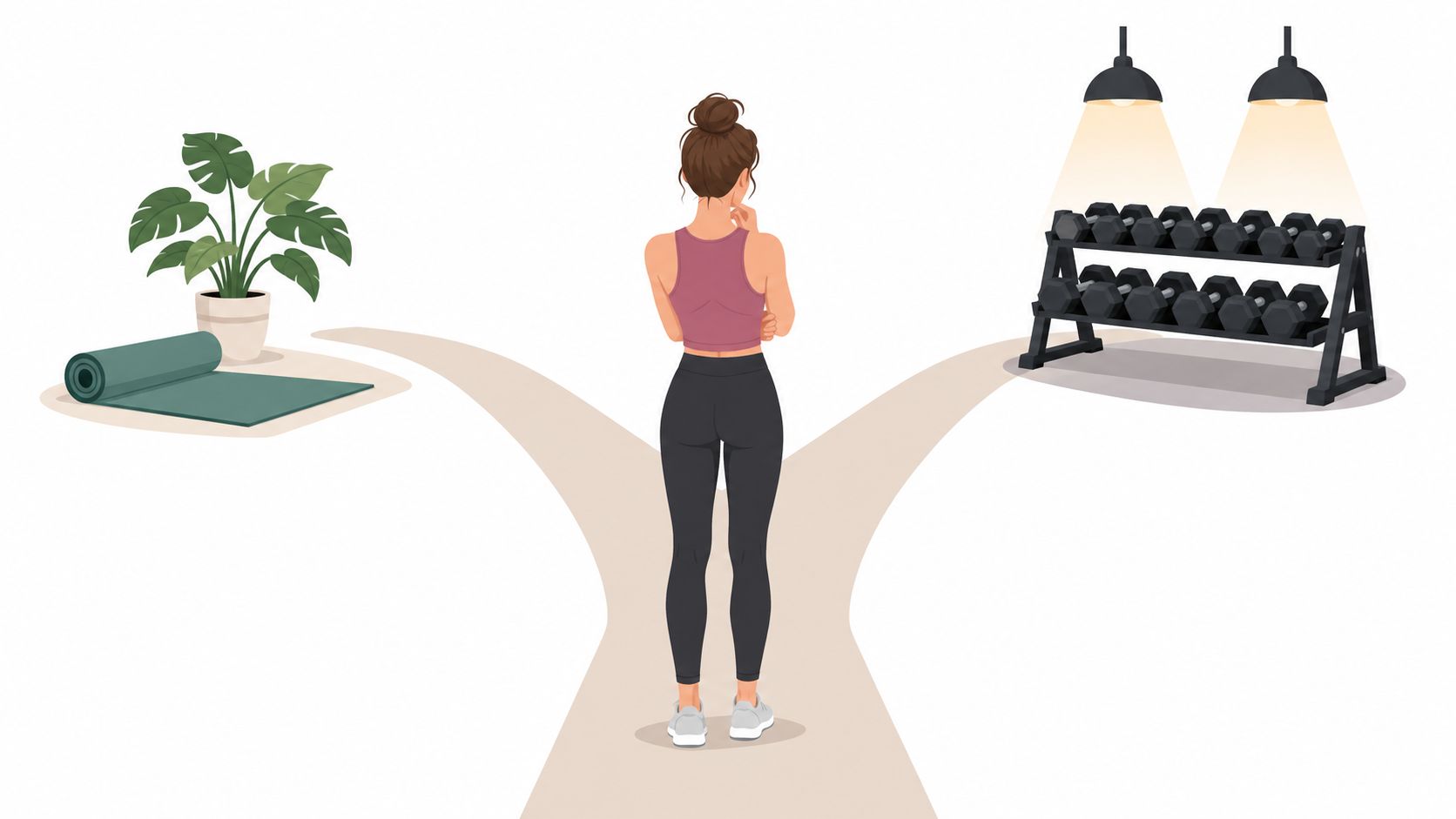
Bodyweight training removes friction. You can train at home, while traveling, or during a short break without setting up equipment. That makes consistency easier, especially for beginners and people returning after a long gap. Push-ups, squats, lunges, bridges, rows, dips, and bird dogs can cover a useful range of movement patterns.
Weighted training offers more precise loading. A dumbbell, kettlebell, resistance band, or barbell lets you increase resistance in smaller increments. That matters when you're trying to build maximal strength, challenge already strong legs, or continue adding muscle after familiar variations become too easy.
The practical question isn't which method is superior in general. Ask which method can provide enough challenge for your current goal and which one you'll repeat reliably. A person who trains consistently at home may progress further than someone who owns a gym membership but rarely uses it.
Decision rule: Start with the method that lowers the barrier to training, then add resistance when progression becomes difficult to control.
Bodyweight and weights can also work together. You might use push-ups and split squats at home, then add a dumbbell movement when your legs or pulling muscles need a more measurable challenge. Even a focused movement such as one-arm dumbbell swings can extend what minimal-equipment training can accomplish.
How Bodyweight Training Builds Strength and Muscle
Muscles don't respond to the presence of a barbell. They respond to mechanical demand, effort, and repeated exposure to a stimulus they must adapt to. Bodyweight exercises create that demand by changing how much of your mass a muscle must move, how far it moves, and how much control you maintain.
A controlled study compared progressive push-ups with low-load bench pressing at approximately 40% of one-repetition maximum. Both groups trained three times per week for 8 weeks, with sessions designed to create a comparable muscular challenge. In the push-up group, bench-press one-repetition-max strength rose from 61.1 ± 12.2 kg to 64.2 ± 12.5 kg, while the bench-press group rose from 60.0 ± 12.1 kg to 65.0 ± 12.1 kg. The study reported significant increases in triceps and pectoralis-major muscle thickness in both groups, with no meaningful difference between methods for the primary hypertrophy outcomes, as detailed in the controlled push-up and bench-press study.
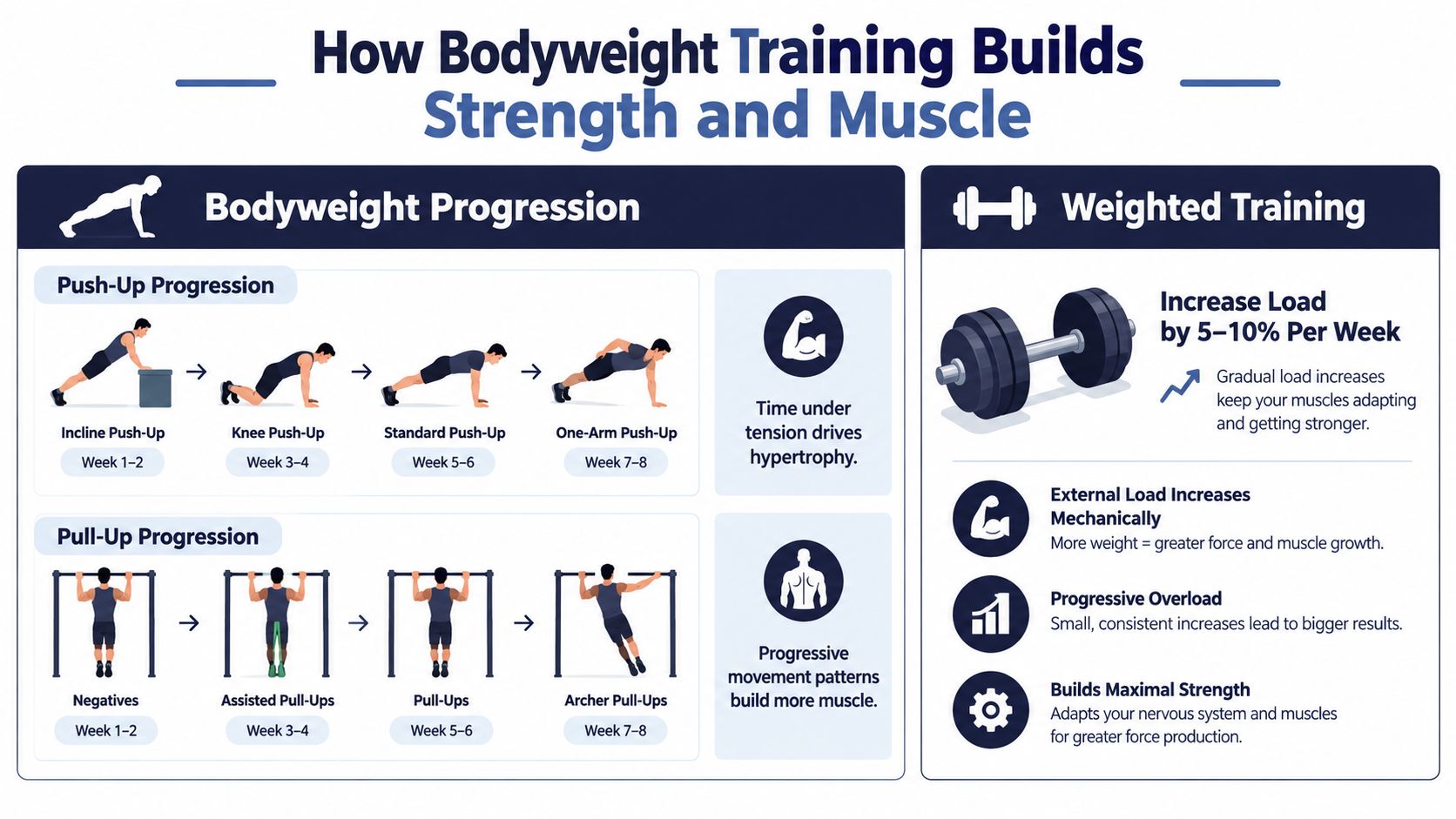
That result doesn't mean every push-up routine will build muscle indefinitely. It shows that challenging, progressive push-ups can function as resistance training, not just as a warm-up.
The resistance tools you already have
You can increase the training stimulus without adding plates:
- Intensify: Move from incline push-ups to floor push-ups, then to feet-high or one-arm progressions.
- Range of motion: Use a deeper push-up or deficit variation when your shoulders and wrists tolerate it.
- Tempo: Slow the lowering phase and pause in the hardest position.
- Stability: Use unilateral variations that demand more control from the working side.
- Effort: Perform technically controlled sets close enough to muscular fatigue that the final repetitions become demanding.
The same principle applies to lower-body work. A standard squat may become too easy, while a split squat, rear-foot-elevated split squat, slow eccentric squat, or assisted single-leg squat changes the demand. A row can become harder through body angle, longer pauses, or a more difficult grip.
Short sets fit this model well because the stimulus comes from the quality and challenge of each set, not from spending a fixed amount of time in a gym. A few demanding push-ups or dips repeated across the week can count as legitimate training when the variation and effort continue to advance.
Progression Systems That Keep Gains Coming
A bodyweight routine stalls when the exercises stay the same while your capacity rises. If you can perform more repetitions with less effort but never change mechanics, range, tempo, or resistance, the work gradually shifts toward endurance.
Use a simple progression system instead of guessing.
-
Choose a variation you can perform cleanly. Start with an incline push-up if a floor push-up breaks your alignment. Use supported lunges if balance limits the movement. Technical control comes before difficulty.
-
Set a repeatable repetition target. Keep the range consistent and stop when form changes. More repetitions aren't automatically better if they turn a strength exercise into a fast, partial-range endurance drill.
-
Progress after repeated success. Once you consistently exceed the prescribed repetitions while preserving full range of motion and technique, make the movement harder. The ACSM progression guidance emphasizes progressive overload, exercise selection, intensity, volume, contraction velocity, rest intervals, and frequency.
Five ways to make a movement harder
- Change the variation: Move from a regular push-up to a feet-elevated push-up, or from a squat to a single-leg progression.
- Slow the eccentric: Take longer to lower into a push-up, squat, or lunge while keeping the same position.
- Increase range: Use a deeper, controlled range when mobility and joint comfort allow it.
- Reduce assistance: Gradually remove support from rows, split squats, and single-leg bridges.
- Add load: Use a backpack, dumbbell, band, or other external resistance when body position no longer gives you a useful next step.
Track the movement, variation, repetitions, and perceived effort in a bodyweight workout journal. You don't need elaborate analysis. You need enough information to see whether the exercise is getting harder or whether you're just repeating the same easy work.
Practical rule: Progress difficulty when you can exceed the target with clean technique, not when you feel bored.
Bodyweight-only training becomes limiting sooner for maximal lower-body strength and advanced pulling because load increments are harder to calibrate. At that point, external resistance isn't a failure of bodyweight training. It's the most efficient way to keep increasing mechanical demand.
Health Benefits of Short Bodyweight Bursts
A short bodyweight set can serve a different purpose from a focused hypertrophy session. It can break up sitting, raise effort during an otherwise inactive day, and make movement possible when a conventional workout won't fit.
A randomized crossover study tested insufficiently active adults with well-controlled, non-insulin-treated type 2 diabetes. Participants completed four one-minute bouts of vigorous bodyweight exercise per day, totaling 4 minutes daily, across two consecutive days. Compared with no exercise, the exercise-snack condition produced small but statistically significant improvements in glycemic variability and post-meal hyperglycemia. It didn't significantly reduce mean glucose, with a between-condition difference of −0.2 mmol/L, a 95% confidence interval of −0.4 to 0.0, and p = 0.07, according to the randomized exercise-snack study.
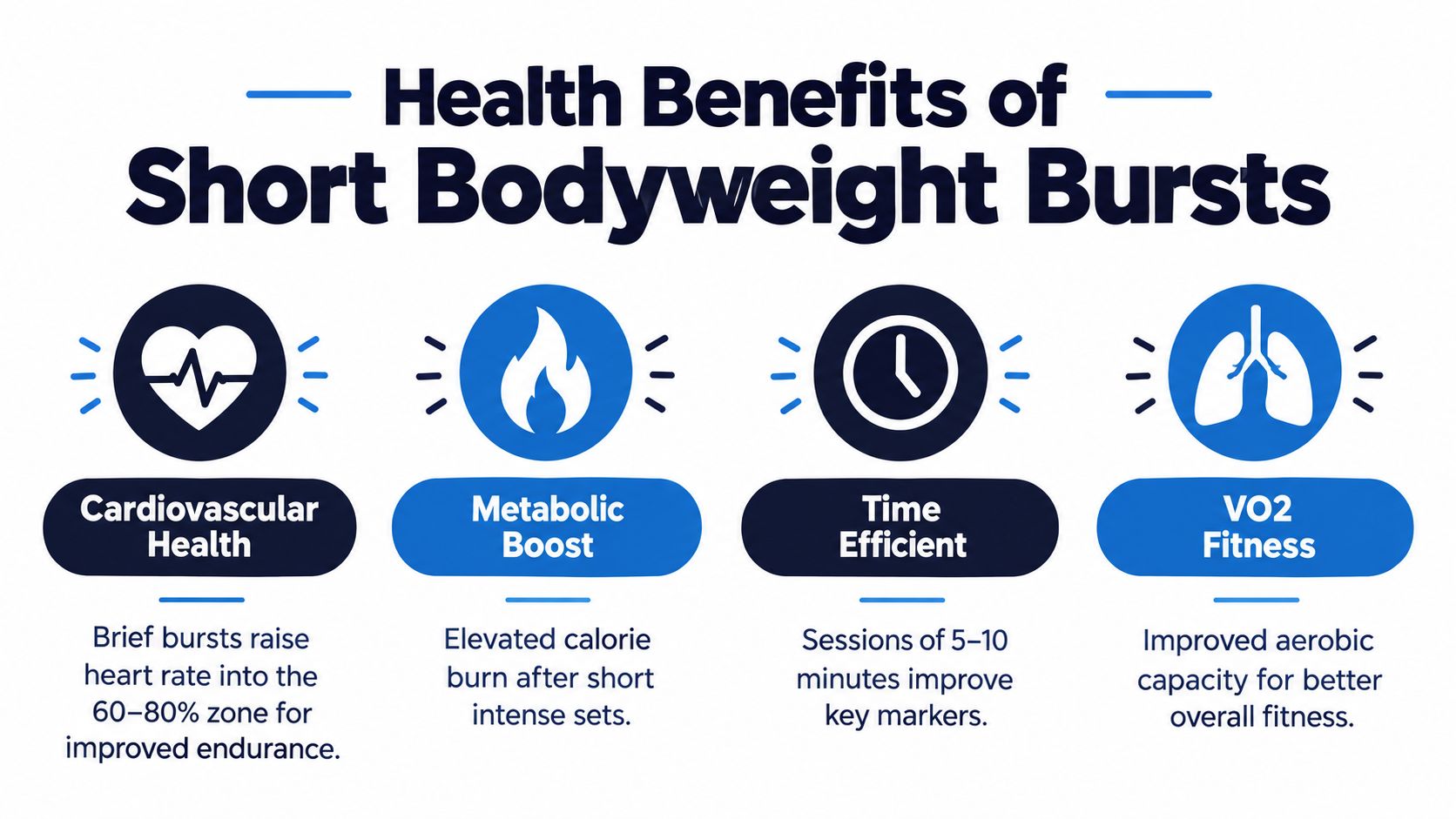
That distinction matters. A micro-workout can improve a specific response without improving every health marker, and a promising short-term result doesn't prove that brief bursts replace all structured training.
The broader practical case is stronger for daily movement, sedentary-time reduction, and metabolic support than for maximal strength. Reviews summarized in the available evidence report improvements in post-meal glucose, insulin, triglycerides, blood pressure, endothelial function, and cardiorespiratory fitness, while strength and body-composition outcomes are less consistent.
You can use exercise snacks around ordinary routines:
- Do push-ups after closing your laptop.
- Perform squats or lunges while waiting for food.
- Use bridges or bird dogs during a break from sitting.
- Add a brisk bodyweight circuit when you can't complete a longer workout.
The following video can help demonstrate simple bodyweight movements and short-session options.
For substantial hypertrophy, sport performance, or maximal strength, short bursts may need to become harder, more frequent, or part of longer focused sessions. Their main advantage is that they make useful movement easier to repeat.
When Bodyweight Training Hits Its Limit
Bodyweight training doesn't hit one universal ceiling. It reaches different limits depending on the movement, the trainee, and the goal.
For a beginner, a push-up can be a serious upper-body strength exercise. For a strong trainee, a regular push-up may no longer provide enough resistance unless the angle, range, tempo, or external load changes. Lower-body movements often reach this issue sooner because strong legs can move body mass through a familiar squat pattern without receiving a sufficiently high stimulus.
| Goal | Bodyweight training can often provide | Where added resistance helps |
|---|---|---|
| General strength | A reliable starting stimulus through controlled variations | More precise progression at higher levels |
| Upper-body muscle | Push-ups, dips, rows, and pull-up progressions | Smaller load increases and targeted volume |
| Lower-body development | Squats, lunges, bridges, and unilateral work | Heavier loading for strong legs and glutes |
| Maximal strength | Skill, control, and useful relative strength | Calibrated resistance and heavier practice |
| Daily fitness | Frequent movement and improved adherence | Structured sessions when performance is a priority |
A systematic review found that health outcomes from accumulated short bouts were broadly similar to longer continuous sessions when comparing bouts shorter than 10 minutes with longer sessions, including outcomes related to body composition, blood pressure, blood lipids, glycemic control, and cardiovascular risk. The same evidence also indicates that exercise snacks improve cardiorespiratory fitness and muscular endurance more consistently than maximal strength or body-fat outcomes, as reported in the systematic review of accumulated activity.
Signs you need a new stimulus
Your routine may be underloaded when repetitions keep climbing but effort doesn't, when the final repetitions look identical to the first, or when weeks pass without improvement in variation, control, or performance. You may also notice that one movement pattern receives plenty of work while pulling, hinging, or trunk stabilization receives little.
Rotate push, pull, squat, hinge, lunge, and trunk movements. If a harder bodyweight variation isn't practical, add a band, backpack, dumbbell, or other external load. The objective isn't to defend a particular training identity. It's to give each target muscle a reason to adapt.
Why Exercise Snacks Are Not Just a Trend
The skepticism is understandable. A few scattered sets can look too small to matter, especially beside a conventional workout. The mistake is treating every short bout as the same. An easy set that stops far from fatigue is a movement break, while a difficult set that challenges the target muscle is training.
A 2025 review of 26 studies reported benefits from brief intermittent activity for glucose control, blood pressure, strength, cognitive function, and cardiorespiratory fitness. A separate 2025 meta-analysis found that exercise snacks improved lean mass by about 0.52 kg, but didn't significantly reduce body fat or total body mass, as summarized in the review of exercise-snack evidence.
The evidence is mixed because the outcomes and populations differ. A review of 11 randomized trials involving 414 participants found improved cardiorespiratory fitness in adults and muscular endurance in older adults, but no significant effect on lower-limb strength or several cardiometabolic markers. Certainty was moderate for cardiorespiratory fitness and very low for older-adult muscular endurance.
Make each snack earn its place
A useful system separates easy movement from challenging work:
- Movement snacks: Gentle squats, mobility, walking, or easy bridges that interrupt sitting.
- Training snacks: Push-ups, lunges, rows, dips, or split squats performed with enough difficulty and effort to require adaptation.
- Progress checks: Record the variation and effort, not repetitions alone.
The unresolved question isn't whether every scattered set works equally well. It doesn't. The better question is whether your short sets are hard enough, repeated consistently enough, and progressed before they become routine maintenance.
Use a walk-out exercise as an example of a movement that can be scaled from an accessible version to a more demanding full-body challenge. Short sessions are strongest for adherence, fitness, and endurance. Treat claims about maximal strength and fat loss with more caution.
Designing a Sustainable Bodyweight Routine
A sustainable plan needs two layers: focused sessions for progression and short bursts that keep movement present on busy days. One layer builds the training stimulus. The other protects consistency when your schedule changes.
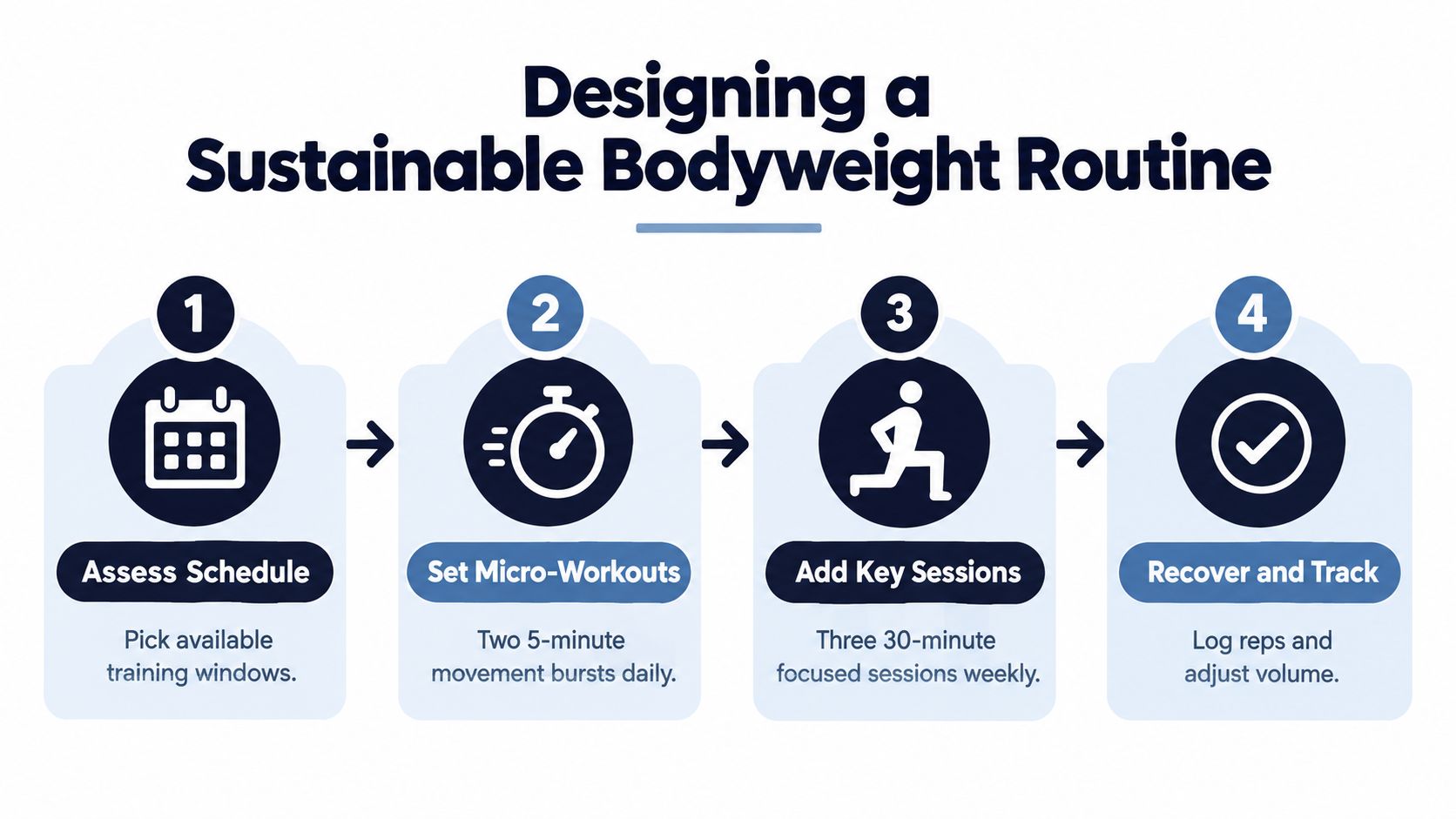
Use this structure:
- Three focused training days: Train push, pull, squat, hinge, lunge, and trunk patterns across the week. Perform controlled sets and progress the hardest movements.
- Daily movement opportunities: Add easy squats, bridges, bird dogs, or push-ups between tasks. Keep them short enough that they don't compete with recovery.
- Variation rotation: When a movement becomes easy, change range, tempo, unilateral demand, or resistance.
- Simple tracking: Log the exercise, variation, repetitions, and effort. Review whether the movement is becoming harder, not just whether the number is getting larger.
A full-body session might pair push-ups, split squats, rows, bridges, and bird dogs. An upper-lower arrangement could alternate push-ups and rows with squats, lunges, and bridges, while short movement snacks fill the gaps on other days.
If recovery falls behind, reduce effort or choose an easier variation. A routine that fits your actual week will outperform a demanding plan you repeatedly postpone.
Deciding What Training Approach Fits Your Goals
Choose bodyweight training when you want accessible baseline strength, useful muscle development, better movement capacity, and a routine you can perform almost anywhere. It suits beginners especially well, and it can remain productive for intermediates who deliberately progress variations rather than repeating the same easy circuit.
Choose weighted training when your priority is maximal strength, precise load progression, substantial lower-body development, or advanced hypertrophy. External resistance gives you more control when bodyweight exercises no longer provide a clear next challenge.
A combined approach often makes the most sense. Keep bodyweight movements for convenience, control, and exercise snacks, then add weights where the goal demands more resistance. You don't need to choose a permanent identity. You need to match the tool to the adaptation you want.
Use this final check:
- Your goal: General fitness and consistency favor bodyweight; maximal strength favors more precise loading.
- Your current level: Beginners have many productive bodyweight progressions available; advanced trainees may need external resistance sooner.
- Your weak links: Add pulling, lower-body, hinge, or trunk work if your routine only emphasizes push-ups.
- Your schedule: A short plan you repeat beats an ideal plan you can't sustain.
- Your progression: If technique is solid and repetitions keep rising without more challenge, change the exercise or add load.
Bodyweight training is enough when it continues to challenge you for the goal you've chosen. Once it no longer does, progress by changing the movement, increasing the demand, or using weights.
SuperStrong organizes short at-home bodyweight sets, tracks effort and progress, and lets up to four friends view the same shared wall. If you want a simpler way to turn push-ups, squats, rows, bridges, and dips into a repeatable weekly practice, visit SuperStrong and build your next training rhythm.