High Knee Skips: How to Perfect the Movement
 15 min
You've got a few minutes before work, practice, or your next meeting, and you want something more useful than standing still while you wait. You start lifting your knees, add a little bounce, then speed up. Within seconds, the movement feels awkward. Your foot lands too far forward, your posture folds, and the drill turns into a frantic run in place.
That's the common mistake with high knee skips. They're not high knees performed faster, and they're not slow running with extra bounce. They're a teachable coordination drill first, then a conditioning tool. Once you control the rhythm, knee position, landing, and arm action, you can scale the movement for a warm-up, athletic preparation, or a short exercise snack without automatically chasing maximum height or speed.
Table of Contents
- Why High Knee Skips Feel Different From Running
- How to Perform High Knee Skips with Proper Technique
- Using High Knee Skips for Conditioning and Quick Drills
- Scaling High Knee Skips for Different Fitness Levels
- Common Mistakes That Ruin High Knee Skip Quality
- Building a Simple High Knee Skip Routine
Why High Knee Skips Feel Different From Running
A high knee skip can look like running viewed from a distance, yet it asks for a different kind of control. Running uses alternating strides to carry you forward. Skipping adds a repeated hop, a clear rise and fall, and more time supporting the body on one leg.
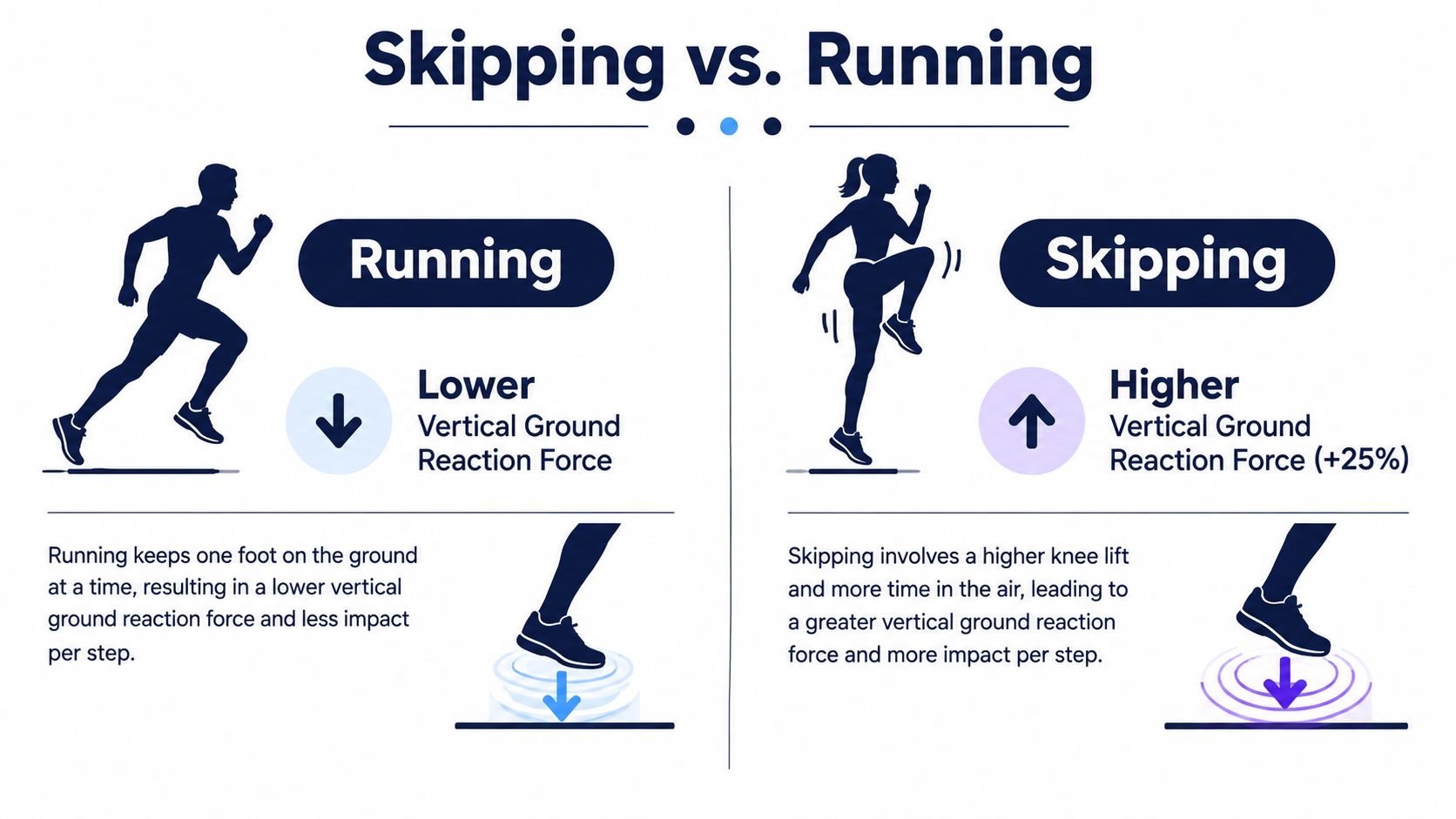
Biomechanical research classifies skipping as its own locomotor pattern rather than a slower running style. In a University of Texas study, five young adults ran and performed two skipping patterns at a controlled speed of 2.5 m/s. Skipping used 32.75 ± 4.04 J/kg of energy, compared with 20.45 ± 4.54 J/kg for running, a statistically significant difference at P = .009, according to the University of Texas biomechanical study.
You can feel the reason without studying the equations. Each repetition asks one leg to support the body while the other knee rises. That support leg then absorbs force and redirects it into the next switch. Because the body's center of mass rises higher during support and flight, the legs and trunk must lift the body as well as move it forward.
The force trade-off matters
The same study found greater knee and patella contact forces, along with greater knee-extensor energetic demand, during running. It also reported approximately 23% greater knee compressive force during running than skipping, so both findings come from the cited comparison rather than an unrelated estimate.
That does not make skipping automatically low impact. High knee skips still involve repeated landings, single-leg support, and forceful push-offs. They may place more emphasis on whole-body elevation and hopping, but cadence, knee height, arm action, surface, and landing control decide how demanding the drill feels.
Coaching rule: Treat every skip as a controlled takeoff and landing, not a race to move your feet faster.
Rushing usually degrades the movement. The knee drops, the foot reaches ahead of the hips, and the trunk either leans backward or collapses. The athlete may raise heart rate, but loses the rhythm, balance, and elastic response that make the drill useful.
Use high knee skips first to teach rhythm, stiffness, balance, and force production without external weight. They can prepare an athlete for sprinting or jumping, or provide a demanding bodyweight drill for general fitness. For people who cannot tolerate repeated impact, begin with marching, then use a low-amplitude step and knee lift before adding the hop. The goal is not to decide whether skipping is easier than running. The goal is to keep the positions that make each skip deliberate.
How to Perform High Knee Skips with Proper Technique
Start with marching A mechanics. Stand tall and walk forward slowly, lifting one knee toward hip height while the opposite arm drives backward. Keep the supporting foot underneath your body instead of reaching out in front. This first version teaches the shape without asking you to leave the ground.
Your trunk should remain upright, with the ribs stacked over the pelvis. Don't lean away from the lifted knee to create the appearance of extra height. The free knee should rise approximately to hip level, but that target only matters if you can keep your pelvis controlled and your stance leg stable.
Build the bounce gradually
Once marching feels natural, add a small skip from the stance leg. Think of a quick, light push into the floor rather than a high jump. Switch legs rhythmically and let the movement travel forward at a comfortable pace.
Keep the ankle neutral or slightly dorsiflexed, with the toes pulled up. This places the foot in a useful position for a quick, balanced contact. Aim to put the foot back under your hips, not ahead of them. A brief contact is helpful, but don't force a silent landing by becoming tense. You're looking for a quiet, organized touch that lets you move into the next skip.
Your arms should work opposite to your legs. When the right knee rises, the left elbow should move backward. Keep the elbows close enough to the body that the hands don't swing across the midline. If the arms cross in front of your chest, the trunk often rotates and the rhythm starts to break.
A practical starting dose is 2–3 sets over 10–15 m, using low hops and rhythmic leg switches, consistent with the NSCA high-knee drill progression. Walk back or pause long enough to reset your posture before repeating.
Use quality as the progression rule
Increase cadence only after the lower-speed version looks and feels consistent. You're ready to progress when you can maintain knee height, keep your hips positioned over the stance foot, and land without excessive noise.
Regress the drill when:
- The contact gets loud: Reduce the hop and focus on landing under your hips.
- The knee drops: Slow the rhythm or return to marching A mechanics.
- The trunk leans back: Lower the knee target temporarily and regain rib-over-pelvis control.
- The arms cross: Reduce speed and drive the opposite elbow backward.
- Balance disappears: Use alternating step-and-drive repetitions instead of continuous skips.
Fatigue isn't a reason to abandon technique. It's information that the current speed, distance, or volume is too demanding.
Using High Knee Skips for Conditioning and Quick Drills
High knee skips can serve three different purposes, and each requires a different effort. As a warm-up, they should raise readiness without tiring the legs. As a coordination drill, they should feel precise and repeatable. As conditioning, they can become vigorous, but the rhythm still needs to survive the effort.
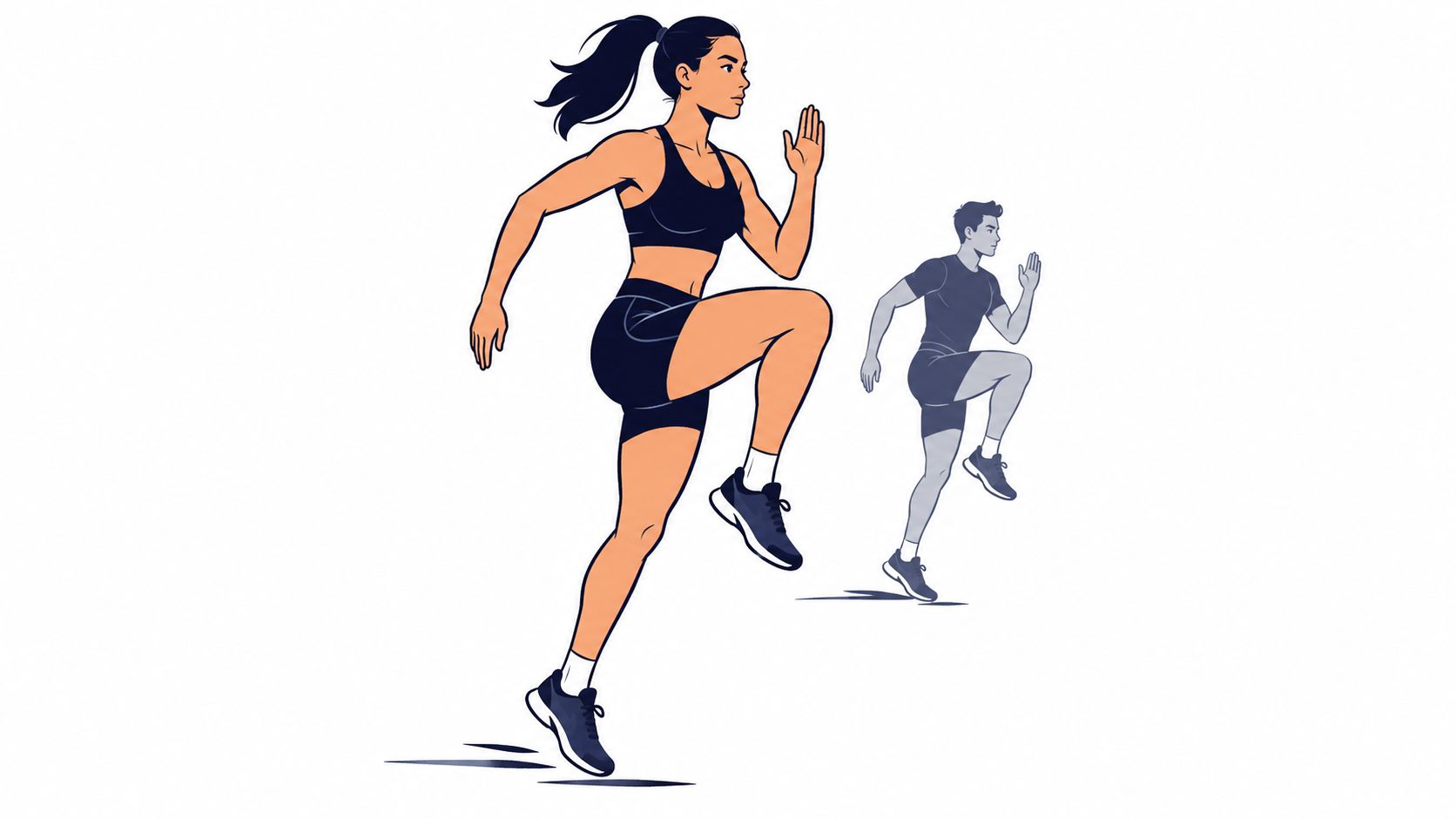
For a warm-up, use low hops and a relaxed pace. Concentrate on the sequence of knee drive, opposite-arm action, and foot placement. A few technically clean passes are more useful than turning the drill into a sprint before your main training begins.
For coordination, use a short distance and stop while the movement still feels crisp. You can alternate marching, low skips, and regular skips to expose whether the athlete can keep the same posture as the rhythm changes. This format works well before acceleration work, field sports, or lower-body strength training.
Why load and position change the demand
A small controlled study of 10 healthy college students compared unweighted high-knee runs with variations using a 5-kg plate. The participants completed repeated 20-second bouts, and holding the plate at collarbone height increased activation in six of eight tested muscles. Holding it overhead increased activation in all eight, according to the muscle-activation report on high-knee running.
The reported differences were substantial in that study. Anterior-deltoid activity increased by 89% with the collarbone position and by nearly 1.5 times overhead. Three-dimensional core activation rose by more than 30% with the lower position and about 50% overhead, while quadriceps and gastrocnemius activation also increased by more than 30% and about 50%, respectively, with the two loading positions.
You don't need to add weight to make high knee skips useful. The lesson is that position changes workload. A taller posture, more deliberate arm drive, or slightly higher knee target can alter the challenge without turning the drill into a maximal sprint. Because the study was small and measured acute muscle activation, its percentages shouldn't be treated as universal training outcomes.
Use a simple conditioning structure: perform a short, controlled bout, recover until you can repeat the same mechanics, then complete another bout. Stop the set if the knee height falls, the landing gets heavy, or you begin reaching forward with the foot. A hard effort that destroys the movement is no longer practicing the quality you intended.
High knee skips fit best into conditioning when you treat them as a repeatable movement rather than an all-out test. If you need more intensity, increase the quality and continuity of the bout before you add reckless speed.
Scaling High Knee Skips for Different Fitness Levels
If a new client cannot keep balance through a full skip, start by teaching the alternating pattern without asking for a large hop. High knee skips are a movement skill first and a conditioning tool second. Build control, timing, and confidence before adding impact or speed.
Use this progression:
- Marching high knees: Lift one knee at a time while keeping both feet on the floor. Stay tall, keep the ribs stacked over the pelvis, and pair each knee with the opposite-arm drive.
- Step-and-drive: Step onto one foot, drive the opposite knee upward, then pause briefly before switching sides. The pause gives the athlete time to organize balance without repeated impact. If balance is the limiting factor, the bear crawl exercise guide offers another low-impact way to train unilateral control.
- Low alternating skips: Add a small bounce and keep the knee target modest. Aim for quiet, controlled contacts and a consistent rhythm.
- Full high knee skips: Raise the hop and cadence only after the lower-impact version stays stable and comfortable.
Choose the highest level you can repeat with good position. Knee height matters, but it is not the first measure of success. A lower knee with a steady pelvis and controlled contact is a better training choice than a high knee created by leaning backward or reaching with the foot.
Exercise snacks need sensible scaling
A 2025 systematic review included 11 randomized trials with 414 participants and found that brief exercise snacks improved cardiorespiratory fitness in adults and muscular endurance in older adults, although certainty varied from moderate to very low for some outcomes, as reported in the University of Birmingham review. Another summary described qualifying exercise-snack interventions as vigorous activity lasting five minutes or less, performed at least twice daily on at least three days per week for four to 12 weeks. The protocols differed, as explained by NBC News coverage of exercise snacks.
Those findings do not mean every short set of high knee skips produces the same result. A relaxed coordination pass provides a different stimulus from a vigorous bout, and repeated maximal skipping does not suit someone with limited impact tolerance.
Use the talk test, perceived effort, and contact quality to select the version. Stop and regress if you feel pain, dizziness, or a loss of balance. Marching, step-ups, squats, and other lower-impact movements can keep a short routine productive without requiring every bout to include jumping.
If you have joint concerns, a diagnosed condition, or a history of falls, clear the low-impact versions with a clinician before adding any hopping.
Common Mistakes That Ruin High Knee Skip Quality
The biggest error is chasing speed before owning the shape. Athletes often believe a faster drill must be a better drill, so they shorten the knee drive, reach the foot forward, and let the trunk move wherever the rhythm takes it.
That creates a poor trade. The drill may feel exhausting, but the athlete is no longer practicing clean unilateral support and coordinated knee drive. Speed has hidden the technical failure instead of improving fitness or movement skill.
Watch for these breakdowns
- Low knees disguised as speed: Keep the knee target consistent. If it falls below the intended position, reduce cadence.
- Foot reaching forward: Land under the hips. Reaching creates a braking contact and makes the next skip harder to organize.
- Backward lean: Keep the ribs stacked over the pelvis. Don't throw the shoulders behind the hips to lift the knee.
- Collapsed stance leg: Let the stance leg support you without sinking excessively. A small bend is useful, but uncontrolled collapse disrupts the rhythm.
- Crossing arms: Drive the opposite elbow back rather than swinging the hands across the body.
- Loud contacts: Reduce the hop and look for a quieter, more balanced landing.
Stop-or-regress rule: If your contacts become loud, your knee no longer reaches its target, or you lose hip position, reduce the height and speed immediately.
The goal also changes the appropriate intensity. A warm-up version should leave you feeling prepared. A coordination version should make you feel more organized. A conditioning version should raise your breathing rate while preserving enough control to repeat the pattern.
Don't count yourself into poor technique
There's no magic number of repetitions that guarantees a useful stimulus. Monitor whether you can speak comfortably, how hard the set feels, and whether the next landing looks like the first one. If you can't maintain the movement, the set has already gone too far for its purpose.
You can use the same quality check with other bodyweight coordination drills, including the scissor-kick exercise guide. The exercise may change, but the coaching principle stays consistent: stop the set when the target position disappears, not only when the clock says you're finished.
Building a Simple High Knee Skip Routine
Start with high knee skips as a small skill practice, not the centerpiece of every workout. After a general warm-up, perform a few controlled passes using marching or low skips. Keep the effort modest enough that you can notice the foot position, knee path, and arm rhythm.
Later in the session, you can use a slightly more demanding version as part of a short bodyweight circuit. Pair the skips with movements that don't duplicate the same balance demand, such as squats, glute bridges, push-ups, or bird dogs. The at-home no-equipment workout guide offers examples of how bodyweight movements can fit around limited space and equipment.
A repeatable weekly rhythm
Use a simple structure:
- Skill work: March or perform low skips while fresh.
- Strength work: Pair the drill with controlled bodyweight exercises.
- Conditioning work: Add short bouts only when landing quality remains reliable.
- Recovery days: Walk, mobilize, or use a lower-impact movement instead of forcing skips.
A three-training-day rhythm with rest days between sessions gives beginners a clear way to practice without turning every day into a hard impact session. If the drill feels easy, progress one variable at a time. You might raise the knee slightly, improve the hop, increase the cadence, or add another controlled pass. Don't change everything simultaneously.
Track what matters: the version used, whether contacts stayed quiet, whether you maintained hip position, and how you felt afterward. Sharing a simple record with a training partner can also make the practice easier to sustain. Visible consistency is more useful than chasing a dramatic single session.
Regress without hesitation when your joints feel irritated, your balance worsens, or your technique deteriorates. High knee skips earn their place in a routine by remaining repeatable. The strongest version is the one you can perform well today and return to confidently at your next session.
SuperStrong organizes short, at-home bodyweight sets into a shared visual wall for small groups, helping you log brief efforts and compare progress with up to four friends. Add a controlled high-knee-skip set alongside simple movements such as squats or push-ups, then visit SuperStrong to build a practical routine around consistent, trackable exercise snacks.