Downward Dog Calf Stretch: Better Positioning and Variations
 14 min
You drop into downward dog after sitting at your desk or finishing a run, expecting a satisfying calf stretch. You press your heels lower, then lower again, but feel either nothing useful or an uncomfortable pull behind the ankle. Before pushing harder, change the question: which position gives you a tolerable muscular stretch without making the rest of your body compensate?
Table of Contents
- Why Most Downward Dog Calf Stretches Miss the Point
- Setting Up a Safe Downward Dog Position
- Gastrocnemius and Soleus Variations Side by Side
- Using Downward Dog as a Warm-Up vs. a Cooldown
- Common Mistakes and Symptoms You Should Not Push Through
- A Repeatable Sequence You Can Use This Week
- Quick Answers About Downward Dog Calf Stretching
Why Most Downward Dog Calf Stretches Miss the Point
The familiar cue, press both heels toward the floor, gives you a direction but not much information. It doesn't tell you which part of the calf you're emphasizing, whether you're substituting movement elsewhere, or whether the sensation is appropriate to stretch through.
Your calf complex includes the gastrocnemius and the deeper soleus. They respond differently to knee position, so treating downward dog as a single fixed shape misses a useful opportunity. Changing the working knee from relatively straight to deliberately bent lets you compare how the lower leg responds, rather than just chase a lower heel.
Use the pose to gather information
A downward dog calf stretch can function as a movement screen, not a diagnosis. Notice which position feels restricted, whether the sides differ, and whether you can maintain the same comfortable setup while changing knee position. Don't conclude that a muscle is shortened solely because you feel a strong pull.
Downward dog isn't entirely passive, either. A surface-electromyography study of yoga postures found relatively high tibialis anterior activity during downward dog and a different gastrocnemius activation pattern from several single-leg poses. Those findings came from experienced practitioners and measured electrical activity, not lasting flexibility gains.
Coaching priority: Choose the position that produces manageable muscular tension, not the position that looks most impressive.
The conventional heel-down cue isn't useless. It becomes useful when you combine it with control, a clear muscle emphasis, and permission to stop short of the floor. The same approach applies to the bend-and-reach movement: reaching farther isn't progress if you have to abandon the position that makes the movement useful.
Setting Up a Safe Downward Dog Position
Build the support position before asking your calves for more range. If you're struggling to hold yourself through your hands or keep your trunk organized, the stretch has already become more complicated than it needs to be.
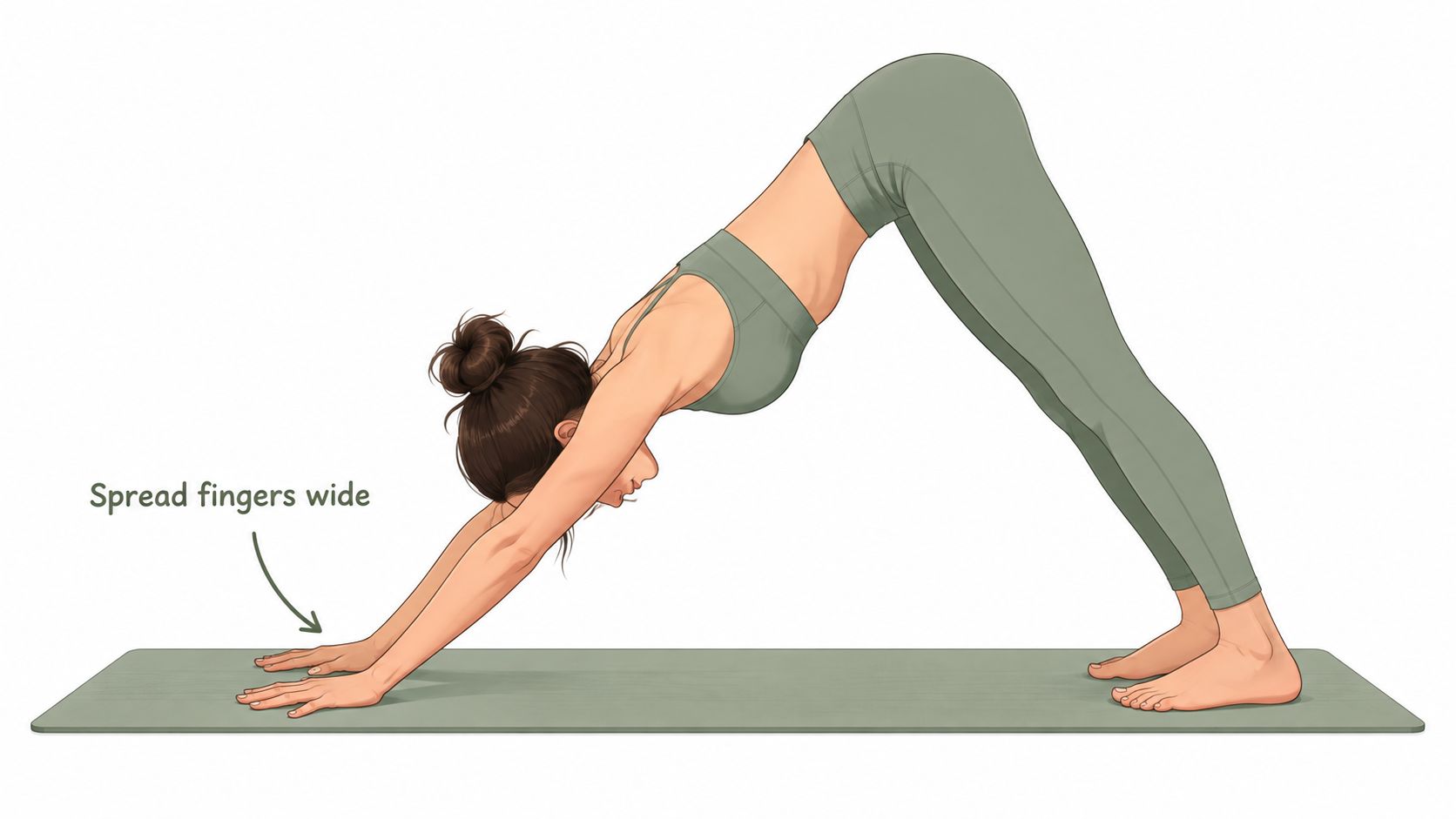
Use the inverted-V shape as a starting reference, not a standard you must reproduce exactly.
Build a broad base
- Start on hands and knees. Place your hands beneath your shoulders and spread your fingers. Press through the palms and finger bases rather than hanging passively into the wrists.
- Tuck your toes before lifting. Raise your knees and send your hips back and up. Keep your knees bent initially so you can organize the position without immediately demanding calf range.
- Support your trunk. Maintain gentle abdominal engagement and lengthen your spine. Let your head sit comfortably between your arms rather than craning your neck to check your feet.
Think of pushing the floor away while moving your hips away from your hands. You should feel supported through the arms, not as though your chest is sinking between your shoulders. Don't round your lower back just to make your hips appear higher.
Let the heels wait
Your heels may remain lifted, especially during entry. That's acceptable. Keep them comfortable while you establish your spine and hand support, then explore the leg positions rather than forcing contact from the outset.
Watch the transition with attention to the hands, hips, and bent-knee entry.
Breathe continuously instead of bracing and holding your breath to tolerate the position. If the transition itself feels awkward, practice entering and exiting without adding a calf stretch. A walk-out exercise provides a related way to practice moving between standing and hand-supported positions, but it isn't a requirement for this stretch.
Gastrocnemius and Soleus Variations Side by Side
Knee position changes the emphasis, not the identity of the entire stretch. Both versions involve the calf complex, and neither isolates a muscle perfectly. The useful distinction is which position places more emphasis on the muscle you're trying to explore.
The gastrocnemius crosses the knee, so extending the working knee increases its length. The soleus originates below the knee and doesn't require knee extension. This distinction also underlies the straight-knee and bent-knee positions in the University of Colorado calf-stretch guidance.
Gastrocnemius vs. Soleus Emphasis in Downward Dog
| Cue | Gastrocnemius Emphasis | Soleus Emphasis |
|---|---|---|
| Working knee | Relatively straight, without forceful locking | Deliberately bent |
| Heel | Ease toward the floor within comfortable range | Maintain comfortable contact where available |
| Other leg | Bend it to make room for the working side | Adjust it so you can explore the working ankle |
| Main action | Gradually straighten the working knee | Keep the working knee bent while exploring ankle dorsiflexion |
| Endpoint | Mild, continuous muscular tension | Mild, continuous muscular tension without ankle or tendon pain |
For the straighter-knee version, bend the opposite knee and gradually lengthen the working leg. Stop extending it when the calf tension becomes clear and sustainable. You don't need to snap the knee into its end position or push the heel down with all your body weight.
For the bent-knee version, soften the working knee while keeping the heel comfortably supported if your range allows it. Explore a small amount of ankle movement without letting the heel rise as a substitute. If you can't find a stable, non-irritating position, reduce the demand rather than trying to reproduce the table perfectly.
Compare before choosing
Alternate sides instead of requiring them to reach matching positions. Then compare the knee positions on each side, using a similar hand base and hip position so you're not changing everything at once.
- Straight-knee tension that eases when bent suggests that gastrocnemius emphasis may be particularly relevant that day.
- Restriction that remains with the knee bent makes the soleus-focused version worth exploring, but doesn't prove the soleus is the cause.
- Discomfort rather than muscular tension means the comparison isn't a useful flexibility test.
Lead with the version you can control and tolerate. A stronger sensation isn't automatically a better choice.
Using Downward Dog as a Warm-Up vs. a Cooldown
A long hold isn't automatically better preparation. Before running, jumping, or demanding lower-body strength work, use downward dog as a brief movement task: pedal the feet smoothly or alternate between softer and straighter knees without bouncing at the end of range.
The immediate benefit deserves realistic expectations. In a study comparing downward-dog dynamic stretching with self-myofascial release, the downward-dog group improved its forward-lunge measurement by an average of 0.700 cm, but differences between intervention groups weren't statistically significant. That supports offering it as an option, not declaring it superior or promising lasting gains.
Before exercise, keep moving
Make each transition controlled enough that you can reverse it comfortably. Don't use momentum to drive the heel lower, and don't let the stretch replace preparation for the activity you're about to perform. If your next task involves faster footwork, the quick-feet guide addresses a different training need from calf mobility.
A review of acute stretching effects and practice recommendations describes modest immediate flexibility benefits and advises against prolonged static stretching of more than 60 seconds per muscle immediately before maximal or explosive contractions. The practical distinction is controlled movement before performance versus unhurried holds during separate mobility work.
Use this visual to distinguish the approaches, not as a mandatory timer or a promise of muscle lengthening.
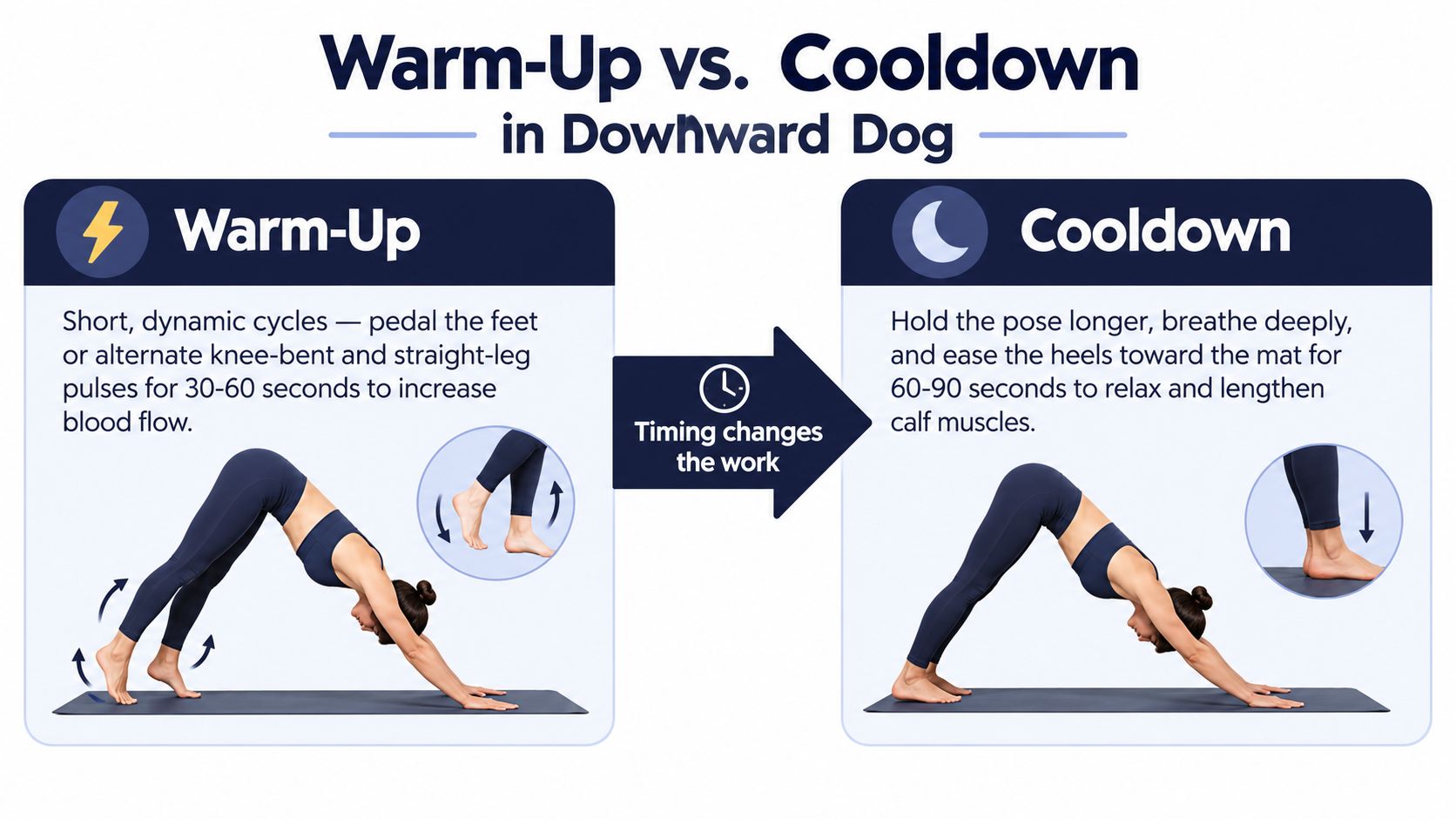
After exercise, remove the hurry
During a cooldown or separate mobility session, you can spend longer in a comfortable position with relaxed breathing. Longer means more time to explore tolerable range, not permission to apply more force. Finish when you can no longer maintain an easy, controlled stretch.
Before training: Short, dynamic, controlled movement.
After training: Longer, relaxed holds within comfortable range.
Common Mistakes and Symptoms You Should Not Push Through
When the stretch stops feeling useful, check what you're doing before adding effort. A heel that moves lower while your shoulders collapse or your spine rounds doesn't demonstrate better ankle mobility. You've changed the task.
Correct the compensation
- Collapsing through the shoulders: Push the floor away again. If you can't maintain support, leave the pose and reset.
- Rounding the lower back: Bend the knees enough to regain a lengthened spine rather than lifting the hips through lumbar rounding.
- Lifting the heel while claiming more range: Heel elevation is fine during setup, but don't count it as increased dorsiflexion during a comparison.
- Locking both knees: Explore gradual extension of the working leg instead of bracing both legs rigidly.
- Demanding symmetrical heel contact: Allow different positions on each side. Unequal mobility doesn't need to be corrected by forcing the more restricted side.
Use the visual as a reminder to distinguish a positioning problem from a symptom that needs you to stop.
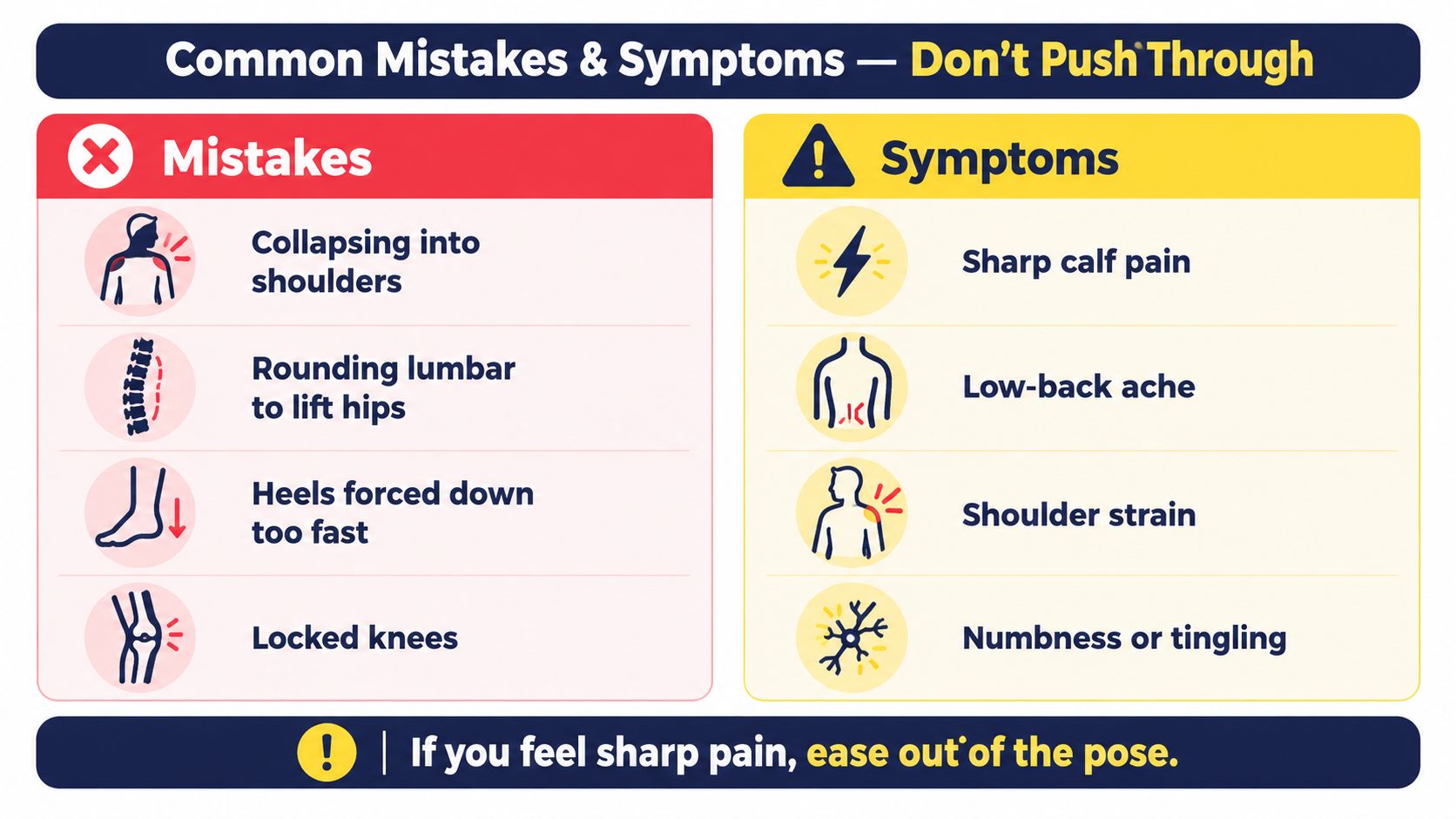
Recognize an inappropriate sensation
Sharp, burning, electric, numb, or tingling sensations aren't targets to stretch through. Neither is pain concentrated around the Achilles rather than a tolerable pull through the muscle. Ease out instead of testing whether another push will make the sensation disappear.
A case report on nerve traction associated with downward dog documented irritation involving the lateral sural cutaneous nerve in a patient with markedly restricted ankle dorsiflexion. Symptoms worsened with combined calf stretching and dorsiflexion. A case report doesn't establish how often this happens, but it shows why aggressive flexibility work can be inappropriate.
For a gentler restart, begin with bent knees and heels lifted, organize your spine, and move your hips back. Only then gradually straighten a working knee. If the troublesome sensation returns, stop that version rather than repeatedly provoking it.
The main benchmark is symptom quality, not whether the heel touches the floor.
A Repeatable Sequence You Can Use This Week
Make the sequence easy enough to repeat on an ordinary training day. You don't need a dramatic stretch or a complicated schedule. Use the comparison to choose an emphasis, then match the pace to whether you're preparing for exercise or finishing it.
The pedal movement gives you a simple way to explore each side without demanding matching heel positions.
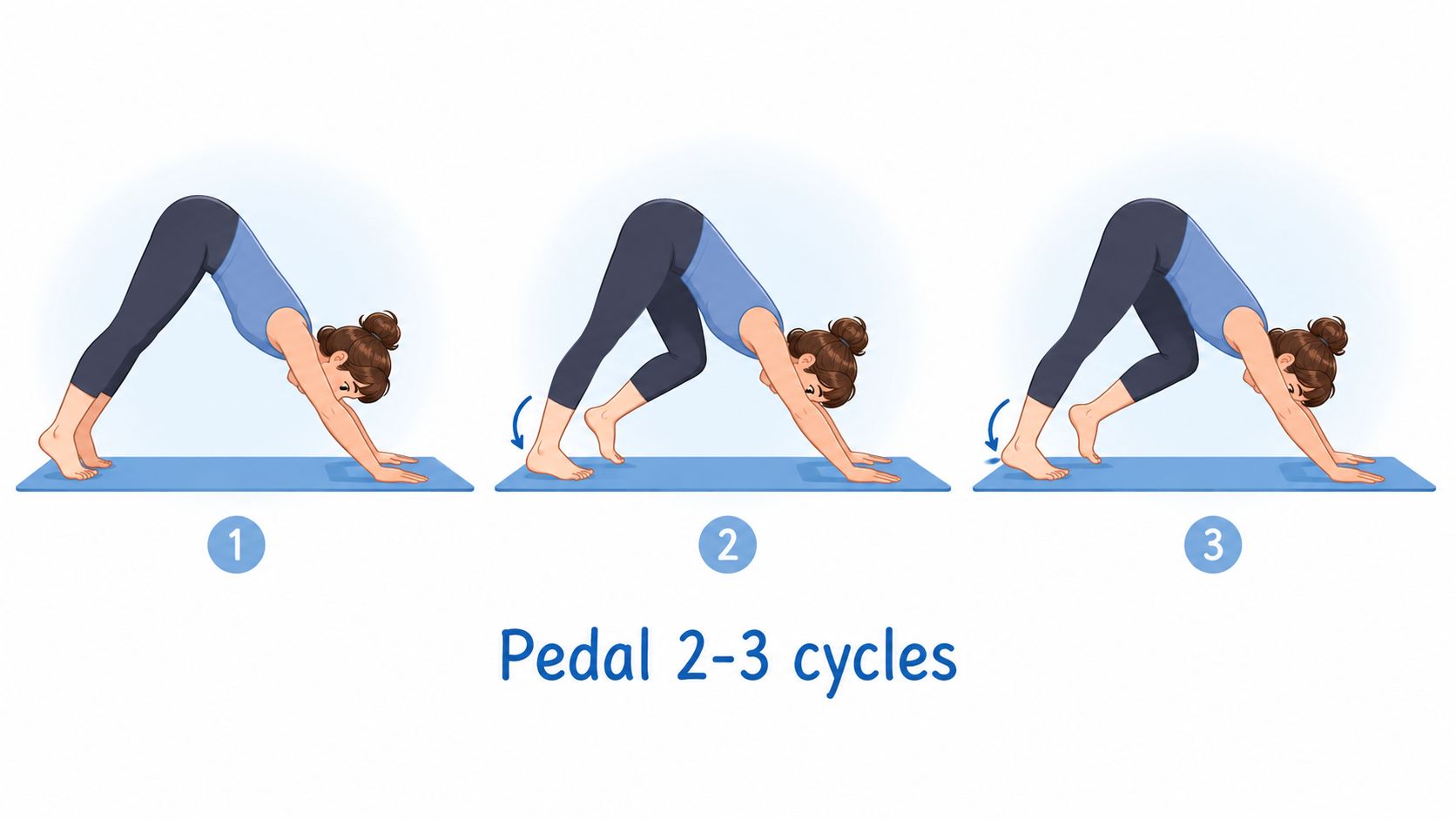
Fit it around your training
- Before your session: Enter comfortably and use a few smooth alternating pedals. Explore the knee position relevant to your day's restriction, then move into preparation for your workout.
- After your session: Revisit whichever version felt useful. Stay briefly in a relaxed hold or alternate sides, ending before your support position deteriorates.
- Between calls or chores: Treat it as a small mobility practice, not an obligation to reach your deepest position every time.
Consistency is more useful to evaluate than an isolated impressive attempt. A four-week pilot yoga intervention used 50-minute sessions twice weekly, including poses emphasizing ankle dorsiflexion, and reported positive changes in some ankle range-of-motion and single-leg-balance measures. It wasn't a trial of downward dog alone, so those results can't justify a guaranteed outcome from this short sequence.
Keep a useful record
Note which version you used, whether the sensation stayed muscular, and whether you could reproduce the position without compensation. Also notice how your lower legs feel during walking, running, or squatting, without assuming every change came from stretching.
Place this practice beside a manageable bodyweight session. It should fit your day, not turn a quick exercise break into another demanding appointment.
Quick Answers About Downward Dog Calf Stretching
How long should I hold it?
There's no validated downward-dog-specific hold duration that guarantees improvement. Use the warm-up and cooldown distinction above, then let comfort and control determine when you finish. Don't keep holding solely because you haven't reached a timer's endpoint.
Do bent knees defeat the purpose?
No. A bent-knee version is a deliberate variation, not a failed straight-leg pose. Choose it because it provides a useful, tolerable response, not because you're trying to conceal limited range.
Is it safe if I have knee issues?
A general technique guide can't establish safety for your particular knee condition. Don't force extension or remain in a position that causes knee pain. If you're recovering from an injury, managing a diagnosed condition, or unsure about restrictions, ask your treating clinician which version, if any, is appropriate.
Can I use it to treat heel or Achilles pain?
Don't treat downward dog as a universal remedy. The stretching review discussed earlier also notes limited evidence for calf stretching in plantar fasciitis, and that condition isn't interchangeable with Achilles pain. A stretch that feels manageable isn't proof that it addresses the cause of your symptoms.
When should I seek an assessment?
Get professional assessment for persistent Achilles pain, plantar-foot pain, or neurological symptoms rather than repeatedly experimenting with deeper stretches. Describe where the symptoms occur and which movements provoke them. That information is more useful than reporting whether your heels reach the mat.
SuperStrong offers an iPhone app for logging short, at-home bodyweight sets on a shared visual wall with friends. Pair this calf-mobility practice with a manageable bodyweight routine between calls or chores, then visit SuperStrong to make those training sets visible and build shared accountability.