How Many Rest Days Per Week You Really Need
 16 min
Most adults training with bodyweight strength sets need three to four rest days per week, which makes a three-day plan with four days off the sensible default. That number sounds generous until you notice how much recovery a single hard set costs, and it sounds conservative the moment you see that ten easy push-ups and ten push-ups taken to the last rep are not the same training event. Two people can log identical weekly schedules while only one of them is recovering. The count that works for you comes from two things you control: how close to failure each set goes, and how often the same muscles get loaded again. Global guidance sets the floor for weekly training frequency and leaves the rest of the week to you. What follows turns that freedom into a number you can put on a calendar.
Table of Contents
- Rest Days per Week by Training Pattern
- What Health Guidelines Require Each Week
- How Intensity and Volume Change Your Rest Needs
- How Rest Works When You Train in Short Bursts
- Sample Weekly Rest Schedules to Copy
- Signs Your Rest Is Not Enough
- Confirm Your Rest Schedule Before Next Week
Rest Days per Week by Training Pattern
Start with the row that matches the week you're having, not the one you plan to run in three months.
| Training pattern | Training days | Rest or light days | Why this count works |
|---|---|---|---|
| Beginner or returner, full-body sets | 2-3 | 4-5 | Time to adapt between whole-body loads |
| Standard bodyweight plan, sets near failure | 3 | 4 | Spacing between repeated full-body work |
| Advanced trainee, heavy sets near failure | 3-4 | 3-4 | Higher fatigue per session needs more recovery |
| Daily exercise snacks, easy sets far from failure | 5-7 | 0-2 full rest days | Low cost per set allows frequent movement |
Beginner or returner, full-body sets. Two or three training days, four or five rest or light days. Early bodyweight work puts push-ups, rows, squats and planks into the same session, and your tissues are still learning to handle that load. Extra days off in month one cost you almost nothing in progress and protect the habit that matters more.
Standard bodyweight plan, sets near failure. Three training days, four rest days. That spacing puts at least one day between repeated whole-body sessions, so no movement pattern gets taken to near failure twice in a row. The four days aren't idle days by default. They're what makes the three hard days repeatable next week.
Advanced trainee, heavy sets near failure. Three or four training days, three or four rest days. Training experience raises the ceiling on how hard a set can be, and a harder set costs more to recover from. Capacity goes up, but so does the price per session, so the number of hard days stays flat or drops.
Daily exercise snacks, easy sets far from failure. Five to seven short training days, zero to two full rest days. A few easy sets spread through a day cost so little that daily movement sits comfortably inside recovery.
The definition that makes the table work: a rest day means 24 hours without near-failure work for a given muscle group. It doesn't mean 24 hours without movement, and a walk or a stretch does not break it.
Pick the row closest to your current effort level and frequency, then write next week's rest days down before reading further. The rest of this guide only tunes the number you've just chosen.
What Health Guidelines Require Each Week
Health guidance sets a floor for the week, and the arithmetic from that floor answers most of the question. Adults should do muscle-strengthening activity involving all major muscle groups on at least 2 days per week, alongside 150 to 300 minutes of moderate-intensity aerobic activity or 75 to 150 minutes of vigorous activity weekly, according to the WHO Regional Office for Africa's physical activity guidance.
If strength work happens on exactly 2 days, the remaining 5 days are free for rest, light movement or aerobic exercise. A three-day bodyweight schedule sits above the minimum for resistance work and still leaves four non-strength days in a seven-day week. That's the whole basis for the standard recommendation, and it's a floor rather than a target.
What the guideline leaves open
WHO treats activity as something you accumulate across the week. There's no required session length and no fixed rest-day pattern, so a rest day can mean skipping demanding full-body strength work rather than skipping movement entirely. That distinction is what makes short sets workable. A ten-minute walk on an off day doesn't convert it into a training day.
Two checks you can run today
- Count strength days. Any day with a set taken close to failure counts as one. Two is the floor, three is above it.
- Total your weekly aerobic minutes. 150 moderate minutes, or 75 vigorous ones, or a mix of the two.
Meet both and the leftover days are recovery days by default. Miss either and the first fix is more movement on days you already have, not fewer rest days.
The guideline sets the floor for frequency. The exact rest count above that floor depends on exercise intensity, which muscle groups you trained, how well you recover, and whether your off days stay easy.
How Intensity and Volume Change Your Rest Needs
Rest needs follow effort, not habit. Two sessions with the same exercises and the same duration can sit four rest days apart if one stays three reps shy of failure and the other goes to the last painful rep.
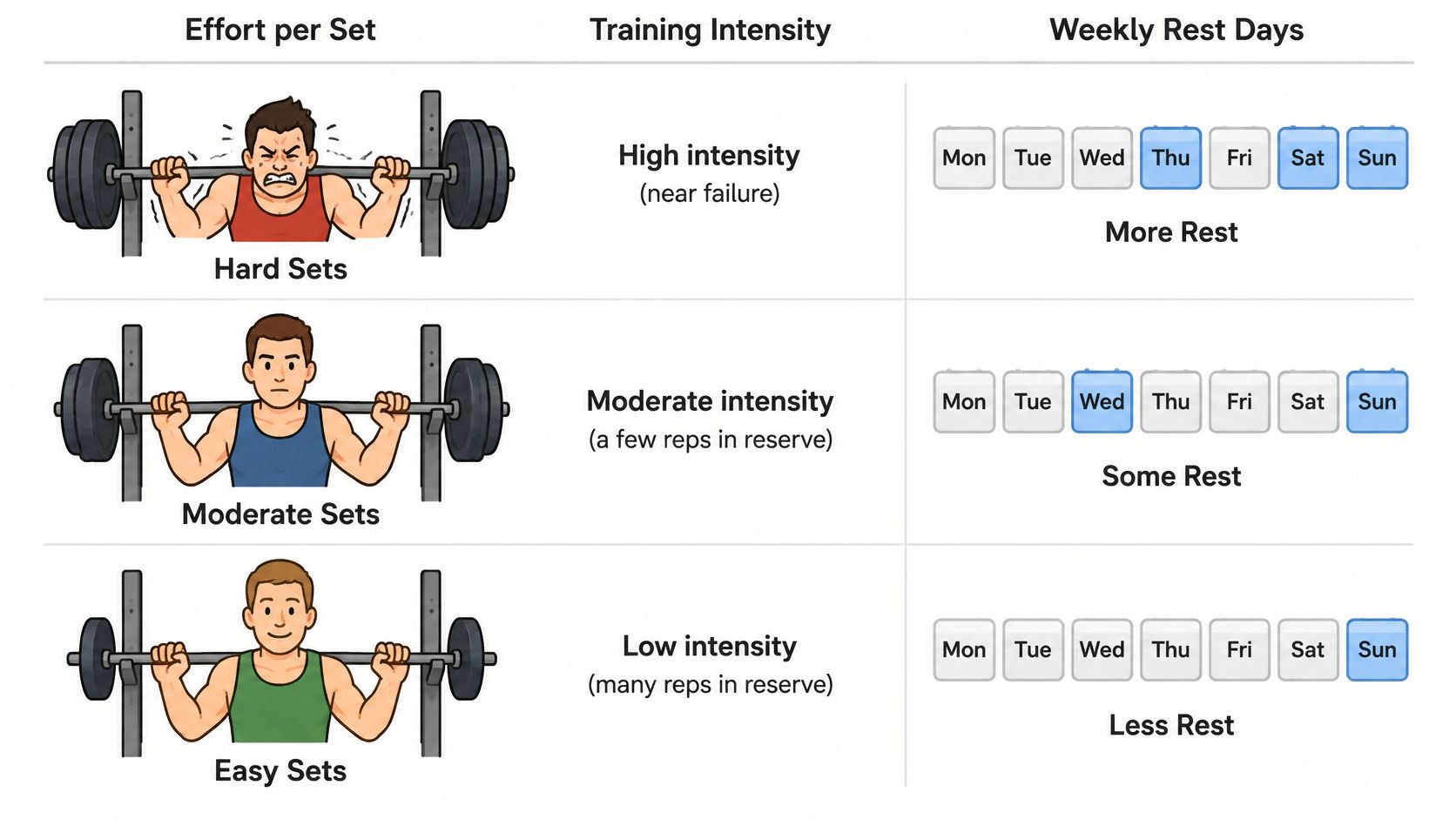
Effort per set is the biggest lever. Sets that stop 3 or 4 reps short of failure are cheap to repeat, and the same muscles can take another round the next day without much cost. A set taken to failure is a different transaction entirely, and those muscles need a day before they're loaded hard again.
| Training variable | Lower demand | Higher demand | Rest adjustment |
|---|---|---|---|
| Effort per set | 3-4 reps left in reserve | Sets taken to failure | Add one rest day before repeating those muscles |
| Hard sets per muscle group | 2-3 per week | The same weekly total packed into one session | Spread sets across more training days |
| Muscle overlap | Alternate push, pull, squat and hinge | Same pattern on consecutive days | Keep the same pattern at least one day apart |
| Impact | Slow bodyweight reps and walking | Jumps and fast plyometric reps | Count jump days as full training days |
Where two high-demand variables stack
Volume compounds the effort bill. Two or three hard sets per muscle group across a week is a light load that three training days absorb easily. Take that same weekly total and cram it into a single session, and one day now carries the recovery cost of the whole week.
Muscle overlap decides how often you can train. Alternating push, pull, squat, hinge and trunk work across the week lets you train more days, because the fatigue lands in different places. Push-ups Monday and push-ups Tuesday isn't variety. It's the same bill paid twice.
Impact counts too. Slow bodyweight reps and walking are gentle on joints and connective tissue. Jumps and fast plyometric reps raise the cost of a session even when the muscles stay away from failure, so a jump day belongs in the training column.
Here's a short walkthrough of how proximity to failure changes the recovery clock.
The stacking rule: when two variables sit at the high end in the same week, add one rest day before you add any load. Recovery debt is cheaper to avoid than to repay.
How Rest Works When You Train in Short Bursts
Exercise snacks need a different answer, and the evidence base is thinner than most advice admits. Studies of the pattern use bouts of five minutes or less, performed at least twice daily on three to seven days per week for four to twelve weeks. A 2025 systematic review and meta-analysis of 11 randomized controlled trials covering 414 participants found meaningful improvements in cardiorespiratory fitness, even though total exercise volume sat below standard weekly activity targets.
The same review found no clear evidence that exercise snacks improve leg strength or broader cardiometabolic outcomes, and no protocol settled an optimal rest schedule for this kind of training. So there's no research-backed rest count for a set of push-ups done between meetings. There is a rule that holds anyway.
Sort each set into one of three buckets
- Easy sets far from failure. Ten push-ups at lunch that leave you able to do five more. That's ordinary movement and needs no training day.
- Near-failure sets. Eight pull-ups where the last one is a grind. That's training, and those muscles need a day before they're pushed again.
- High-impact or repeated same-muscle sets. Jumps, or the third round of squats in one day. Give those the longest gap of the three.
The test is the cost of the set, not the fact that you did it. A day with two easy sets and a walk is a rest day that happens to include movement. A day with three near-failure sets on the same muscles is a training day wearing a snack costume.
If you want more patterns to work with, these examples of exercise snacks you can slot between daily tasks sit firmly at the low-effort end.
Movement frequency and recovery cost are separate variables. Once you separate them, the question of how many rest days per week you need stops being about the calendar and starts being about the sets.
Sample Weekly Rest Schedules to Copy
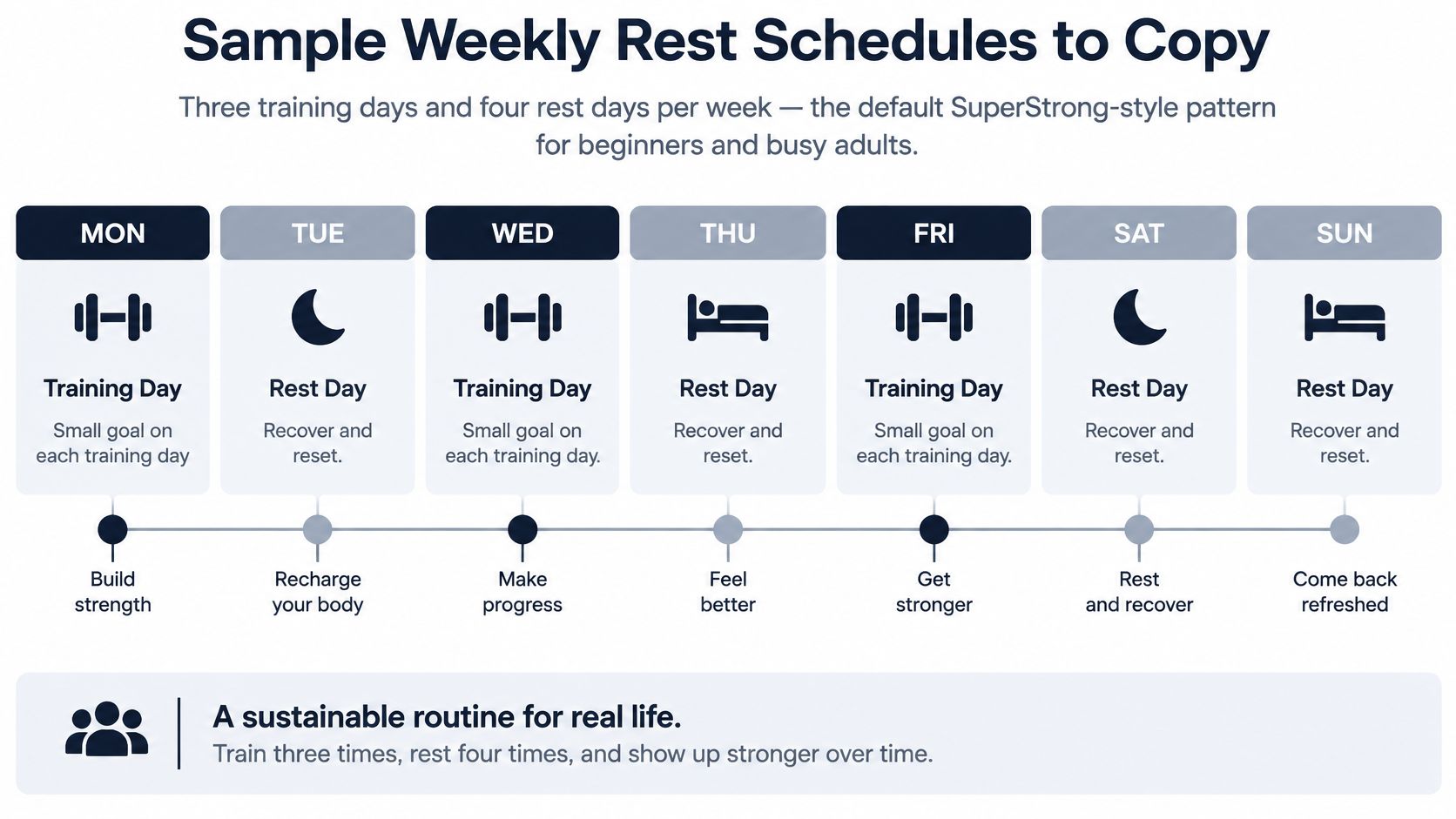
Take the calendar first, then decide whether you need a different one. Train Monday, Wednesday and Friday, and rest Tuesday, Thursday, Saturday and Sunday. That's the rhythm our own plan runs on: three training days, four rest days, a small goal on each training day, and a move to a harder week once the current week feels easy.
Why the default week works
Three full-body sessions hit every major muscle group more than once, and no movement pattern repeats on consecutive days. The four rest days aren't four days on the couch. Tuesday and Thursday take a walk, Saturday stays free for something you enjoy, and Sunday closes the week before the next Monday session.
| Schedule | Week layout | Best for | When to change it |
|---|---|---|---|
| 3 on, 4 off | Train Mon, Wed, Fri; rest Tue, Thu, Sat, Sun | Beginners and busy adults | Step up after an easy week |
| 2 on, 5 off | Train Mon and Thu; walk or stretch on other days | Returners after a break | Add a third day after two easy weeks |
| 4 on, 3 off at easy effort | Train Mon to Thu; rest Fri, Sat, Sun | Trainees doing lighter sets | Cut to 3 on if soreness lasts past a session |
| Daily snacks, 2 full rest days | Snack daily; full rest Wed and Sun | Exercise-snack users | Add a rest day if effort rises |
The other three layouts
Two on, five off suits a returner. Monday and Thursday sessions, walking or stretching on the days between. Hold that for two easy weeks before adding a third training day, because the goal in month one is showing up, not accumulating volume.
Four on, three off at easy effort fits someone whose sets stay well short of failure. Monday through Thursday, then three days clear. If soreness is still present when the next session starts, drop back to three training days.
Daily snacks with two full rest days works for the short-burst pattern. Short sets every day, full rest on Wednesday and Sunday. The moment effort creeps toward failure, add a rest day rather than pushing through.
How to choose without overthinking it
Start with the layout nearest your current week. Run it for two weeks, then move one step up or down. Put the rest days into your calendar before the week begins so they're protected the way training days are, because a rest day that isn't scheduled gets overwritten by whatever else shows up.
If you're building the sessions themselves alongside the schedule, this guide to bodyweight training for beginners pairs with the three-day setup.
Signs Your Rest Is Not Enough
A rest plan earns its keep when each session starts fresh and reps hold steady across the week. Failure is quieter than that. Nothing dramatic happens; the numbers drift and each session costs a little more effort than the last.
The signals worth acting on
- Soreness still present at the next session in the same muscles.
- Reps falling two sessions running at the same effort level.
- Joint discomfort that does not settle within a day or two.
- Poor sleep or unusual tiredness running through the week.
- Perceived effort climbing on sets that used to feel routine.
One flat session is noise. A pattern needs at least two sessions, ideally across two weeks, before it earns a change.
Fix it in this order
- Extend rest for the affected muscles.
- Cut the number of near-failure sets.
- Swap one high-impact session for a lighter version.
- Only then consider adding volume.
The order matters because each step is cheaper than the one below it. An extra rest day costs nothing. Added volume raises the recovery bill you are already failing to pay.
Say your pull-up reps drop from 10 to 7 on the second training day of the week. The fix is one more rest day before the next pulling session, not an extra set to make up the difference. The same logic scales with effort: a short set stopped well short of failure carries a small recovery cost and tolerates a tighter rest schedule, while a set taken near failure does not. That is why the count of hard sets predicts trouble earlier than the count of sessions.
For most healthy adults, two to three resistance-training days per week is a practical baseline: the WHO Eastern Mediterranean Regional Office guidance summary sets the minimum at two days of muscle-strengthening work, which leaves roughly four to five days for recovery, aerobic work or complete rest. Soreness, declining repetitions or joint discomfort that carry into the next planned session are a reason to extend recovery rather than add volume.
Coming back after time away makes every signal louder, and this guide to how to start working out again after a long break covers how to ramp without tripping them.
Persistent pain, unusual symptoms or an existing health condition call for a doctor's input before you change the plan.
Confirm Your Rest Schedule Before Next Week
Three steps finish this today.
- Choose your row and your layout. Match the training-pattern table to your real effort level, then pick one schedule from the layout options.
- Enter the rest days as calendar entries. Add a note to each one saying what it allows: a walk, a stretch, or nothing at all. Vagueness is how rest days disappear.
- Log your sets for two weeks. Then read the rep trend against the recovery signals before changing a single variable.

What the log is and isn't
SuperStrong is an iPhone app that records each bodyweight set as a tile on a wall. It is a log, not a coach and not medical advice, so check with a doctor before starting any exercise programme. Its structure matches the schedule in this guide: a small goal on each training day, tiles that grow with the number of reps logged, and one wall you can zoom from a single day out to a full year. That view shows whether your reps hold steady or slip across the week, which is the signal the log makes easiest to track alongside soreness, joint discomfort and sleep when deciding whether to change your rest count.
If you're new, run three training days and four rest days, and move up to a harder week only when the current one feels easy. That single rule prevents most of what goes wrong in month one.
SuperStrong gives you one shared wall for up to four friends, where every logged set lands as a tile sized to the reps you did. It runs the same three training days and four rest days this guide recommends, so your recovery rhythm stays visible on the wall instead of living in your head. Visit SuperStrong to start a wall and log your first week.