Do Ab Wheels Work? What the Evidence Shows
 14 min
Yes, ab wheels can train the abs hard. As the wheel reaches farther from the body, the rectus abdominis works substantially harder to resist the lower back arching. That makes the rollout a demanding anti-extension exercise, but it does not make it a shortcut to visible abs or prove that strength will improve over time.
The challenge comes from reach: extending farther increases the demand while making it harder to keep the torso controlled. Use a range you can manage, then increase it when you can maintain your position. A difficult set shows that the movement loads your core; lasting strength gains depend on repeating and progressing the exercise over time.
Table of Contents
- Do Ab Wheels Work? The Short Answer
- Which Muscles a Rollout Really Trains
- Progression Ladder for Ab Wheel Rollouts
- Common Form Errors and How to Fix Them
- Who Should Be Careful and How to Regress
- Bodyweight Core Exercises That Train the Same Skill
- Start a Simple Weekly Rollout Routine
Do Ab Wheels Work? The Short Answer
Yes for high abdominal and anti-extension demand, likely for strength if you progress gradually, and no for spot reducing belly fat or guaranteeing a visible six-pack. Strength gain itself hasn't been directly measured in the research reviewed here, so that part of the verdict stays honest rather than certain.
| Outcome | What the evidence shows | Verdict |
|---|---|---|
| Rectus abdominis activation | Very high in healthy adults, a 2006 Power Wheel group and a 2023 lab study both show high activation | Works |
| Oblique and shoulder stabilization | High, the 2006 Power Wheel group showed high oblique and latissimus activity, and rollouts load the shoulder to back muscles | Works |
| Progressive core strength | Plausible when range and reach increase gradually, but not directly tested | Likely with progression, not directly tested |
| Visible six-pack | Depends mainly on body fat, not on any single exercise | Not guaranteed |
| Fat loss around the waist | Abdominal exercise cannot selectively remove fat from the midsection | Does not work |
| Athletic performance transfer | Not directly measured | Unproven |
Activation Is Not the Same as Strength
A lab reading tells you a muscle worked hard during that set. It doesn't tell you how much stronger you'll be in three months, because strength also needs repeatable load, enough total work, and recovery. Treating activation as a guarantee leads people to buy a wheel for fat loss, then blame the tool when their waist doesn't change.
Apply three tests to any ab exercise. Does it train the target muscle, can you make it harder over time, and does it fit the goal you actually have?
The wheel passes the first test clearly and the second test if you manage reach carefully. It fails the third test when your goal is a leaner waist, since no rollout can choose where fat comes off.
Which Muscles a Rollout Really Trains
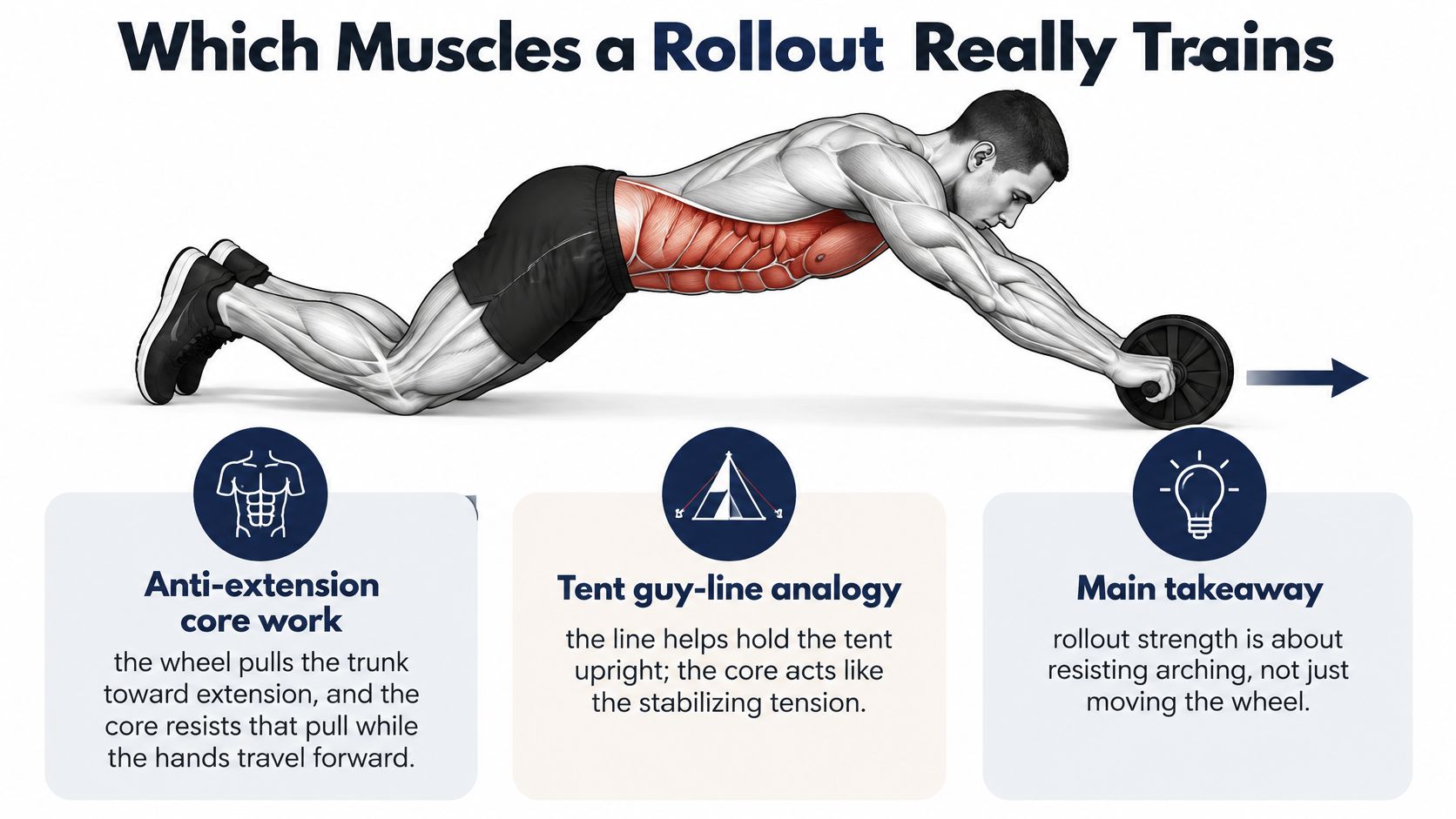
A rollout is an anti-extension exercise. As the wheel travels forward, it pulls your trunk toward arching, and your core has to resist that pull while your hands move away from your knees. You're not crunching your ribs toward your hips. You're stopping your spine from bending under a growing load.
Think of a tent guy line holding a pole upright in wind. The line doesn't shorten to do its job, it creates tension that stops the pole tipping. Your abs and obliques work in a similar way, creating stiffness so your pelvis and ribs stay aligned while your arms reach.
What the 2006 EMG Study Found
In the 2006 study in Physical Therapy, researchers used surface electromyography, which measures electrical activity in working muscles, in 21 healthy adults performing traditional and nontraditional abdominal exercises. The Power Wheel group, comprising pike, knee-up, and rollout movements, produced the highest EMG activity for the upper and lower rectus abdominis, internal obliques, and latissimus dorsi among the exercises assessed.
That grouping creates an important limit. Because pike and knee-up movements were combined with rollouts, the study can't isolate the rollout alone or prove the rollout caused all of that activity. It still shows rollout type patterns demand far more than the front of your abdomen, since the obliques and shoulder to back muscles have to stabilize you as the wheel moves away.
What EMG Cannot Tell You
EMG measures activation during the set, not strength gained, muscle size, fat loss, or sport performance afterward. A high reading means the exercise is a strong candidate for training, not that a visual transformation is guaranteed.
Use feel as a practical check alongside position. A good rollout should feel like your abs and obliques working hard while your lower back stays quiet. If your back takes over, the range is too long for you right now, however impressive the distance looks.
Progression Ladder for Ab Wheel Rollouts
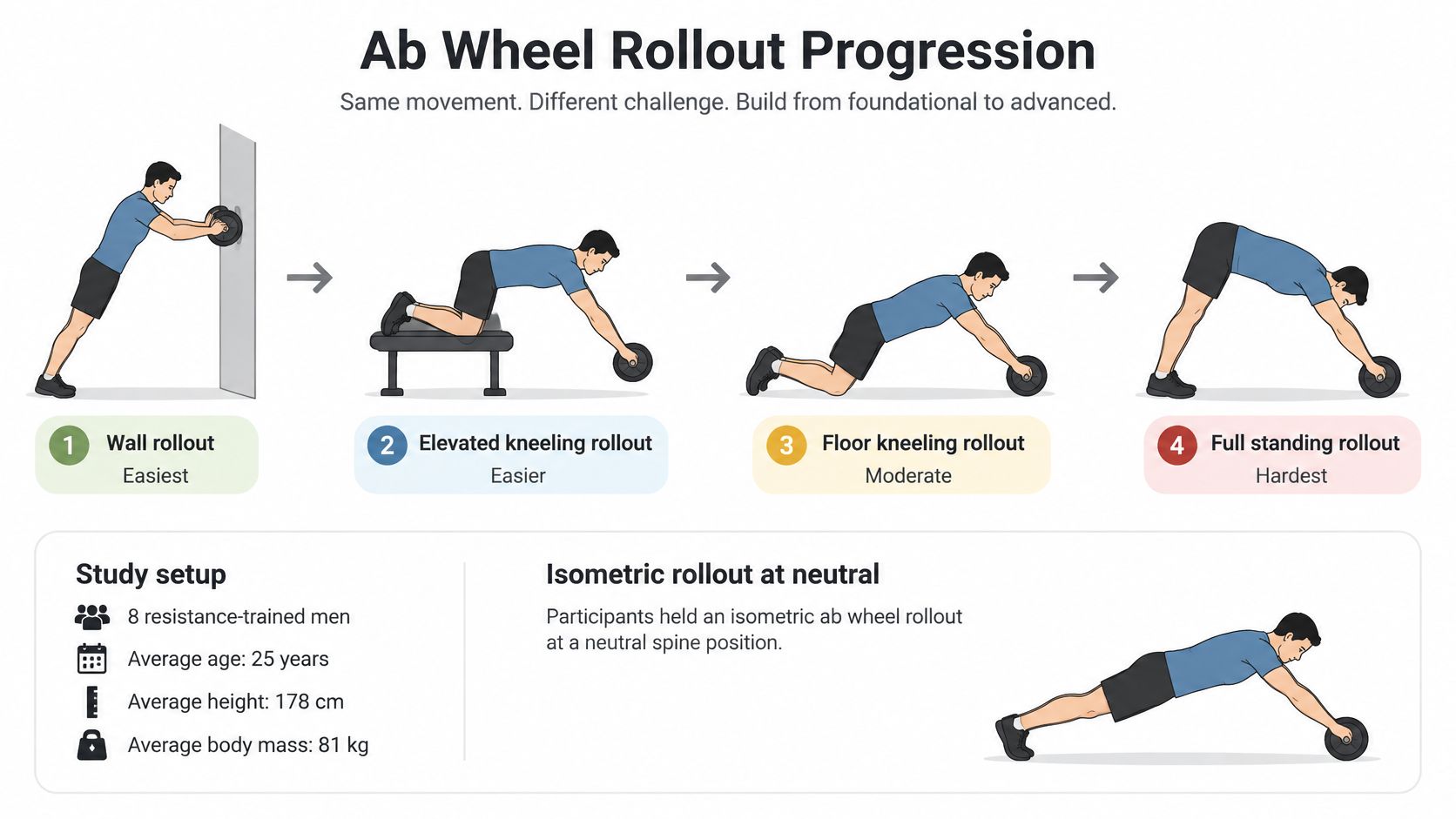
Range of motion sets the difficulty of an ab wheel rollout. In a 2023 laboratory study of ab wheel isometric rollouts, eight young, healthy, resistance-trained men held positions at neutral, 90 degrees, and 150 degrees. Their average age was 25 ± 3 years, height 178 ± 5 cm, and body mass 81 ± 2 kg. Rectus abdominis activity rose by 97.6% from neutral to 90 degrees and by 98.5% from neutral to 150 degrees.
Both increases from neutral were statistically significant. The study also found that the wheel emphasized the rectus abdominis and pectoralis major more than the latissimus dorsi and erector spinae. As the wheel travels farther forward, the trunk must resist a longer lever arm. That raises the exercise's immediate demand, but lab activation does not establish how much strength someone will gain over weeks.
Climb One Rung at a Time
| Variation | Setup | Relative difficulty | Use when |
|---|---|---|---|
| Kneeling, short range | Knees down, roll out a short distance | Lowest | Starting with a limited, controlled reach |
| Wall rollout | Hands on a wall at chest height, wheel rolls along it | Low | A shorter reach is needed |
| Elevated hands | Hands on a bench or box, wheel rolls forward | Low to moderate | Full kneeling range is still too hard |
| Kneeling, full range | Knees down, roll until hips are close to the floor | Moderate | Short kneeling range is controlled for every rep |
| Standing, short range | Standing, roll a short distance and return | High | Full kneeling range is controlled |
| Standing, full extension | Standing, reach as far as control allows | Very high | A demanding variation suits your current ability |
Move-up rule: Add range only when you can reverse every rep with a neutral spine. A longer reach is useful only if you can return from it under control.
Start with a short reach and increase it gradually. The study involved eight trained men holding isometric positions, so its percentages describe lab demand, not the strength gains a beginner should expect. The ladder instead gives you a practical way to adjust difficulty: change the reach and shoulder angle by choosing a variation that lets you control the movement.
Common Form Errors and How to Fix Them
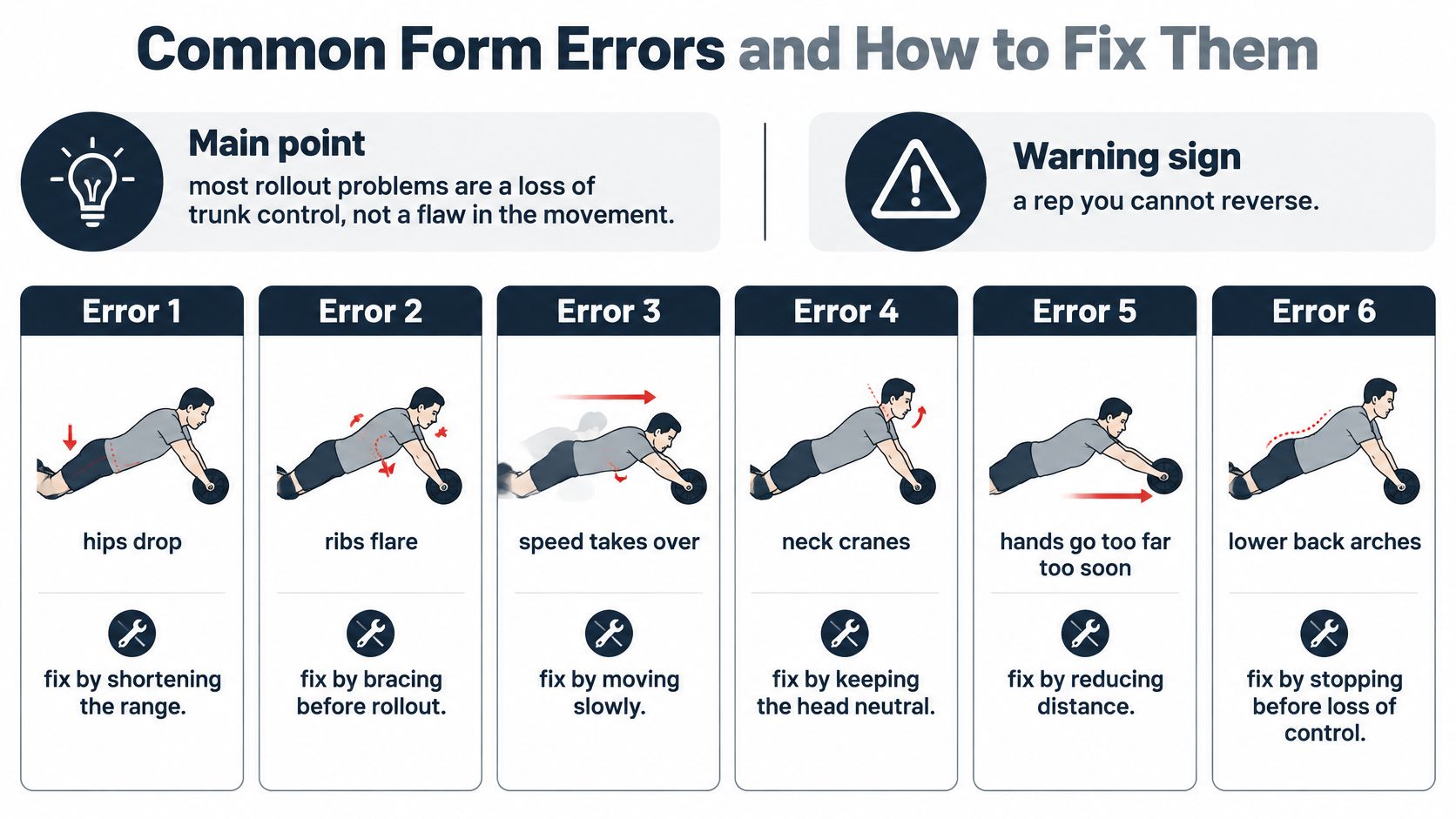
Most rollout problems come from a loss of trunk control, not from a flaw in the movement itself. Your clearest warning sign is simple, you've reached a point you can't reverse without your hips dropping or your back arching. At that moment the exercise has stopped training the brace you wanted.
| Error | What it looks like | Fix |
|---|---|---|
| Lower back sag | Hips drop and the lumbar spine arches as the wheel goes out | Shorten the range and return before the arch begins |
| Ribs flare | Chest lifts and the ribs point toward the ceiling | Pull the ribs down toward the hips and reduce the reach |
| Hips pike | Hips rise into a V shape and the shoulders do less work | Keep hips in line with the body, or train the pike as a separate skill |
| Breath held | Breath stops for the whole rep | Exhale on the way out and breathe through the return |
| Rolling too far too soon | The wheel travels past the point where the trunk can control it | Return to the last range you can reverse with a neutral spine, add distance only after several controlled sessions |
| Shoulders shrug | Shoulders creep up toward the ears during the rep | Set shoulders down and back and reach from the lats |
Build the Brace Before You Roll
Set your trunk before the wheel moves, ribs down, glutes tight, and shoulders away from your ears. If you can't hold that position still, build it first with a push-up position plank, then transfer the same shape to a short rollout.
A hip pike deserves separate treatment because it changes the exercise into a hip flexion movement. Train it later as its own skill if you want it, don't let it replace the rollout. Stop each rep the moment your back begins to arch or your ribs begin to flare, because a rep you can't reverse has passed the point of control.
Who Should Be Careful and How to Regress
Calling the ab wheel either dangerous for everyone or safe for everyone goes beyond the evidence. As one source on back pain and the ab wheel notes, spinal loading during rollouts has not been directly measured in a study and rollouts have not been tested in people with back pain. Strong activation data in healthy participants therefore can't establish that the movement suits acute pain, disc symptoms, pregnancy, post-surgery recovery, or poor trunk control.
Regress Before You Quit
Start where you can stay pain free and controlled. These options reduce stress without abandoning the anti-extension skill.
- Pain-free partial range: Roll only to the distance you can reverse with ribs down and no back arch.
- Wall rollout: Stand facing a wall and roll upward, keeping the load low enough to practise bracing.
- Raised hands: Place your hands or the wheel higher to shorten the lever.
- Plank-based alternatives: Build a quiet trunk first, then return to the wheel when the position feels stable.
Losing a neutral trunk matters because demand rises as lever length increases. If your ribs or pelvis flare, the challenge can shift away from controlled anti-extension toward painful lumbar compensation. A regression that removes the symptom gives you a sensible starting point to progress from.
Stop Signs That Need Assessment
Stop and seek a qualified clinician if you get pain that spreads or radiates, numbness, weakness, acute injury pain, or pain during a rep that persists afterward. Check with a clinician first if you have persistent or acute back symptoms, you're pregnant, you're recovering from surgery, or you have poor trunk control.
SuperStrong is a log, not a coach and not medical advice, and you should check with a doctor before starting an exercise programme. If symptoms persist despite an easier variation, don't negotiate with them through more reps. Get assessed, then rebuild from the level your body tolerates.
Bodyweight Core Exercises That Train the Same Skill
You don't need a wheel to train resistance to extension. The shared skill is keeping your ribs and pelvis aligned while your arms or legs move, so several bodyweight options can replace the wheel for beginners or support it on lighter days.
- Forearm plank: Hold for 20 to 45 seconds with ribs down and glutes tight.
- Plank with arm reach: Hold for 15 to 30 seconds, reaching one arm forward without rotating your hips.
- Dead bug: Perform 8 to 10 reps per side, extending each leg slowly while your lower back stays quiet.
- Bird dog: Perform 8 to 10 reps per side with a two-second hold at full reach.
- Hollow hold: Hold for 15 to 30 seconds, shortening the lever by bending your knees if your back arches.
- Body saw: Perform 8 to 10 slow forward and back moves from a plank, travelling only as far as you can reverse.
A 60-Second Session Between Tasks
Say you've got one minute at home between calls. Do a 30-second forearm plank, rest briefly while you reset, then do dead bugs for 30 seconds at a slow pace. You'll practise the same brace without needing floor space for a wheel.
A walk out exercise also bridges the gap well, since your hands travel forward in small steps and you can stop before your trunk loses position. Whichever option you choose, keep the same rules, brace before you move, breathe steadily, and stop the set when you can't hold alignment. Easier doesn't mean careless, it means the dose finally matches your control.
Start a Simple Weekly Rollout Routine
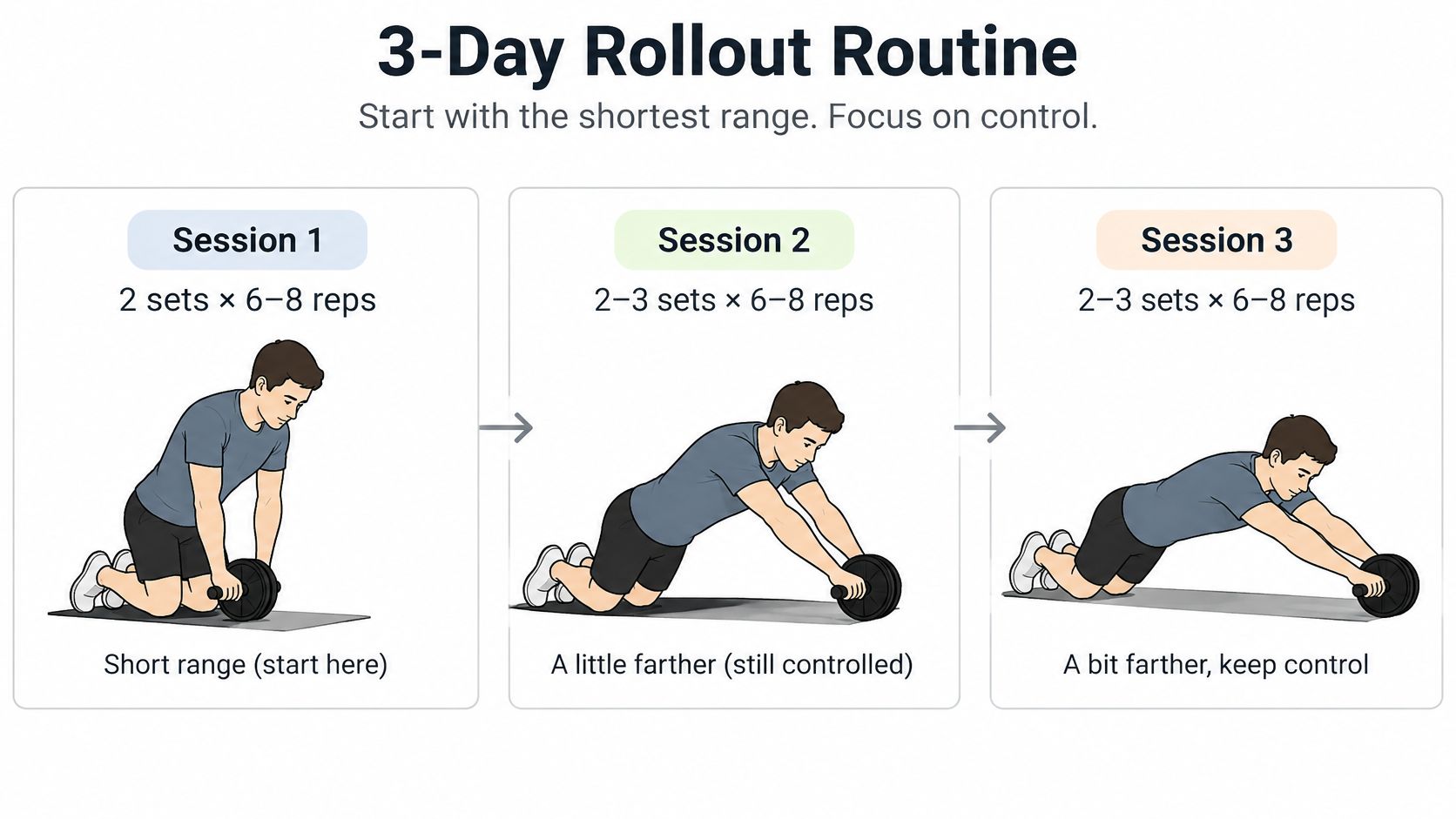
Start with three short sessions per week. In each session, do two or three sets of six to eight controlled kneeling rollouts using the shortest range on the progression ladder. Rest long enough between sets to reset your brace properly, because rushed reps usually become longer and sloppier.
When to Make It Harder
Move up when the current week feels easy and every rep stays controlled. Next week, add a little range or move to the next variation, not both at once. If the first set at the new level breaks position, return to the previous rung and build more clean reps there.
Record each session's sets, reps, and range so your next change reflects what you did, a habit explained in this guide to keeping a bodyweight workout journal. SuperStrong is an iPhone app that logs bodyweight exercise sets as tiles on a wall, you tap the big key, pick an exercise, set the reps or seconds for a hold and confirm, and the tile lands on the wall. It records effort only and doesn't replace a coach or medical advice.
Before every session, check five things. Spine neutral, ribs down, breath steady, range matched to control, and stop if any symptom appears.
That checklist turns the form fixes into a habit you can run in seconds. It also gives you a clear reason to end a set early, which protects the quality of the next one. If you're in any group named in the safety section, check with a clinician before you start rather than testing symptoms with a full rollout.
Log your first week of short, controlled rollouts in SuperStrong, where each set becomes a visible tile on your wall and harder weeks follow only when the current one feels easy. You'll see your range and reps build over time, share progress with up to four friends, and keep the focus on clean reps rather than promises about belly fat.