Bodyweight Workout Journal: Track Reps, Sets, and Progress
 14 min
You finish a few push-ups between emails, then answer a message, then move the kettle, then do a couple of squats while dinner heats up. By the end of the week, you know you've moved, but you can't say what added up, what repeated, or whether those tiny efforts formed a pattern. A bodyweight workout journal fixes that problem by turning those invisible sets into something you can see, count, and come back to without guessing.
That matters because small bouts of exercise work best when they stop disappearing into memory. The research on self-monitoring shows that written logging improves follow-through, and exercise-snack research keeps pointing to the value of repeated, low-friction effort rather than one heroic session meta-analysis summary, exercise-snack review. If your workouts happen in kitchen gaps and between calls, the journal isn't homework. It's the wall where the evidence finally shows up.
Table of Contents
- When Sets Disappear Into the Day
- What a Bodyweight Workout Journal Actually Is
- Core Fields Every Entry Should Capture
- Paper Spreadsheets or a Shared Wall
- A Week of Logging From Blank Slate to Visible Wall
- Tracking What Actually Matters for Micro Workouts
- Why a Small Group Changes the Whole Equation
- Getting Started and Reviewing After Thirty Days
When Sets Disappear Into the Day
A lot of people don't miss workouts because they're lazy. They miss them because the workout never felt like a workout in the first place. Ten push-ups before a Zoom call, a few lunges while the pasta boils, a plank in the hallway, all of it gets swallowed by the rest of the day.
By Wednesday, the memory gets fuzzy. Was that six sets of squats, or two? Did the incline push-ups happen on Tuesday or Thursday? You may remember the effort, but not the shape of the week. That's the frustrating part, because the effort was real, it just never got a place to live.
A bodyweight workout journal gives those little sessions a home. It's a wall in your kitchen where each set gets pinned up, one by one, instead of floating around in your head. Once you can see the accumulation, the week stops feeling vague.
Practical rule: if a set took effort and changed your breathing, it deserves a line in the journal.
That simple shift makes the rest of the process easier. Instead of asking, “Did I do enough?”, you ask, “What happened today?” That question is much easier to answer, and honesty is what makes the log useful.
What a Bodyweight Workout Journal Actually Is
A bodyweight workout journal is a simple record of movement. At minimum, it captures the date, the exercise, the sets, the reps, and a quick note about how it felt. That is enough to show what you did without turning the log into another chore.
A traditional gym log often focuses on load, rest times, and progression across plates. That makes sense for barbell training, where the exact weight is the main story. Bodyweight work lives in a different rhythm. You change angle, tempo, range, or volume, and those shifts are easy to miss if the journal is built like a powerlifting spreadsheet.
A better comparison is a photo album next to a budget sheet. The budget sheet is precise. The photo album shows the story. For at-home micro workouts, that story matters, because question is whether small sessions are stacking up across ordinary days.
A journal also helps you avoid a common trap. If you only track outcomes, like body weight or appearance, you can miss the fact that consistency is improving long before anything visible changes. The self-monitoring evidence is clear that writing down behavior, not just outcomes, strengthens follow-through and makes patterns visible over time exercise self-monitoring guidance.
What the journal is not
It is not a judge. It is not a scorecard for perfect form. It is a place to capture small completed actions, so you can see whether today added to yesterday.
That is why a good bodyweight journal feels light. It records the work, then gets out of the way.
Core Fields Every Entry Should Capture
A good entry should be quick enough to finish before the day pulls you elsewhere. If the format feels heavy, the log turns into another task you keep postponing. A short template keeps the habit alive and makes the work easy to see.
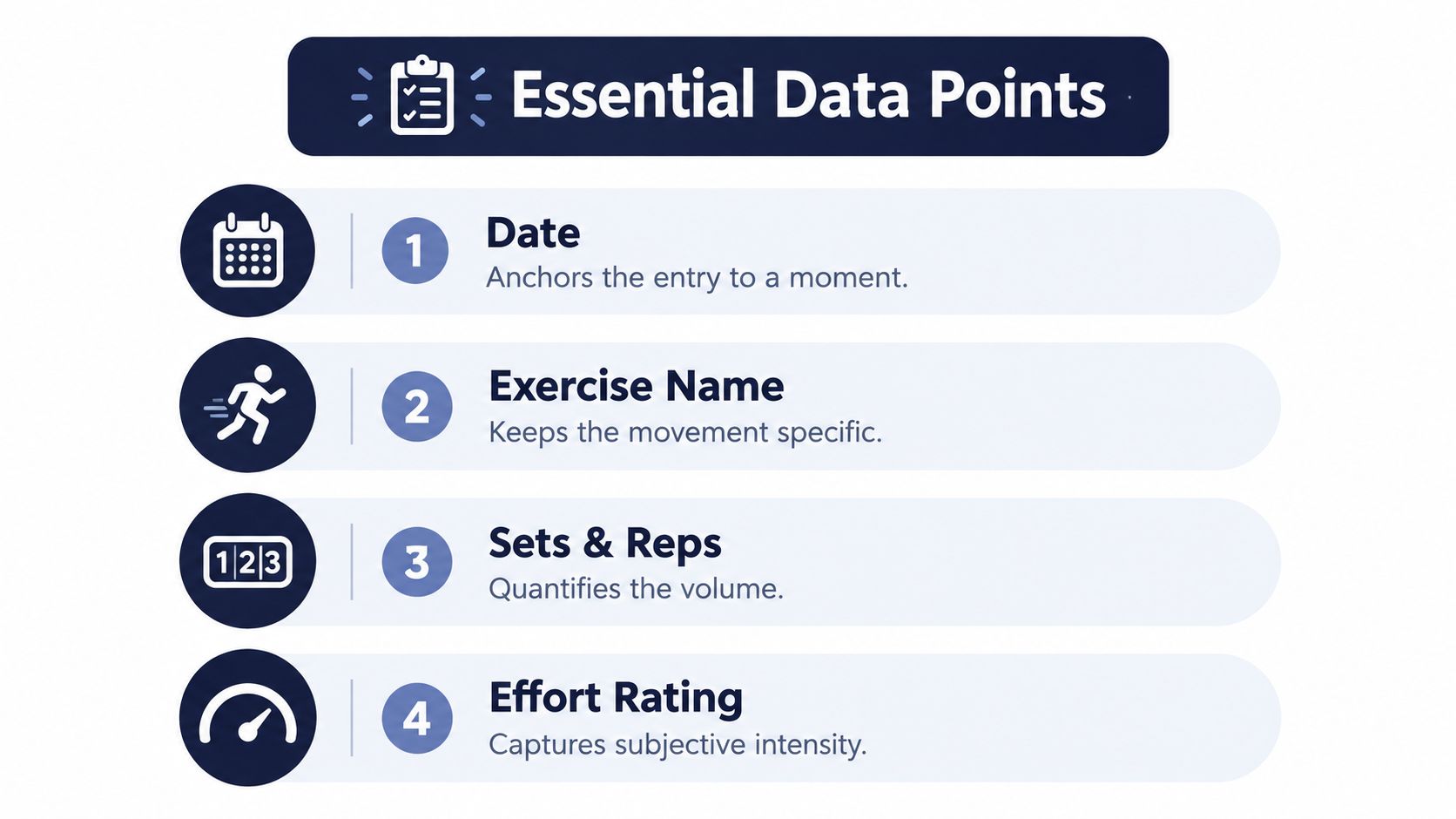
The four fields that earn their place
- Date. This ties the session to a real day, which helps when the week starts to blur.
- Exercise name. “Squats” and “lunges” are different movements, and the label keeps the record honest.
- Sets and reps. This turns effort into a count you can compare later.
- Effort rating. A quick easy, medium, hard note, or a simple number, captures how the session felt.
Those four fields do most of the work because they support self-monitoring, the habit of recording what you did so progress stays visible meta-analysis summary. The 2016 meta-analysis in Psychological Bulletin synthesized 138 studies with 19,951 participants and found that self-monitoring reliably improves goal attainment, especially when progress is recorded more often and written down by hand meta-analysis summary. The point is not fancy tracking. The point is that the act of writing helps small sessions add up on the page, like pins going into a shared wall one by one until the pattern becomes obvious.
What to add when the day needs context
A short note can explain a strange session without turning the page into a report. Maybe your knees felt stiff after a long walk. Maybe a meeting ran late, so you cut the set short. Maybe your push-ups felt easier after a warm-up flow.
Practical rule: record the session, then add one sentence if the context would help you make sense of it next week.
A variation note helps too. If you moved from knee push-ups to full push-ups, write that down. The goal is not a lab notebook. The goal is a record that shows how your accumulation is building, even when each session looks small on its own.
Paper Spreadsheets or a Shared Wall
The right format depends on what helps you keep going. Some people want the fastest possible entry. Others want a visual record they can't ignore. A few want both.
| Format | Entry Speed | Visual Accumulation | Shareability | Best For |
|---|---|---|---|---|
| Pocket notebook | Very fast | Low to medium | Low | People who like pen and paper |
| Google Sheets | Fast once set up | Medium | Medium | People who want sortable data |
| Shared visual wall | Fast and highly visible | High | High | Small groups and accountability |
A notebook is the easiest place to scribble a quick log, and that tactile feel can make the habit stick. Its weakness is visibility. The evidence is there, but it stays buried in pages.
A spreadsheet is better at sorting and reviewing. It can show patterns cleanly, especially if you care about comparing movements across weeks. But it can feel emotionally flat. It tells you what happened, not what it looked like when your effort kept piling up.
A shared wall changes the mood. Each set becomes visible to other people, and that gives the log a social shape. For readers who want a simple app-based version of that idea, this workout journal app guide is a useful reference point. The important thing is not the tool itself, but how clearly it shows accumulation.
Matching format to personality
If you like privacy, use paper or a spreadsheet. If you're motivated by being seen, use a shared wall. The format should fit the way you behave, not the way you think a disciplined person would behave.
The shared-wall idea matters because it turns accumulation into something you can glance at. A notebook hides the row. A spreadsheet charts it. A wall puts it in front of you.
A Week of Logging From Blank Slate to Visible Wall
On Monday morning, the log starts empty. That's normal. The first entry doesn't need to be impressive, it just needs to exist.
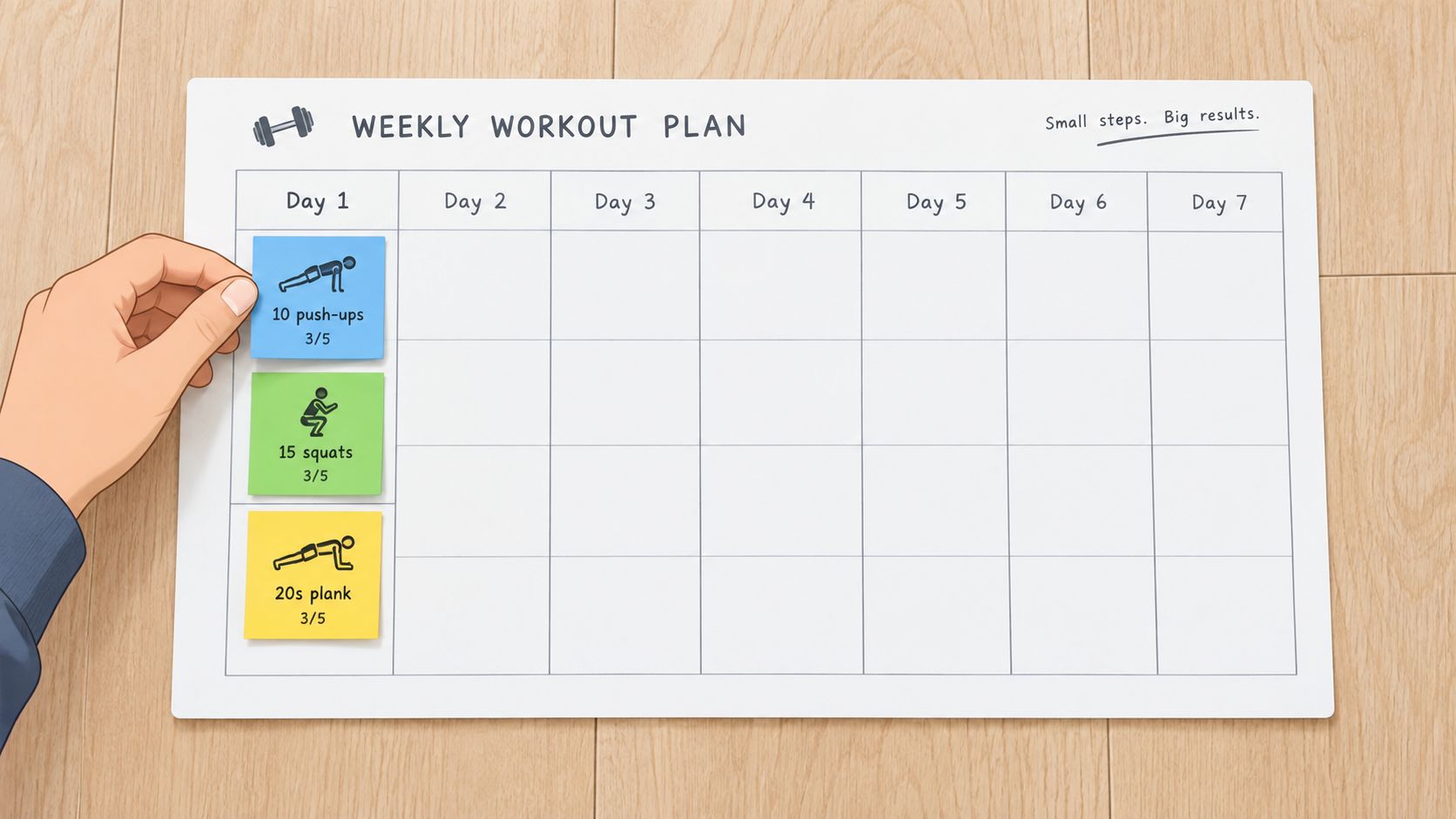
Day 1 might look like this, 10 push-ups, 15 squats, and a 20-second plank, logged as three colored tiles with an effort note of 3 out of 5. Day 2 could be a 4-minute mobility flow, 12 incline push-ups, and 10 glute bridges, with effort marked 2. Day 3 gets a plain rest gap, because honest gaps matter too.
By Day 4, the entries start to show rhythm. Maybe 8 push-ups, 8 squats, and two short sets between meetings, with effort at 4. Day 5 adds 15 push-ups, 20 squats, and a 30-second plank. Day 6 might be 10 incline rows using a table and 20 squats, again at effort 4.
A 6-minute circuit on Day 7 brings the week to a close with 5 movements, 3 rounds, and effort at 5. The details aren't the point by themselves. The stack is the point.
By Sunday evening, the wall shows about 22 tiles, with different colors and obvious clusters on busier days. The rough total, around 250 reps across the week, becomes real only because it's stacked in front of you. A blank spreadsheet can hold the same number, but the wall lets you feel it.
That's the useful part of a shared wall. It doesn't just count. It shows density, rhythm, and repeatability. It tells you when effort was spread across the week instead of hidden in a single heroic day.
Tracking What Actually Matters for Micro Workouts
Micro workouts need a different scorecard from traditional lifting. Scale weight will not tell you whether you did push-ups at lunch and squats before dinner, and one-rep max thinking misses the goal, which is consistency rather than peak load.
The numbers worth watching are frequency, effort, variety, and session shape. If you can see how often you trained, how hard it felt, and which movement patterns showed up, you get a clearer picture of what is building over time. Exercise-snack research and bodyweight micro-workout reviews both point in the same direction, short bouts spread through the day matter because they make repeated effort easier to notice and repeat exercise-snack review, bodyweight micro-workout review.
Practical rule: treat reps and sets as accumulated effort, not as a test of toughness.
Short bouts can improve cardiorespiratory fitness and some metabolic markers, while body mass and triglycerides may stay fairly unchanged over short interventions bodyweight micro-workout review. A journal should reflect that reality. It should reward repeated effort, the same way a wall with many small tiles shows a growing pattern better than one big isolated block.
A simple rubric makes the pattern easier to read. Give yourself one point for each logged session. Add one more if the effort was 4 or higher. Add another if the day included a push, pull, hinge, squat, and core pattern. Then the weekly score becomes a quick snapshot of both volume and quality, like checking the shape of a mosaic instead of staring at one tile.
For movement ideas that fit this style, bear crawl exercises show how a bodyweight pattern can stay short, clear, and easy to record. The point is not a perfect number. It is making sure the journal captures the kind of work that stacks up.
Why a Small Group Changes the Whole Equation
A journal gets harder to ignore when other people can see it. One person logs alone for a while, then a shared wall appears, and the empty spaces start to matter. The missed entry is no longer hidden in a private notebook. It sits there like an unfilled spot on a kitchen checklist.

Self-monitoring research supports logging for adherence, and a shared wall adds a gentle layer of social visibility on top of that. You are not trying to collect praise. You are making effort easy to see, so it can be repeated instead of forgotten.
Bodyweight training fits this setup well because the work is small and easy to mark. A few push-ups, a short squat set, a quick plank, each one becomes a tile on the wall or a line in the log. No special room is needed, and no long setup gets in the way.
Keep the group small
Two to four people is enough. A larger group can make the wall feel anonymous. A smaller one may not create enough visibility to keep the log alive.
Silent logging still works. Shared logging works differently. It turns consistency into something other people notice, like a row of stones forming a path. That is often the missing piece when private motivation runs out.
Getting Started and Reviewing After Thirty Days
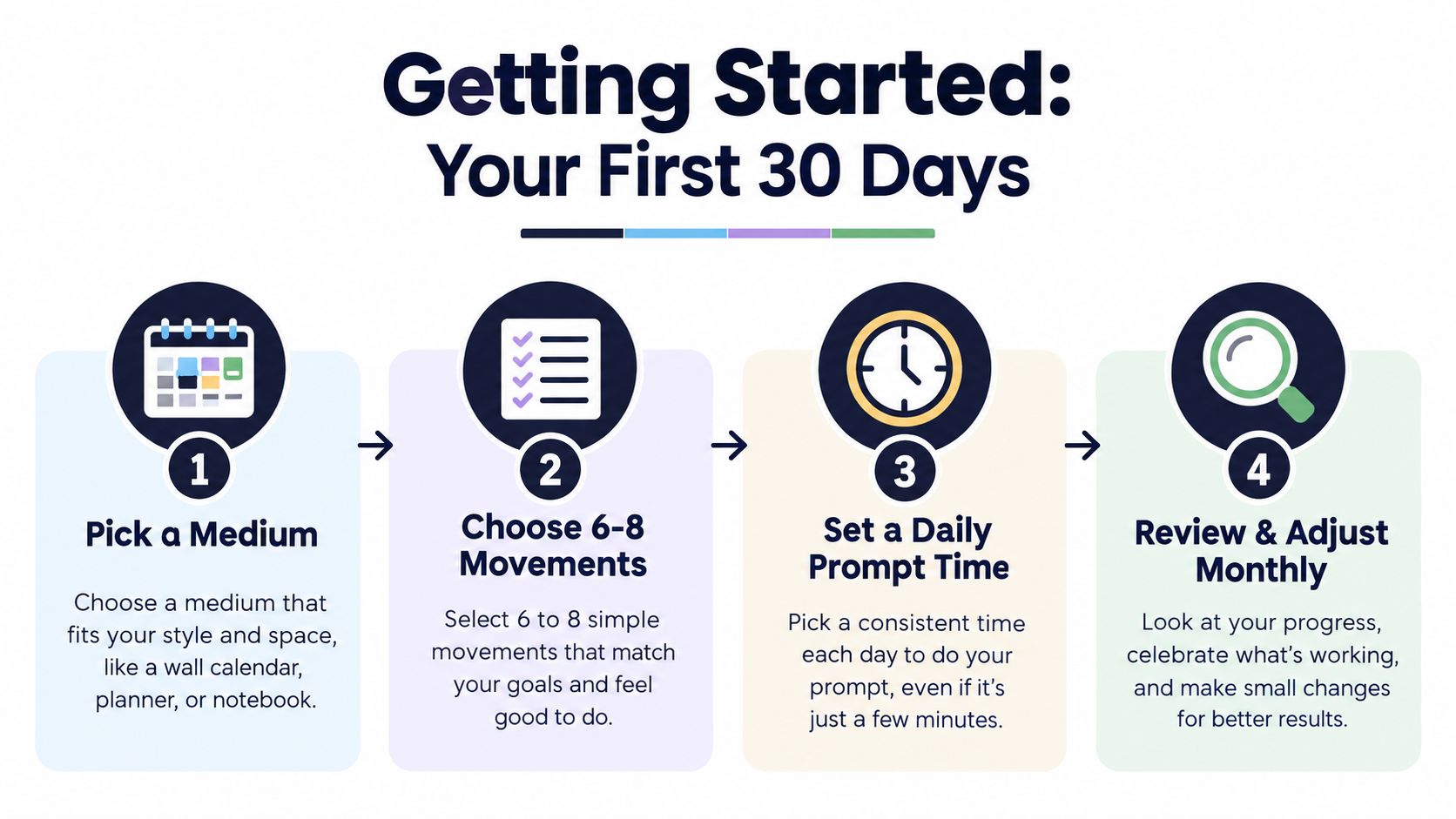
Start small enough that you won't talk yourself out of it. Pick one medium, paper, spreadsheet, or a shared wall. Choose six to eight movements you'll use, then set one daily prompt time so the log gets a predictable cue.
A simple starter checklist looks like this:
- Pick a medium. Use the format you're most likely to open on tired days.
- Choose 6 to 8 movements. Mix push, pull, squat, hinge, and core patterns.
- Set a daily prompt time. Link it to something that already happens, like coffee or a lunch break.
- Decide on one primary metric. Use sessions, reps, or effort, not everything at once.
- Invite one or two accountability partners. Keep the group small enough to stay real.
After thirty days, review the journal in ten minutes, not an afternoon. Count total sessions, notice which movement collected the most reps, mark the days you missed, and choose one tweak for the next month. That tweak might be a harder variation, a second micro session, or just a better prompt time.
Practical rule: review the record as evidence of effort, not as a verdict on your fitness.
That mindset keeps the journal useful. It shows what accumulated, where the gaps were, and what's ready to change next. If the page makes you want to open it again tomorrow, it's doing the job.
SuperStrong is built around the same idea, short bodyweight sets that become visible as they stack up on a shared wall. If you want a simple way to log reps, see progress without graphs, and stay accountable with a small group, visit SuperStrong and see how the shared-wall approach fits into your day.
Composed with Outrank app