Squat Challenge for Beginners: Your Complete Plan
 14 min
A successful squat challenge for beginners means completing 2–3 nonconsecutive training days per week with controlled technique, not chasing a large daily repetition total. Start with 2–3 sets of 6–12 pain-free repetitions, then progress only when your form stays consistent.
You may be looking at a calendar, a fitness app, or a list of ambitious promises about completing more squats every day. The first session feels manageable, but soreness appears quickly, your knees feel uncertain, and a missed day starts to look like failure. That approach turns a simple strength habit into a test of willpower.
A better plan treats squats as a small, repeatable practice. You'll build confidence with bodyweight repetitions, use short sets when your schedule is crowded, and measure progress through control, consistency, range of motion, and gradually harder variations. A squat challenge should make it easier to keep training, not give you another reason to quit.
Table of Contents
- Why Most Squat Challenges Fail Before They Start
- Mastering the Bodyweight Squat Form
- Building Your Weekly Training Schedule
- Fitting Short Squat Sets Into a Busy Day
- Progressions and Variation Options
- Common Mistakes and How to Fix Them
- Staying Motivated and Measuring Success
Why Most Squat Challenges Fail Before They Start
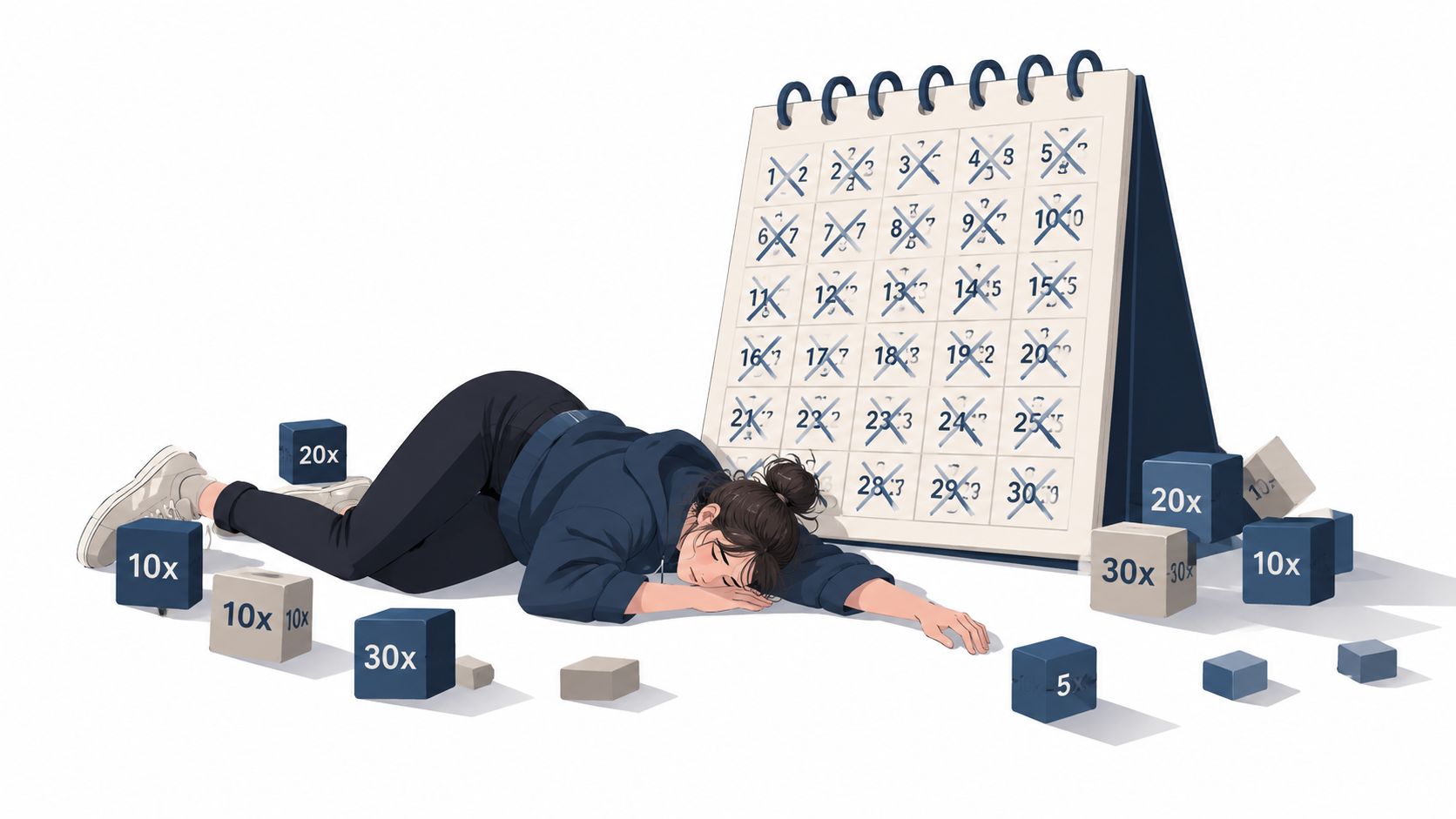
Many beginner programs make volume the headline. They promise a fixed daily target and encourage you to add repetitions whether your movement feels ready or not. That format looks motivating on paper, but it ignores the difference between completing repetitions and completing useful, technically sound repetitions.
A new trainee often responds to high daily volume with soreness, fatigue, or rushed mechanics. The knees may drift inward, the heels may lift, or the torso may collapse as the set continues. Once every session feels punishing, missing a workout becomes relief rather than a temporary interruption.
A smaller target creates a stronger habit
The World Health Organization's physical activity guidance recommends muscle-strengthening activity involving all major muscle groups on at least 2 days per week for adults aged 18–64. It also recommends 150 minutes of moderate-intensity aerobic activity weekly, or 75 minutes of vigorous activity, with additional benefits associated with increasing moderate activity to 300 minutes weekly.
That guidance doesn't make a daily squat total necessary. It supports a more practical structure: train on two or three nonconsecutive days, keep the initial sets modest, and allow recovery between sessions. Squats can be a useful entry point, but they shouldn't replace walking, aerobic movement, or strengthening work for the upper body and trunk.
Practical rule: Finish each set feeling that you could perform a little more with good form. A beginner challenge should leave you ready for the next session.
A consistent bodyweight routine can also be effective without a gym membership or equipment. The important distinction is that bodyweight squats still count as resistance training. Technique, recovery, and progression matter more than an arbitrary target such as completing a large number every day. For broader context, see whether bodyweight training is enough.
Mastering the Bodyweight Squat Form
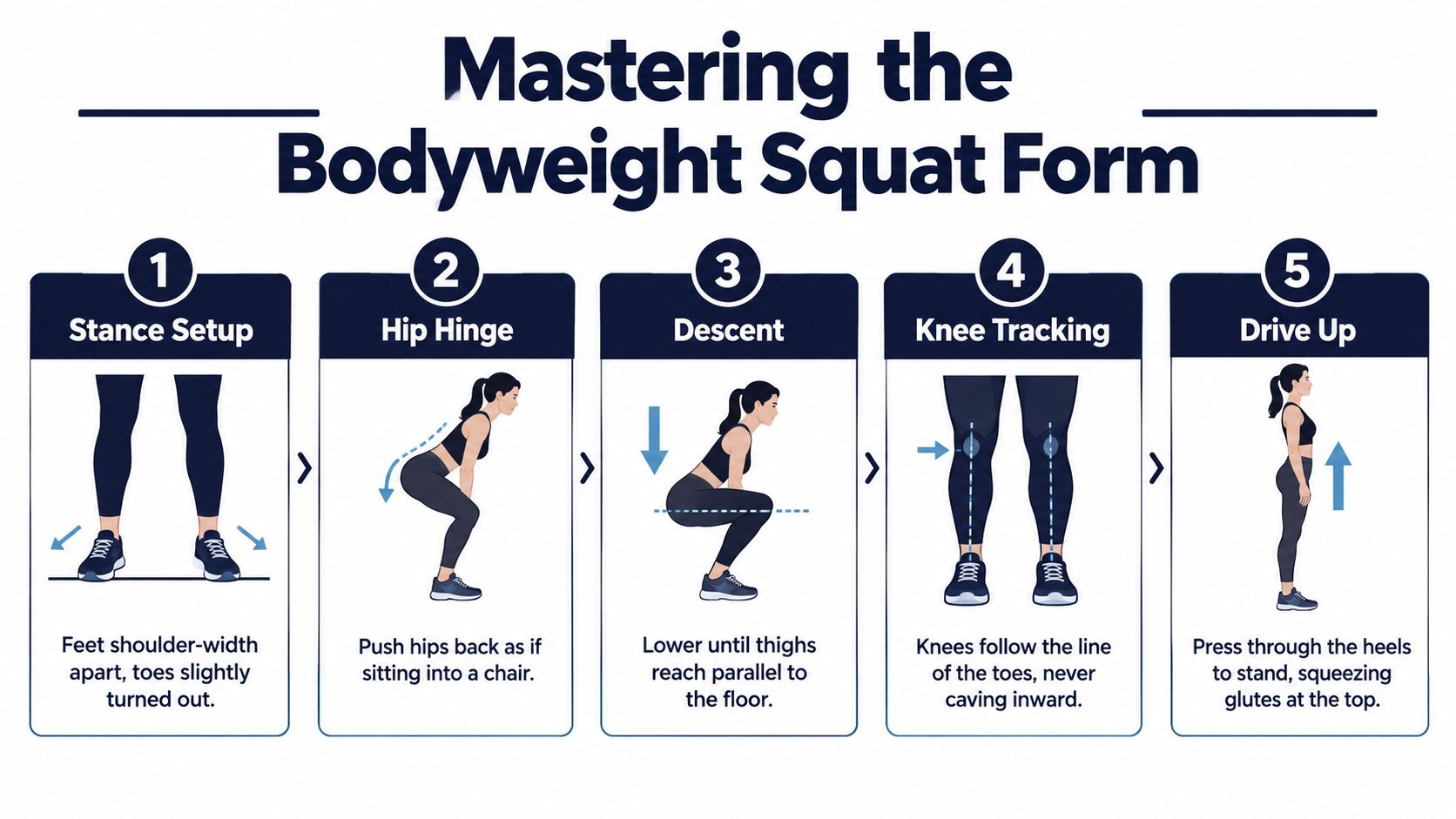
Your first priority is to make every repetition predictable. Use a chair or sturdy box behind you if balance is uncertain. The support gives you a target for depth and lets you practice controlling the descent without treating every repetition as a test of flexibility.
Set your position before moving
Stand with your feet approximately hip- to shoulder-width apart. Turn your toes slightly outward, brace your trunk without holding your breath rigidly, and spread pressure across the heel, the base of the big toe, and the base of the little toe.
Begin the descent by moving your hips and knees together. Think of lowering yourself into a chair rather than pushing your hips dramatically backward or dropping straight down. Keep your whole foot planted and let your knees travel generally in the direction of your second toes.
Choose the deepest controlled position
Lower only as far as you can maintain balance, heel contact, and a controlled spine. A deep squat isn't automatically a better squat if you lose control at the bottom. Your usable range depends on your ankle mobility, hip structure, balance, and trunk control.
The ACE bodyweight squat exercise guide supports using a pain-free range and controlling the movement rather than forcing a preset depth. Rise by extending your hips and knees together, maintaining foot pressure as you return to standing.
Use these checks during practice:
- Feet stay grounded: If your heels lift, reduce depth or use a supported squat.
- Knees track cleanly: They don't need to stay perfectly still, but they shouldn't collapse inward.
- Torso remains organized: A slight forward lean can be normal. A sudden fold or loss of control means the variation is too difficult.
- Pain stays absent: Muscle effort and mild fatigue are different from sharp or escalating pain.
Two or three controlled sets of 6–12 repetitions provide a useful starting range. If you lose balance, experience sharp pain, or can't control the final repetitions, stop the set and regress to a chair-assisted or box squat.
Building Your Weekly Training Schedule
A schedule works when it matches the week you have, not the ideal week you wish you had. Place squat sessions on nonconsecutive days and attach them to an existing routine, such as after brushing your teeth, before a shower, or during a regular afternoon break.
Start with a dose that feels almost too manageable. That restraint gives you room to learn the movement, recover, and return without dreading the next session. You can increase repetitions, add a set, slow the lowering phase, or choose a harder variation, but only one change needs to happen at a time.
A simple weekly rhythm
| Day | Focus |
|---|---|
| Monday | Squat practice, 2–3 controlled sets |
| Tuesday | Walking, mobility, or rest |
| Wednesday | Squat practice, repeat the manageable dose |
| Thursday | Walking, mobility, or rest |
| Friday | Optional third squat session if technique is stable |
| Saturday | Easy aerobic movement or rest |
| Sunday | Rest and prepare for the next week |
The third training day is optional, not a requirement to prove commitment. If Monday and Wednesday leave your legs unusually fatigued, keep Friday as recovery. If you feel fresh and your technique remains steady, use Friday for practice rather than a maximum-effort test.
Progress by readiness
Record the quality of the final repetition. When your current sets feel controlled, your range is comfortable, and you recover well, choose one progression:
- Add a small number of repetitions within your planned range.
- Add another controlled set.
- Slow the lowering phase while keeping the ascent smooth.
- Move from a chair squat to a free bodyweight squat.
- Try a more demanding variation only after the basic movement is reliable.
This is how a squat challenge becomes progressive resistance training instead of a calendar-based endurance stunt.
Fitting Short Squat Sets Into a Busy Day
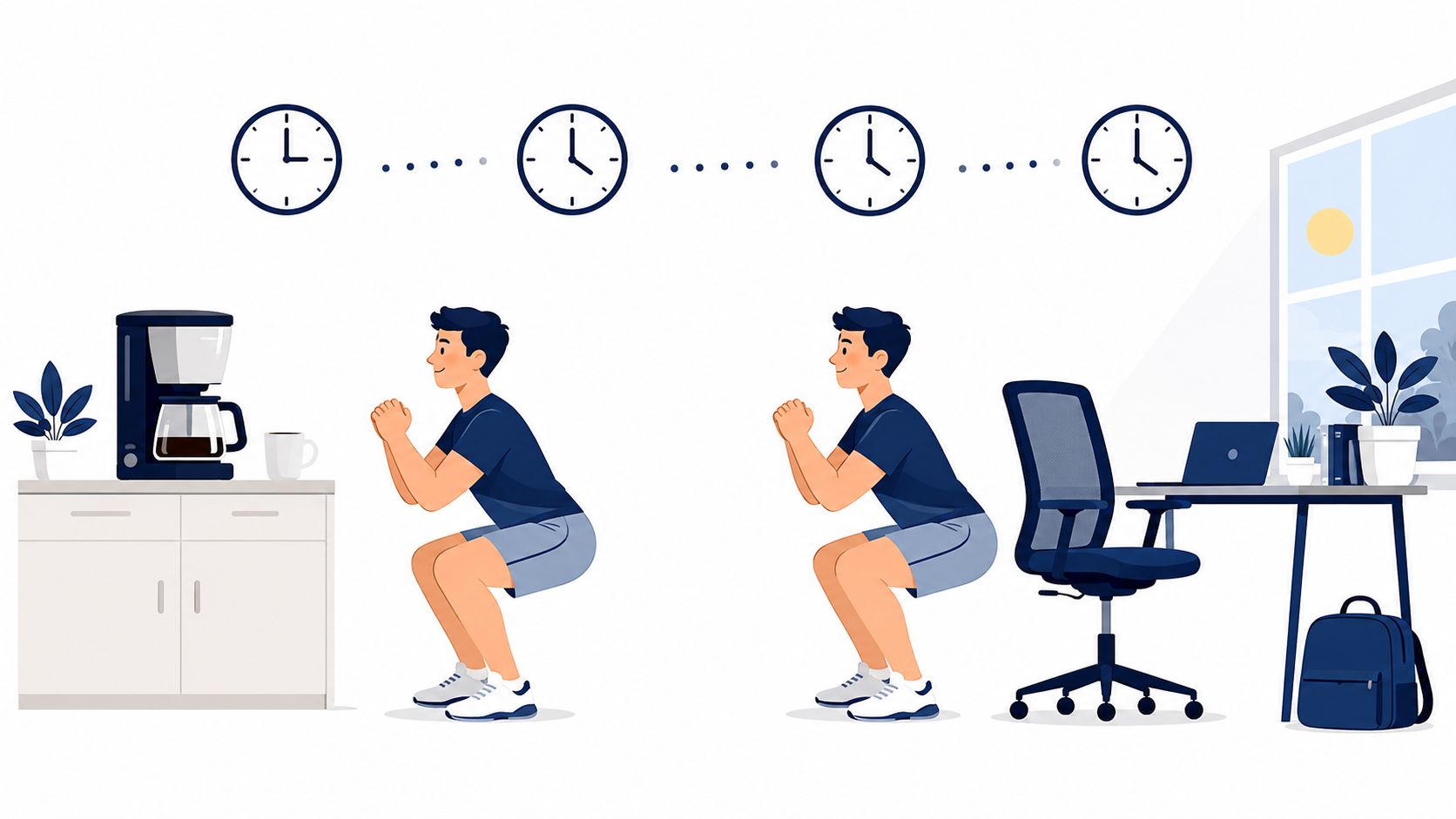
A single uninterrupted workout is convenient, but it isn't the only way to train. A short set can fit beside a kettle, between work calls, or before an evening routine. The choice depends on what helps you perform controlled repetitions consistently.
A longer session makes it easier to warm up, focus, and record one complete workout. It also creates a larger time barrier, and beginners may rush the final sets once fatigue accumulates. Multiple short bouts reduce that barrier and can make technique easier to protect, but they require you to remember to return to the movement and avoid turning every spare moment into another hard set.
Choose the format you can repeat
A single session may suit you if you prefer a clear start and finish:
- Before breakfast: Complete your planned sets after a few easy practice repetitions.
- After work: Train before sitting down, when the transition is predictable.
- At home: Keep a chair nearby so you can use a supported regression if needed.
A micro-bout format may suit you better if your day is fragmented. Perform one modest set while coffee brews, another during a break between calls, and a final set before you begin an evening task. Keep the repetitions technically controlled and stop when your mechanics start to deteriorate.
The exercise-snack evidence needs a careful interpretation. A 2026 systematic review defined exercise snacks as bouts lasting 5 minutes or less, performed at least twice daily, and found improved cardiorespiratory fitness, but not significant improvements in lower-limb strength or broader cardiometabolic outcomes, with moderate or very low certainty of evidence. Read the review of exercise snacks and their outcomes as a reason to use short bouts thoughtfully, not as proof that scattered squats automatically build substantial leg strength.
Short sets can support consistency, but they don't remove the need for progression or recovery. An at-home, no-equipment workout approach can help you organize movement around your environment, provided the plan still includes other major muscle groups and aerobic activity.
Progressions and Variation Options
Progression doesn't have to mean adding weight. It can mean controlling the same squat better, moving through a larger pain-free range, or choosing a variation that demands more balance and coordination.
Consider a beginner who starts with a chair behind them. In the first sessions, the chair provides confidence and limits depth. Once the person can lower under control without dropping onto the seat, they can lightly touch the chair and stand. Later, they can remove the chair and use a free bodyweight squat.
A practical sequence
- Supported squat: Hold a doorframe or use a chair for balance while learning the pattern.
- Box squat: Touch the seat lightly, pause without collapsing, and stand with control.
- Bodyweight squat: Remove the support while keeping the same stance and knee tracking.
- Split squat: Move one foot forward and one foot back, using support if balance is limited.
- Assisted single-leg work: Hold a stable surface and gradually transfer more effort to one leg.
- Plyometric variation: Add a jump only when landing mechanics are quiet, stable, and pain-free.
The small randomized study summarized in the bodyweight squat hypertrophy evidence compared 30 sedentary young women over 8 weeks. One group used progressive bodyweight squat variations and another used barbell back squats, with 15 participants in each group. Both groups trained 3 times per week, and both reportedly improved quadriceps muscle thickness and isokinetic knee-extension strength without a significant difference between groups for those outcomes.
That result illustrates the value of progression, but its small sample, narrow population, and short duration limit how broadly you can apply it. You can also progress through tempo. Lower slowly, pause briefly at a stable depth, then stand smoothly, but don't sacrifice balance or turn a controlled drill into a fatigue contest.
Common Mistakes and How to Fix Them
Most squat errors appear when the trainee tries to complete more repetitions than their current control allows. The repetition count then becomes the priority, while the movement shifts underneath it.
Correct the problem you can see
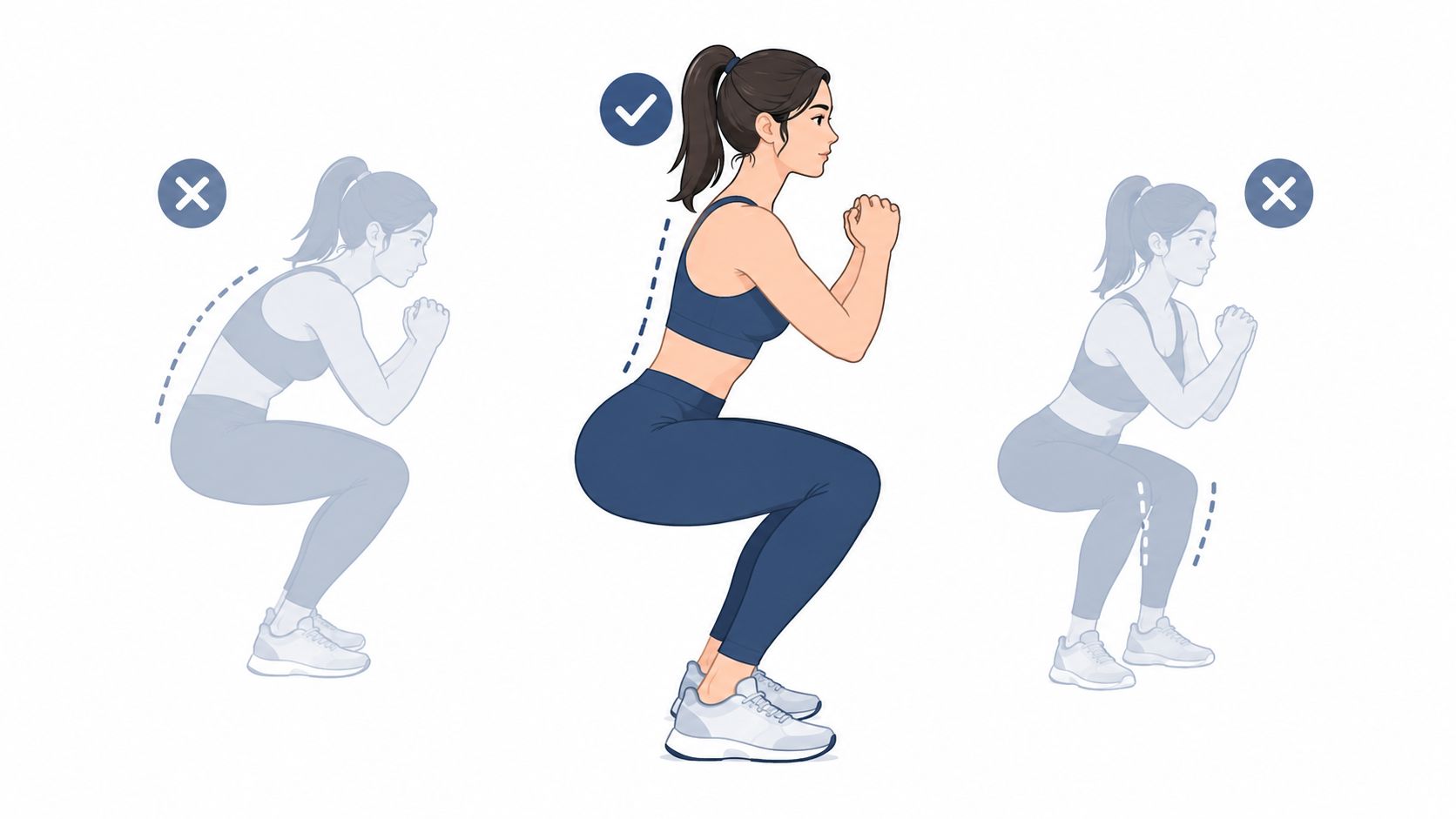
Knees collapsing inward usually means you're losing control during the descent or drive upward. Reduce the range, slow the movement, and think about keeping the knees aligned toward the second toe. A chair or doorframe can reduce the balance demand while you practice.
Heels lifting often means the chosen depth exceeds your current ankle or balance capacity. Raise the squat target, shorten the range, and keep pressure across the whole foot. Don't force your heels down by pushing into a depth you can't control.
The torso folding forward can occur when the legs and trunk are fatigued or when the squat variation is too difficult. Use a higher box, hold a stable support, and brace before descending. A modest forward angle can be normal, but an abrupt collapse isn't a useful repetition.
Know when to stop
Muscle fatigue can feel warm, heavy, or effortful. Sharp pain, sudden instability, or pain that changes your movement is a different signal. Stop rather than trying to complete a preset target, then seek clinical guidance if the problem persists or you're managing an existing condition.
Quality check: If the final repetition looks different from the first, the set has probably gone far enough.
Film a set from the side or front if you can do so safely. Look for consistent foot pressure, controlled depth, and knees that follow the general line of the toes. You don't need to chase a perfect visual standard. You do need to notice when fatigue changes the movement and respond by reducing repetitions or choosing an easier regression.
Staying Motivated and Measuring Success
A squat challenge becomes sustainable when success has more than one definition. Repetitions matter, but so do showing up on the scheduled days, using a comfortable range, and finishing a set without losing control.
Track the process in a notebook, calendar, or bodyweight workout journal. Write down the date, variation, sets, repetitions, and one brief note about technique. “Chair squat, controlled” tells you more than a total that hides rushed or painful repetitions.
Measure what you can influence
Use these markers:
- Consistency: Did you complete the planned training days?
- Control: Did your first and final repetitions look similar?
- Range: Can you lower comfortably without losing balance?
- Confidence: Do you need less support than before?
- Progression: Can you add a set, repetitions, tempo, or a harder variation without pain?
A shared commitment can also help when motivation fades. Tell a friend which days you intend to train, or use a simple visual record so missed sessions are visible without turning the process into punishment. For some people, an app such as SuperStrong records short bodyweight sets on a shared wall for a small group, with squat entries and a three-training-day weekly rhythm.
For the first month, keep the checklist simple: schedule two reliable sessions, add a third only when recovery is good, use a supported regression when needed, and progress one variable at a time. The strongest result is not an impressive day of volume. It's becoming the person who can keep practicing next week.
Build your squat habit with small, trackable sets that fit around real life, then use SuperStrong to log bodyweight work and share visible progress with up to four friends. Start with your next scheduled training day, choose a controlled squat variation, and record the set before you move on.