Bend and Reach Stretch: A Practical Mobility Guide
 14 min
You stand up from your laptop, take two steps, and your back feels like it's been folded in half for an hour. Your hamstrings aren't the only thing talking, your hips are stiff, your shoulders are rounded, and the first instinct is usually to grab your toes and see how far you can force it. That's exactly where a bend and reach earns its keep, not as a party trick, but as a quick check-in you can repeat between meetings without turning it into a contest.
Table of Contents
- Why This Simple Movement Stays Worth Doing
- What Bend and Reach Really Tests in Your Body
- Three Ways to Perform It With Clean Form
- Common Mistakes and How to Fix Each One
- Pairing It With an Exercise-Snack Routine
- Stop Rules and Variations for Common Symptoms
Why This Simple Movement Stays Worth Doing
A useful reset, not a performance test
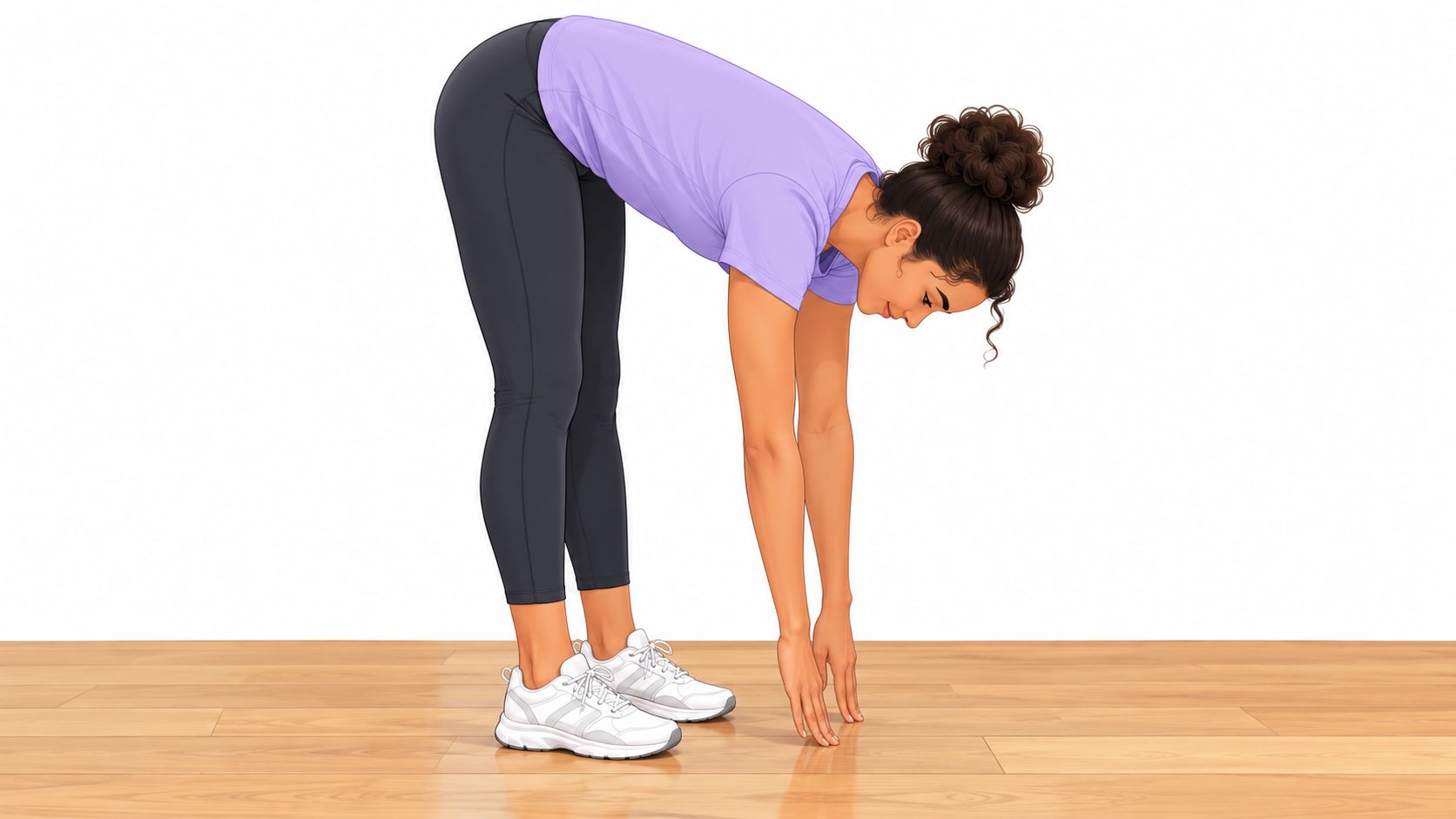
Many treat the bend and reach like a leftover school fitness test. That misses the point. Used well, it's a fast mobility check that tells you whether your body wants a small reset, a supported version, or a stop because something feels off.
I cue it for desk workers the same way I cue it for someone warming up before a walk. Stand up, soften the nervous system, and find a clean hinge. If the movement feels smoother after a few controlled reps, that matters more than whether your fingertips reach a certain landmark today.
The practical win is simple. You get a repeatable way to notice stiffness before it snowballs into that locked-up feeling later in the day. You also get a movement that can be scaled without pretending every body should look the same.
Practical rule: If the movement feels better, smoother, and more balanced on rep two or three, you're using it correctly.
What makes it different from a toe-touch race
The standard stretch version has value when it's controlled. The problem starts when people turn it into a reach-for-the-floor contest and sacrifice breath, posture, and balance to get lower. A deeper-looking fold isn't automatically a better one.
That's why this article keeps coming back to repeatable range, symptom awareness, and support options. A movement you can own for 30 seconds beats a dramatic fold you can only survive once.
What Bend and Reach Really Tests in Your Body
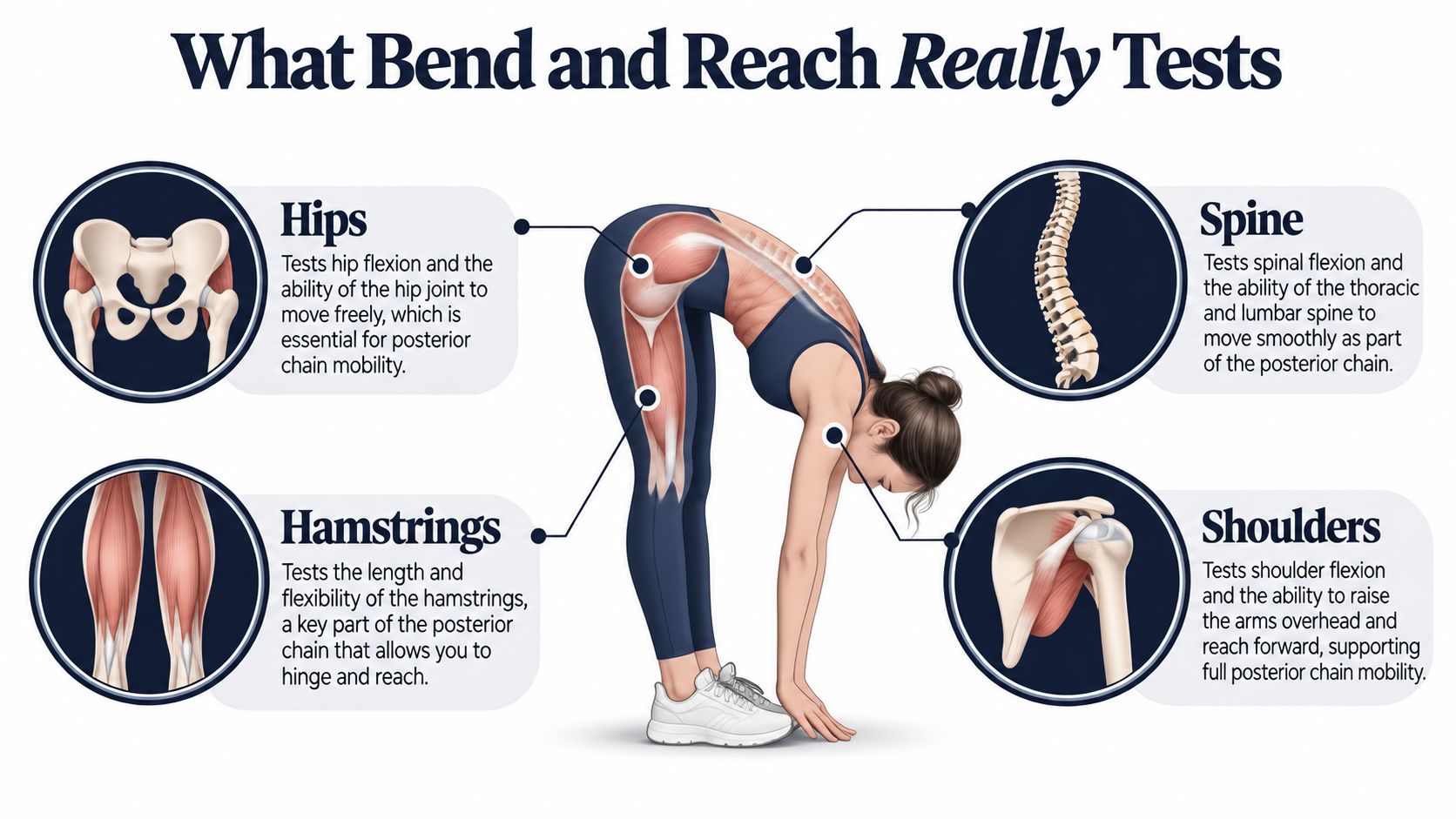
The reach is a team effort
A clean bend and reach is not a pure hamstring test. It reflects how the hips, spine, knees, and ankles share the load, which is why the same person can look different from one trial to the next depending on how the motion is organized. Segmental assessment matters because fingertip distance alone can hide what the body is doing. A study of 200 children aged 10–14 used segmental measurements to judge both the amount and the quality of the bend, and overweight status did not significantly change overall reach quantity or bend quality, although overweight participants showed a more nearly neutral knee position (PMC study).
That is the part many people miss. A deeper lumbar curve can increase fingertip distance without showing better hip mobility. If knee angle or spinal shape keeps changing, the test itself changes.
Coach's takeaway: identical setup matters more than chasing a bigger score.
Why technique changes the meaning of the movement
For a controlled assessment, keep the setup simple. Feet stay planted, knees stay as straight as possible without being forced back, arms hang, the head stays neutral, and the body folds forward slowly without bouncing. Record the fingertip position at the end of the controlled range, then repeat under the same conditions so you can compare results fairly over time.
That is also why I do not let people win the rep by wrenching through the low back. If the lumbar spine does all the work, the movement tells you less about hip or hamstring function. The cleaner the setup, the better the feedback.
Use this movement as a consistency check during the week. Same time, same support, same knee position, same breathing. Pay attention to how it feels, not just how far it goes.
A related pattern worth comparing
If you already use trunk-and-hip patterns in your warm-up, the bent-leg body twist gives you a useful contrast because it shows how much rotation, spinal control, and support you have in a different plane of motion. You do not need to turn the bend and reach into a twist. You do need to know whether your body is borrowing motion from the wrong place.
Three Ways to Perform It With Clean Form
The right version depends on the day. I coach people to choose the version they can do without bracing, because clean shape matters more than forcing depth.
Barefoot floor reach
This is the classic version. Stand with your feet about hip-width, let your arms hang, and soften your knees just enough to avoid locking them. On the exhale, send your hips back and let your spine lengthen forward, then reach toward your shins or feet without bouncing.
Hold the end range for two or three calm breaths, then come back up slowly. The endpoint should feel like a working stretch, not a strain. If your breath gets stuck or your heels start to rock, you've gone too far.
Good floor cue: hips back, long spine, reach comfortably.
Chair-supported reach
Use this version if you are new to the movement, if standing balance feels shaky, or if a long day at a desk has left your body stiff. Stand in front of a sturdy chair, keep one hand or both hands near the seat, and hinge back until your torso is at a comfortable angle. The chair gives you feedback without forcing depth.
Keep the neck long and the ribs from flaring forward. The point is not to lean on the chair and dump your weight into it. It is to stay organized while you fold.
Wall-anchored reach
The wall version helps when dizziness, fear of falling, or general instability gets in the way. Stand an arm's length from a wall, place one hand lightly on it, and use that contact to guide a small hip hinge. The goal is not to press hard. It is to stay oriented while you fold.
If you start feeling floaty, shorten the range and keep your eyes on a fixed point. If the wall contact turns into a crutch and you are yanking through the shoulders, back off.
| Bend and Reach Variations at a Glance | Best For | Stop If |
|---|---|---|
| Barefoot floor reach | People who can hinge with steady balance | Breath gets held, low back pinches, or heels rock |
| Chair-supported reach | Beginners, older adults, cautious movers | You feel strain in the neck or a sharp pull in the back |
| Wall-anchored reach | Dizziness, balance concerns, first-time practice | You feel unstable even with support |
If you want a second drill with the same small-dose, clean-shape logic, the walk out exercise uses it too. Support the pattern first, then build range later.
Common Mistakes and How to Fix Each One
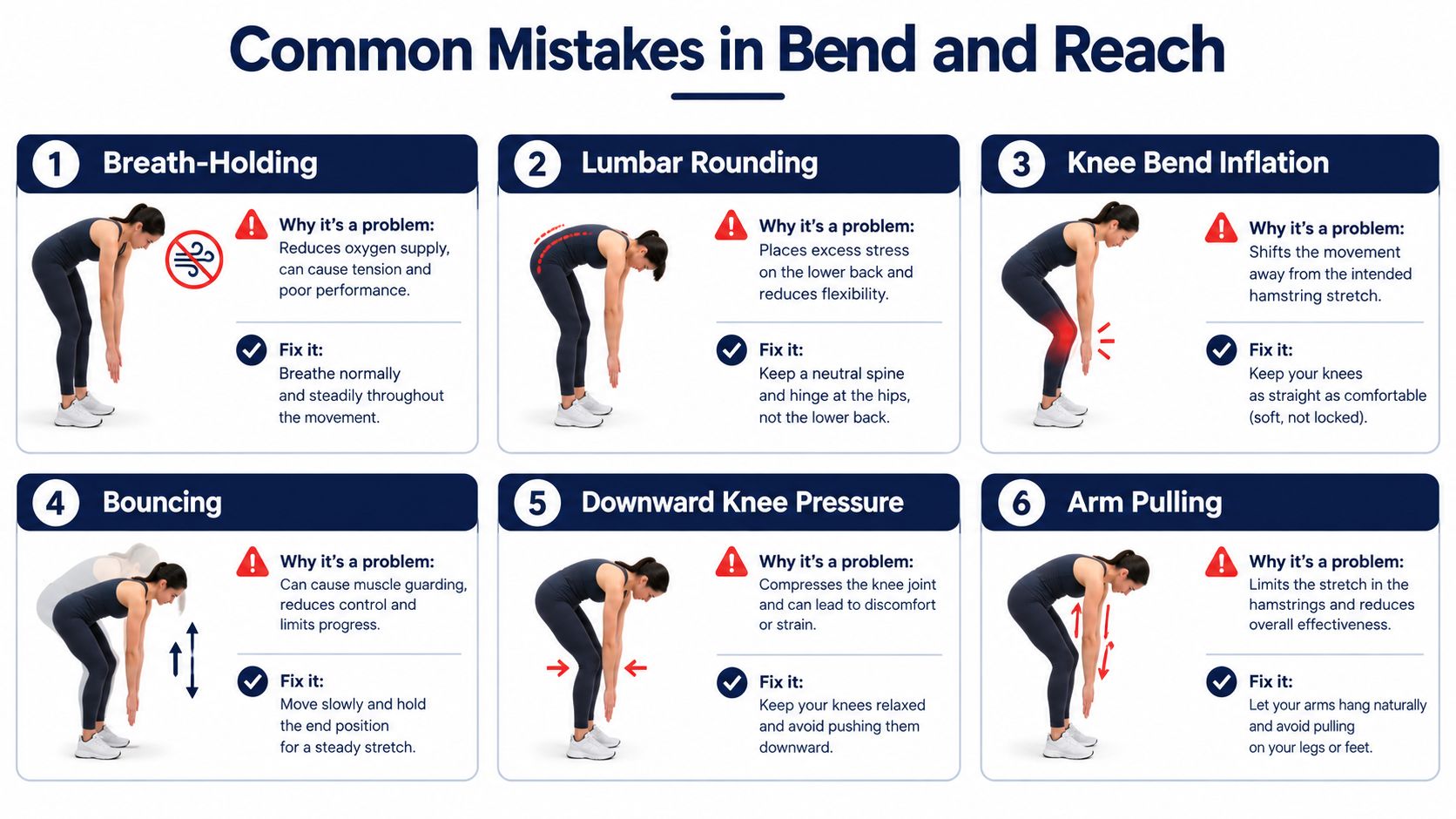
The first two errors are the ones I stop fastest
Breath-holding and aggressive lumbar rounding sit at the top of the list because they make the movement feel harder than it needs to be. When someone locks their breath, the whole trunk braces and the fold gets jerky. When the low back rounds hard, the movement often stops being a hip hinge and turns into a spine dump.
The fix is boring and effective. Exhale as you fold, keep the chest soft, and think about moving the hips back before you reach down. If the fold gets smaller but smoother, that's a win.
Neck strain often tags along with these first two mistakes. If you're craning the head down to chase depth, reset your gaze and let the neck stay long.
The middle mistakes are about false depth
Knee bend inflation happens when people bend the knees a lot to buy more range. Bouncing does something similar, it gives the illusion of more motion without control. Downward knee pressure is the version I see when someone tries to force the knees straighter than their tissues allow.
Those three usually show up as one thing, a reach that looks deeper but feels uglier. Correct them by freezing the knees in one honest position, slowing the tempo, and removing any spring from the bottom of the rep. The body should settle, not jerk.
Simple fix: if you can't repeat it twice with the same shape, you're not testing mobility anymore.
The last error is chasing depth for its own sake
The final problem is arm pulling or grabbing harder just to increase fingertip distance. That usually shifts stress into the shoulders and upper back, and it can make the whole rep look more flexible than it really is. A cleaner reach uses the arms as extensions of the hinge, not levers to drag the body lower.
The blunt truth is that the best version often looks smaller than the worst version. Balance, breath, and joint position matter more than fingertip distance. If you want one phrase to remember, use this, more reach is not always better.
Pairing It With an Exercise-Snack Routine
Use it as a small interrupt, not a full workout
The bend and reach fits the exercise-snack idea because it is short, easy to start, and simple to repeat during the day. The research behind exercise snacks is more restrained than the hype. A 2025 review of 11 randomized trials involving 414 participants found gains in cardiorespiratory fitness for inactive adults and muscular endurance for older adults, while clear improvements were not found for muscular strength, body fat, blood pressure, or blood lipids (BJSM review).
That makes bend and reach a useful interruption, not a full training plan. It helps break up sitting, rehearse a hip hinge, and keep the body moving with less friction. It does not replace walking, resistance training, or clinical rehab when those are needed.
A realistic weekly pattern
Keep the cadence simple and the target small. On three training days, do one to three controlled bend and reach reps after a long sitting block, between meetings, or before you leave your desk. On the four rest days, use the movement once if you feel stiff, or skip it if you already feel fine.
A separate 2025 synthesis covered 33 studies and 1,118 participants, though the median study size was only 24 people and intensity, motivation strategies, adverse events, and intervention fidelity were often underreported. The takeaway is promising, but it is not a magic wand.
Best use: keep the reps brief, comfortable, and consistent, then build the habit before you build ambition.
How to make the habit stick
Log the set the same way each time, even if it was tiny. A shared wall app like SuperStrong works best when the habit is visible, simple, and tied to real moments in the day, like after your first call or before dinner.
If you also want another short bodyweight option, the bear crawl exercises pattern pairs well with this kind of scattered routine because it keeps the focus on small, repeatable effort rather than a perfect session.
Stop Rules and Variations for Common Symptoms
Use symptoms to choose the version
If your low back pinches, stop the rep and shorten the range. That usually means the fold got too spinal and not enough hip-driven. Swap to the chair-supported version, breathe out, and keep the spine longer on the way down.
If your knees hurt, don't force them straighter. Soften the knees a little and remove any pressure aimed downward through the joint. Pain in the knee is a sign to back off, not to push through for a cleaner-looking reach.
If you feel dizzy, end the set right away and stand still until it passes. Then use the wall-anchored version next time, or skip the movement for the day if the dizziness repeats.
Know when to modify and when to stop
If your shoulders feel tight, check whether you're pulling too hard with the arms. Let the arms hang heavier and stop at a shallower range. If the shoulder discomfort is sharp, persistent, or linked to reaching rather than the fold itself, that's not a cue to grind harder.
Stop rule: pain, numbness, or loss of balance means the set is over.
For older adults and beginners, repeatable pain-free movement and confidence in balance are valid wins. You do not need maximum reach to get value from the drill. You need a version you can repeat tomorrow without flinching.
If you want a simple way to keep bend and reach honest, visible, and easy to repeat between busy hours, SuperStrong helps turn short sets into a habit you can see. It's built for quick bodyweight work and shared accountability, which makes this kind of micro-mobility feel less like a chore and more like something you'll return to. Visit SuperStrong if you want a cleaner way to track those small daily wins.