Pull Up Schedule for Beginners: A Weekly Plan
 14 min
You did three pull-ups on Monday. On Tuesday you managed one. On Wednesday you hung from the bar, pulled, got halfway, and dropped. By Friday you'd decided your arms just aren't built for this.
That story usually isn't about strength. It's about a schedule that asked for a personal best every time you touched the bar. A pull up schedule works like any other training plan: one test sets the starting point, most sessions stay well below your limit, and hard work shows up on planned days only.
Here's the plan, built around a single number you can measure this afternoon.
Table of Contents
- Your Weekly Pull-Up Schedule at a Glance
- How to Run One Pull-Up Session Step by Step
- Stop Rules and Fixes for Common Problems
- When and How to Progress Your Reps
- Rest Days, Recovery and Exercise Snacks
- Start Your First Pull-Up Week
Your Weekly Pull-Up Schedule at a Glance
Start with one test set, not a week of max attempts. Grip the bar at shoulder width, hang until your shoulders settle, pull, and lower under control. Stop one rep before your form breaks: no swinging legs, no shortened range, chin clearly over the bar. The clean reps you get become your row in the table below.
| Current ability | Training days per week | Work per session | Rest between sets |
|---|---|---|---|
| Zero strict reps | 3 nonconsecutive days | Dead hangs 3 x 10-30 s, slow negatives 3 x 3 with 5 s lowering | 1-2 min |
| 1-3 strict reps | 3 days | 4 sets, each 1 rep short of your max | 2-3 min |
| 4-7 strict reps | 3 days | 4-5 sets, stopping 2 reps short of failure | 2-3 min |
| 8-12 strict reps | 3 days | 4-5 sets plus one harder variation (slow tempo or added load) | 2-3 min |
| 13+ strict reps | 2-3 days | 4-6 sets of 3-6 reps, one day near max | 2-3 min |
Zero strict reps is a normal result, and the table treats it as a starting point rather than a verdict. Three nonconsecutive days of dead hangs for 10 to 30 seconds and slow negatives, 3 sets of 3 with a 5-second lowering, build the grip and shoulder control a full rep needs. Rest a minute or two between those sets, because the goal is quality, not exhaustion.
How the Rows Change as You Get Stronger
At one to three strict reps you move to 4 sets, each one rep short of your max, resting 2 to 3 minutes. Four to seven reps means 4 or 5 sets stopping two reps short of failure. Eight to twelve reps adds one harder variation: a slow tempo, or a small amount of added load. From 13 reps up, cut back to 2 or 3 days, run 4 to 6 sets of 3 to 6 reps, and keep one day near max so you still know where you stand.
Three training days with four rest days between them is the default for most beginners. That cadence clears the World Health Organization's physical activity guidance, which recommends adults aged 18 to 64 do muscle-strengthening activity involving all major muscle groups on at least 2 days per week. Pull-ups train the back, arms and shoulder girdle, so two or more nonconsecutive sessions put you inside that benchmark. The same guidance sets 150 to 300 minutes of moderate aerobic activity weekly, or 75 to 150 vigorous, and those minutes don't replace strengthening work. Our training plan runs on the same rhythm: three training days a week, four rest days, and a small goal on each training day.
The one number to watch: strict reps in a single test set. Not total reps, not how sore you feel the next morning.
Move up a row only after a retest proves you've earned it, either with more strict reps or the same reps with less assistance. Until then, the row you tested into is the row you train.
How to Run One Pull-Up Session Step by Step
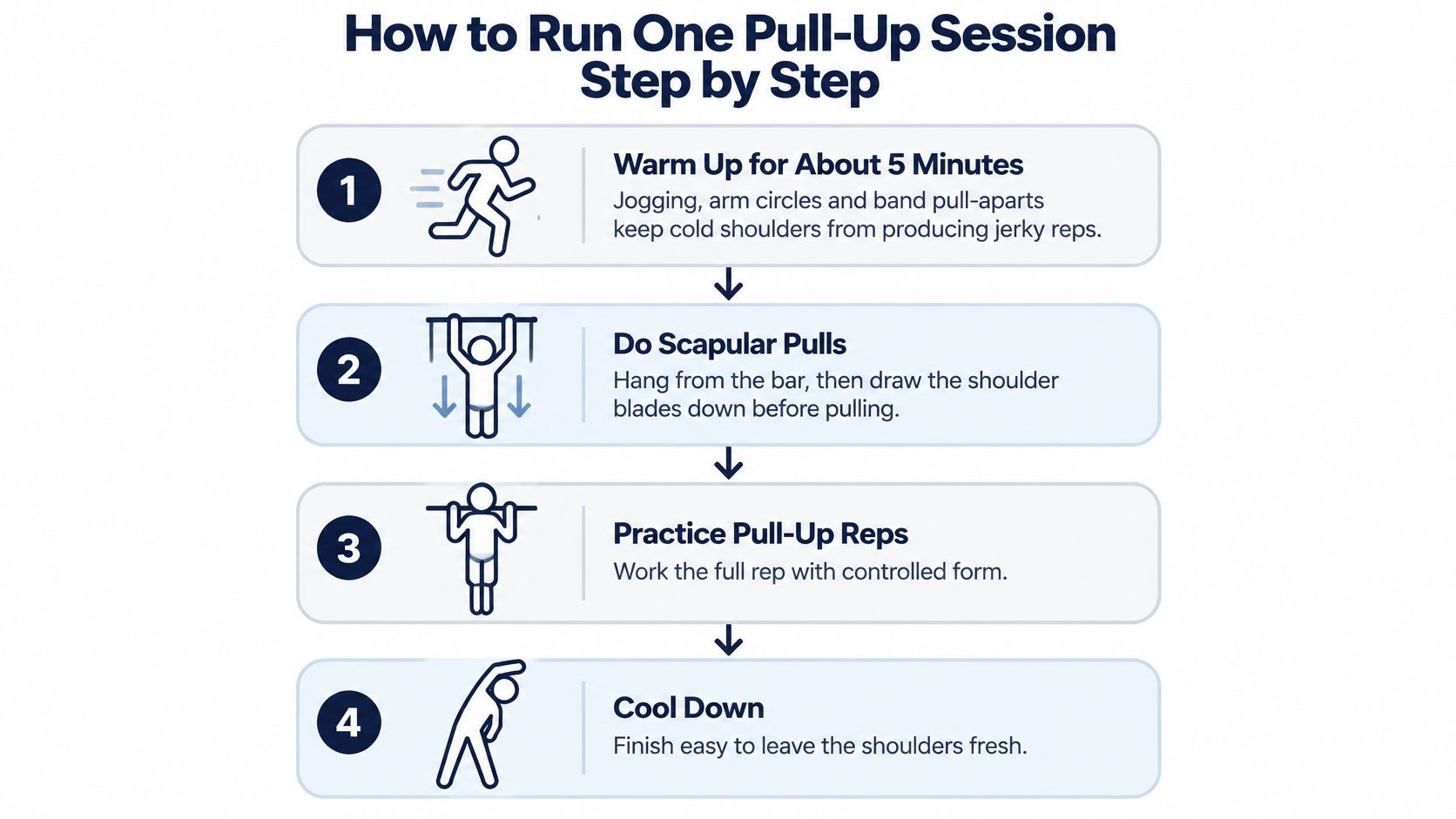
A session is six steps and fits inside half an hour. The order matters more than the effort: warm the tissue, wake up the shoulder blades, then do the work your row prescribes.
Here's the shape of it, warm-up through cool-down.
The Session in Order
- Warm up for about five minutes. Jog in place, circle your arms, and pull an exercise band apart a dozen times. Cold shoulders produce jerky reps, and jerky reps are the ones that leave you sore for three days. The common slip is walking straight to the bar.
- Do scapular pulls and dead hangs first. Hang from the bar, then draw your shoulder blades down without bending your elbows: 2 sets of 5, followed by a 10 to 30 second hang. This teaches the shoulder blades to move before the arms bend, which is the difference between a pull-up and a yank.
- Run the main work from your row. Negatives, band-assisted reps, or submaximal strict sets, all at shoulder width. If you're training at home without a bar, how to do pull-ups without a bar covers doorframes, park bars and other safe grips. The common slip here is kipping or swinging the legs to steal a rep your back can't finish.
- Rest the full interval from your row. One to two minutes for negatives and hangs, two to three minutes for strict sets. Cutting rest short turns set three into a grip contest and teaches nothing.
- Log each set by type. Strict, assisted, negative, hang, in separate columns. Keeping the types apart is how you avoid fooling yourself later when a wall of "pull-ups" is really a wall of band-assisted half reps.
- End on a clear picture of a good session. Every rep complete, a controlled lowering of about three seconds, at least one rep left in reserve, and the whole thing done in under 30 minutes so it fits between other tasks.
Stop Rules and Fixes for Common Problems
Elbow and shoulder pain is the complaint that ends most beginner schedules, and it usually starts with a grip that's too wide or a week that holds too many sessions.
One stop rule governs every set in this plan: end the set when your trunk loses its neutral position, when you can't control the descent, or when you feel pain in a shoulder or elbow. Substitute assisted or eccentric work for the missing reps instead of forcing them.
Grip choice drives that risk more than beginners expect. Biomechanical analysis of pull-up grip variations found wide-grip pull-ups relatively emphasize the latissimus dorsi, front-grip pull-ups favor the elbow flexors, and reverse-grip pull-ups produce higher proportional rotator-cuff activation. Another kinematic analysis in the same body of work linked wide and reverse techniques with movement patterns associated with greater subacromial impingement risk under high arm elevation, and a separate study warned that increased lower-back flexion can create poor posture and pain over time. That's why shoulder width is the default until your reps are clean and pain-free.
| Symptom | Likely cause | Change | Time frame |
|---|---|---|---|
| Elbow or shoulder pain | Wide or reverse grip, or too many weekly sessions | Return to shoulder-width grip, drop to 2 sessions, use negatives | 1-3 weeks |
| Lower-back pain | Excess arching or lumbar flexion | Brace the trunk, shorten sets, stop when neutral is lost | 1-2 weeks |
| Reps falling across sessions | Accumulated fatigue | Take an extra rest day and cut one set | 1 day to 1 week |
| Zero reps after four weeks | Too little assistance work | Add assisted reps or band work, keep dead hangs and negatives | 1-3 weeks |
| Kipping or swinging | Fatigue or rushed reps | Slow the descent and count only strict reps | 1 day |
| Grip gives out before back | Grip under-trained | Add dead hangs and grip work on rest days | 1-2 weeks |
| Partial reps | Sets run past form breakdown | Stop at neutral trunk and use assisted reps | 1 day |
Some rows of that table resolve overnight and others need close to a month of patience. Give any change at least two full weeks before you decide it isn't working, because a sore elbow that improves by day five will still feel tender on day six.
Tell the difference between muscle soreness and joint pain. Soreness lives in the belly of the muscle and fades in two or three days. Sharp, pinpoint pain at the elbow crease or the front of the shoulder is your signal to change the grip and cut a session.
When and How to Progress Your Reps
Progression isn't adding a rep because you feel strong on a Tuesday. It's a number you earn on a schedule, and the schedule uses a small, boring increase.
Treat 5 to 10% as your working guideline. If week one produced 20 clean reps across all sets, week two targets 21 or 22, not 30. Programming guidance published in Sport Sciences for Health puts it the same way: raise total clean repetitions by roughly 5 to 10% only when the previous week was completed without swinging or a shortened range of motion, and retest a maximum set every 3 to 4 weeks. The same evidence notes an eight-week controlled intervention in inactive men reported a 222.5% increase in pull-up repetitions in the group receiving pull-up-focused forearm training. That group and design were narrow, so treat the figure as proof that beginners can move fast, not as a target you should expect.
The Order Changes Follow
Change one variable at a time, and change them in this sequence.
- Reduce assistance first. Move from a thick band to a thinner one, then from band-assisted reps to negatives, then from negatives to singles. Fewer assists is the clearest sign of progress you'll get.
- Add reps second. Once a row's sets are clean at the target, add one rep per set inside the 5 to 10% ceiling.
- Retest last. One true max set every three to four weeks tells you whether to move up a row. Daily max attempts turn skill work into fatigue and stall more beginners than any other habit.
What Counts as Progress
Log strict reps, assisted reps and negatives separately, in whatever you already use. A simple bodyweight workout journal with the same three columns every session removes the guesswork, and it stops the quiet inflation that happens when a band-assisted triple gets written down as a triple.
Use the feel test as a second opinion. When the current week feels easy, step up to a harder one, but only if the 5 to 10% rule agrees with you. Feeling fresh after a light week is not the same as being ready for double the volume. And when the two signals disagree, the logged numbers win.
Rest Days, Recovery and Exercise Snacks
Four rest days can feel like a wasted week when your goal is one clean pull-up. So beginners add a set of max reps every morning, and by day ten the elbows ache and the numbers slide backwards.
The instinct is understandable and the logic is backwards. Repeated max testing converts skill practice into accumulated fatigue, and fatigue is what makes a rep look like a strength problem when it's really a recovery problem.
A Sample Week That Fits Real Life
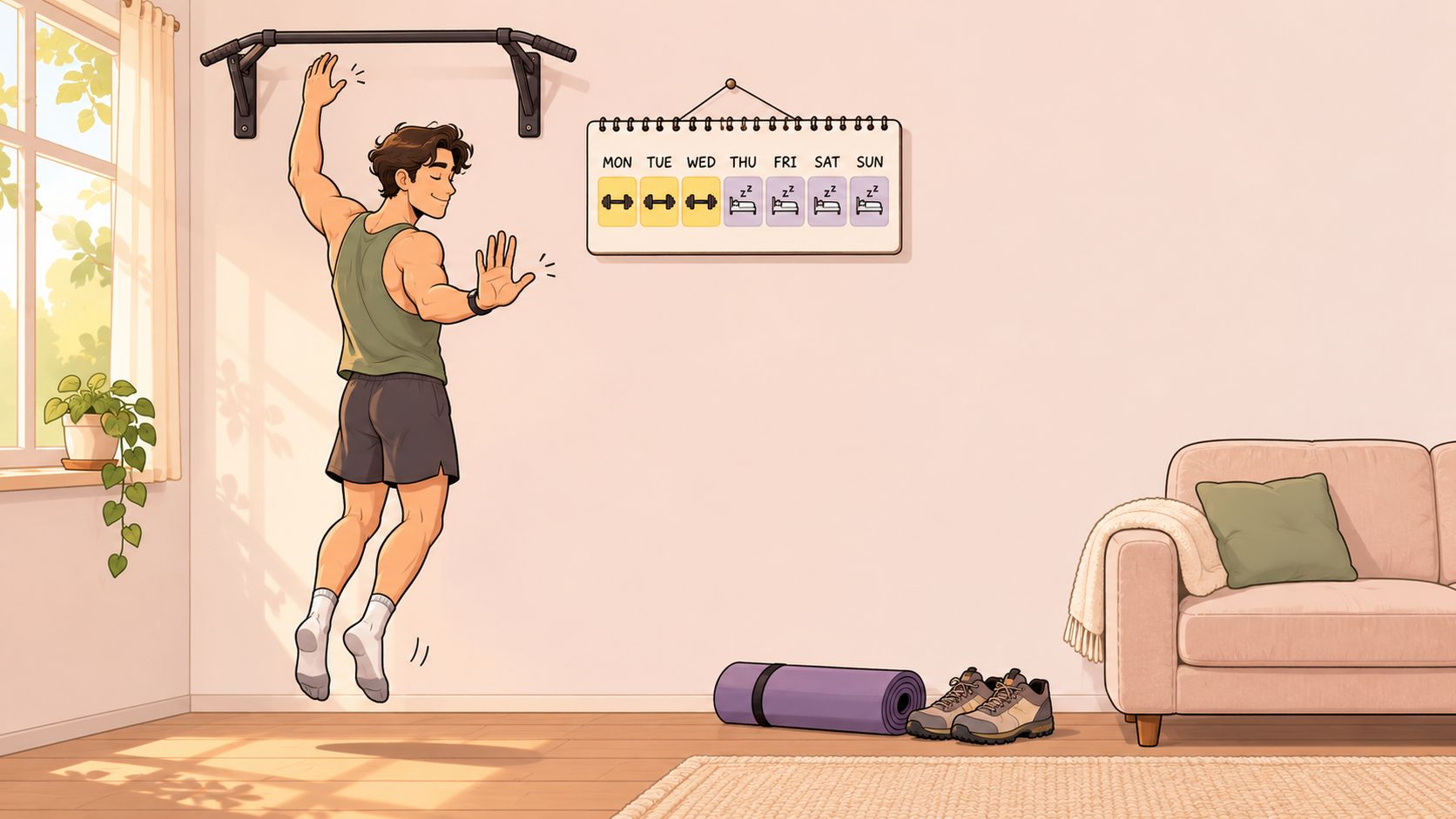
Monday pull session, Tuesday rest, Wednesday pull session, Thursday rest, Friday pull session, Saturday walk, Sunday rest. Fill the off days with a 20 minute walk, mobility work for the lats and shoulders (doorframe stretches, thoracic rotations), or a push, squat or core session from another day. Keep them easy enough that Friday still feels good.
Exercise snacks can add practice without adding fatigue, provided you keep them far from failure. A 2025 scoping review of 33 studies involving 1,118 participants on exercise snacks found wide variation in how these micro-bouts were run: the median bout lasted 120 seconds, the median frequency was three bouts per day, and the median accumulated daily duration was 16 minutes, with rest intervals ranging from 1.5 to 240 minutes. Meta-analytic evidence in the same area supports exercise snacks for cardiorespiratory fitness and other cardiometabolic outcomes, which is a broader claim than any specific pull-up prescription. Translate it this way: one or two minutes of easy hangs or scapular pulls after a phone call builds skill and consistency, and it never replaces a scheduled session.
If you want a longer treatment of how much time off a bodyweight plan needs, how many rest days per week breaks down the recovery side in more detail.
Here's the movement itself if you want a quick visual check before your next session.
Decide each training day with one rule: if you can complete the planned reps with clean form today, train. If form slips on the first set, take a light day or rest. Sleep under six hours after a hard session is a reason to take the extra rest day, not a reason to push through.
Start Your First Pull-Up Week
Week one starts at the row you tested into, no adjustments and no optimism.
- Run week one at that row. Three nonconsecutive pulling days, rest days in between. If your row says negatives, do negatives, even if you suspect you could grind out one ugly strict rep.
- Log three columns from session one. Strict, assisted, negative. A notebook, a notes app or a spreadsheet all work, as long as the columns stay the same every session.
- Book the retest four weeks out. Write the date down. You move up only when the 5 to 10% rule and the feel test both point the same direction.
Before the first session, check four things off.
- Bar at shoulder width, set high enough that your feet clear the floor at the bottom.
- A timer for rest intervals and dead hangs, so 90 seconds doesn't slowly become 25.
- A log with three columns for strict, assisted and negative reps.
- Your retest date, written where you'll see it.
If you're starting from zero, you're in the majority rather than the exception. The World Health Organization's physical activity fact sheet reports that nearly 31% of adults worldwide, roughly 1.8 billion people, were physically inactive and did not meet the minimum recommendation of 150 minutes of moderate-intensity activity per week. The same guidance states that any amount of physical activity is better than none, and that inactive people should begin with small amounts before gradually increasing duration, frequency and intensity. Three short sessions a week built on hangs and negatives is exactly that small amount.
If week one brings falling reps or pain, check the stop rules and take the extra rest day before you add anything at all.
SuperStrong turns that first week into something you can see: three training days, four rest days, and a small goal on each training day, with every pull-up set logged as a tile on a shared wall with up to four friends. Tap the big key, pick pull-ups, set your reps, and the set lands where your group can see it, so a four-week retest date stops drifting and a new personal best gets noticed. Visit SuperStrong to start week one at the row your test set earned.