How to Fit Exercise Into a Busy Day: 5-Minute Routines
 14 min
In 2022, about 1.8 billion adults worldwide, or 31% of the global adult population, fell short of the basic activity benchmark of 150 minutes of moderate activity a week or 75 minutes of vigorous activity, according to the World Health Organization's physical activity fact sheet. The shortfall is a scheduling problem.
Busy adults don't need convincing that movement matters. They need a plan that survives a Tuesday where the 6 a.m. slot gets eaten by a school run and lunch disappears into a call that runs long. Fit exercise into a busy day without waiting for a free hour: short sets, placed in advance, with a defined minimum for the days that fall apart. Decide that minimum before the week crowds in, so a missed block still counts and the routine holds.
Table of Contents
- How Much Exercise a Busy Week Really Needs
- Bodyweight Sets for Tight Spaces and Short Breaks
- Map Your Day and Plan for the Bad Days
- Turning Breaks Into Movement Snacks
- Start Your First Busy-Day Week Today
How Much Exercise a Busy Week Really Needs
Start with the benchmark rather than the workout, because the benchmark is cumulative. 150 moderate minutes a week can arrive as five sessions, ten, or thirty, and the total is what counts. WHO's numbers show why the target has to bend to real schedules rather than the other way round. Inactivity sat at 48% in high-income Asia-Pacific countries, 45% in South Asia and 28% in high-income Western countries, while the global share rose about 5 percentage points between 2010 and 2022, with a WHO projection of 35% of adults by 2030 if trends hold (WHO).
Here is the same 150 minutes split four ways. Pick the row that matches your calendar, not the one that sounds most disciplined.
| Pattern | Sessions per week | Length per session | Best fit |
|---|---|---|---|
| Five 30-minute sessions | 5 | 30 min | Days with a clear calendar slot |
| Ten 15-minute sessions | 10 | 15 min | Split between lunch and evening |
| Thirty 5-minute bouts | 30 | 5 min | Breaks between work tasks |
| Three 50-minute sessions | 3 | 50 min | Weeks with full blocks free |
If you'd rather train harder and shorter, the vigorous benchmark of 75 minutes is met by three 25-minute sessions. That's one fixed evening a week plus two that you protect in advance.
One cadence that fits a crowded calendar is a three-day training week with four rest days, where each training day carries a single small goal. That's the rhythm our plan uses in SuperStrong, and it works because four days are allowed to be unremarkable. You aren't failing on Wednesday; Wednesday is a rest day by design.
The choice between patterns comes down to one count. Look at a typical week and tally the free windows of five minutes or more you would use, not the ones you'd use in a perfect week. Then pick the split that fits the fewest windows you can reliably find. Write that number down before you read on, because every later decision depends on it.
Bodyweight Sets for Tight Spaces and Short Breaks
The room you're in is enough. A kitchen counter, a bedroom doorway, an office chair, a patch of floor between the bed and the wardrobe. None of it requires a change of clothes, which is the single biggest reason planned sessions collapse at short notice.
| Movement | Where to do it | Easier version | Starting reps per set |
|---|---|---|---|
| Push-ups | Kitchen counter | Hands on counter, feet close | 6 to 10 |
| Chair dips | Sturdy chair | Bent knees, short range | 5 to 8 |
| Doorframe pull-ups | Doorway with a bar or towel | Feet on floor, body angled | 3 to 6 |
| Squats | Any open floor space | Sit to a chair and stand | 8 to 12 |
| Glute bridges | Floor by a bed or sofa | Shorter hold at the top | 10 to 15 |
Add bird dogs to the list if your lower back complains during the day; they need nothing but floor space and they teach the bracing you'll want for everything else.
Choosing reps that leave something in reserve
Finish each set with two or three reps left in the tank. That's the difference between a set you can repeat at 3 p.m. and one that leaves you sore for two days and cancels the rest of the week. If a set feels easy for a full week, add a few reps or move to the harder version in the third column.
We built the daily goal in SuperStrong around that same principle. It's a suggestion drawn from your own past sets, so the target grows out of what you did rather than a generic plan written for someone else. Each logged set becomes a tile on the wall, and tile size scales with reps: eight push-ups makes a small tile, thirty push-ups makes a big one.
If you want the full progression behind those five movements, our guide to bodyweight training for beginners covers form, tempo and how to swap variations as you get stronger.
Scaling rule for a rushed break: a snack should feel hard but controlled. Breathing gets quick but still lets you say a short sentence out loud. If you can't speak at all, you went too far for a set you have to repeat later.
Run the same version for a week before making it harder. Consistency is what builds the habit, and a slightly easy set done five days running beats a maximal set done once. Stop at any pain, dizziness or chest discomfort, and get that checked rather than trained around.
Map Your Day and Plan for the Bad Days
A plan that assumes a free hour isn't a plan, it's a hope. What follows is the method I'd use with anyone whose week changes shape without warning. It takes about ten minutes once, and then it runs itself.
- List your fixed anchors for a typical weekday. Waking up, the first coffee, lunch, the commute and dinner happen whether or not you schedule anything. Write them in a column. The usual slip is listing an aspirational anchor, like a 6 a.m. session, that you keep twice a month.
- Mark every gap of at least 5 minutes after each anchor. Include the minute while the kettle boils and the two minutes before a call starts. Those gaps feel too small to matter, which is exactly why they sit unused.
- Attach one movement from the table to each gap. Choose a set you can do without changing clothes, or the window will close while you're looking for shoes. In a shared office, the counter push-up and the sit-to-stand both work without drawing a crowd.
- Set a minimum for bad days: one set at the first available anchor. One set is the floor, not the target. A single set of squats keeps the trigger intact, and the trigger is the part that has to survive.
- Log it for two weeks and drop any anchor you skip more than twice. Two misses is noise. A third is proof the anchor doesn't exist in your life, so replace it instead of attacking it with willpower.
The full sequence, compressed into one map:
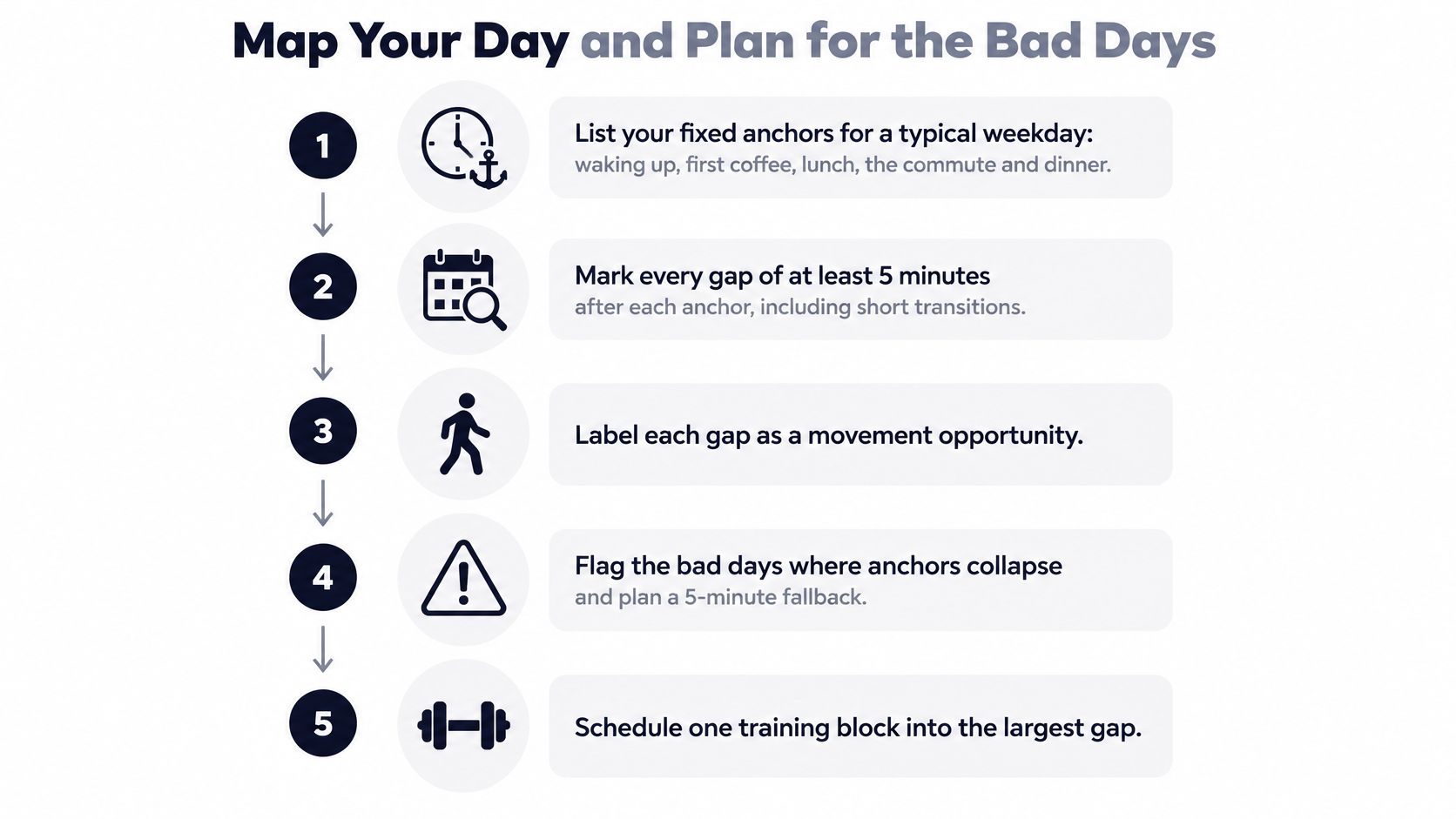
Anchors do the work that motivation can't, because a trigger tied to something you already do doesn't need to be remembered. The minimum matters just as much: it stops one bad day from becoming a skipped week, and a skipped week is where most routines die. The adherence numbers back this up. A 2024 review in the American Journal of Lifestyle Medicine found adherence of at least 92% in the five short-bout studies that reported it, which is what you'd expect when the unit of work is small enough to fit inside a normal day.
What to do when the day blows up anyway
Shift workers, caregivers, commuters and anyone with a meeting-heavy calendar face the same problem: the planned time disappears, and the routine goes with it. WHO guidance is useful here because it doesn't demand a formal workout. Replacing sedentary time with physical activity of any intensity provides health benefits, per the WHO guidance document, so the question becomes what you can salvage in the gap you got.
That framing is supported by a 2025 real-world study in the same document, which found remotely delivered snacks feasible for inactive middle-aged adults across 12 weeks, with participants encouraged to complete at least three isolated bouts per day on three days each week. Treat that as a floor for disrupted weeks, not a ceiling for good ones.
| Disruption | Minimum move | Next step |
|---|---|---|
| Only 30 to 60 seconds free | One set of push-ups or squats | Resume the planned session on schedule |
| Full session cancelled | Two 1-minute snacks at natural breaks | Keep the same daily goal |
| Two or more missed training days | Repeat the easiest set for three days | Move up only when it feels easy |
| Travel or long meeting day | Five-minute bodyweight set in a hotel room or office | Log it and continue the week |
That last rule is built into the app: you move up to a harder week of the plan when the current week feels easy. Nothing escalates while you're still scraping sessions together.
A missed session is the normal case, not the exception. The table above is the fix, because it answers the only question that matters at 9 p.m. on a bad day: what's the smallest thing I can still do? If you want the habit mechanics behind this, our piece on how to build habits covers triggers and the two-week test in more detail.
By the end of two weeks you should know which two anchors are reliable enough to build the whole routine on. Those two are the ones that survive a deadline, a sick child or a delayed train.
Turning Breaks Into Movement Snacks
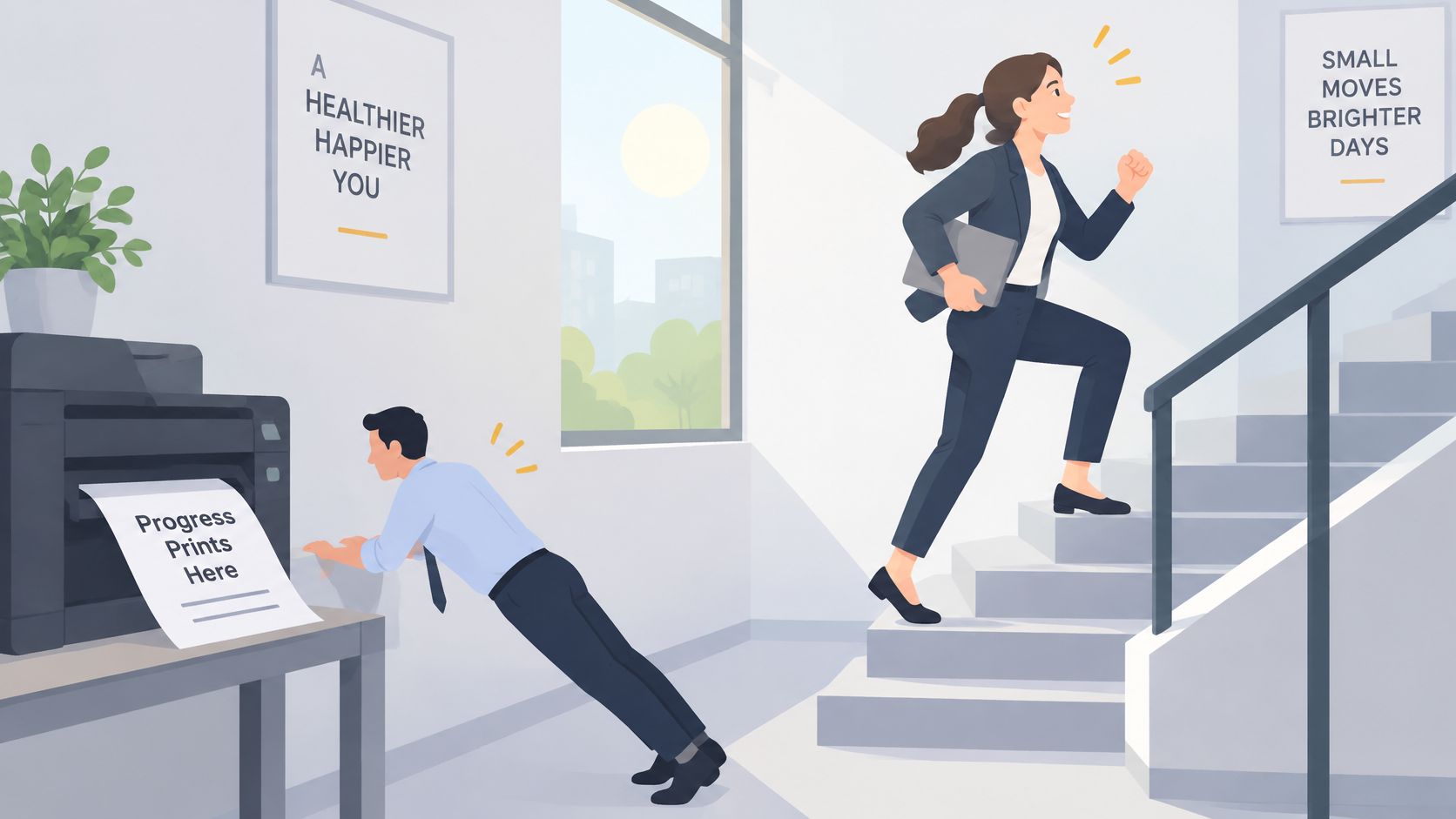
Picture the office at 2:40 p.m. You've been sitting since lunch and the printer is grinding through forty pages. You climb three flights of stairs in about twenty seconds, come back, and knock out ten wall push-ups while the last pages come out. Nobody noticed, you didn't change clothes, and the afternoon slump loses its grip.
That's an exercise snack: brief bouts of movement distributed through the day rather than saved for a single session. A 2024 scoping review in Sports Medicine examined 32 studies on exercise snacks and concluded the approach appeared feasible and safe for adults and older adults.
The intensity question is where most advice goes wrong. People either treat every break as a mini-workout and burn out in nine days, or keep it so gentle it never touches fitness. A 2025 scoping review indexed on PubMed Central found 33 original studies with 1,118 participants, with protocols varying widely across cycling, stair climbing and bodyweight exercise, and most conducted in laboratories or at home. There is no standard prescription for duration, intensity, rest or progression yet.
The effort rule I give people: hard enough that talking is possible but singing isn't, and short enough that you could do it again in an hour.
The same review reports a 2025 meta-analysis finding that exercise snacks improved cardiorespiratory fitness in inactive adults, with a large pooled effect (g = 1.37; 95% CI 0.58 to 2.17) and substantial heterogeneity (I² = 71.4%), meaning results differed considerably between interventions. Translation for your week: the approach works, the exact recipe doesn't matter as much as repeating a version you can control.
Snacks add to the weekly total rather than replacing it. Three stair climbs won't cover 150 minutes, and treating them as a full training program is how people end up fitter than before but still short of the guideline. Use the anchors you already mapped, after calls, while food heats, after bathroom breaks, at each flight of stairs, and let the movement come to you. More ready-made examples are in our guide to exercise snacks examples.
Watch that through once before your next workday and pick the two snacks you'd do in your building.
Start Your First Busy-Day Week Today
Five decisions, one action. Work down the list in order and you have a working week by tomorrow morning.
A crowded week fails on the plan, not on motivation. Write the fallback before the calendar fills.
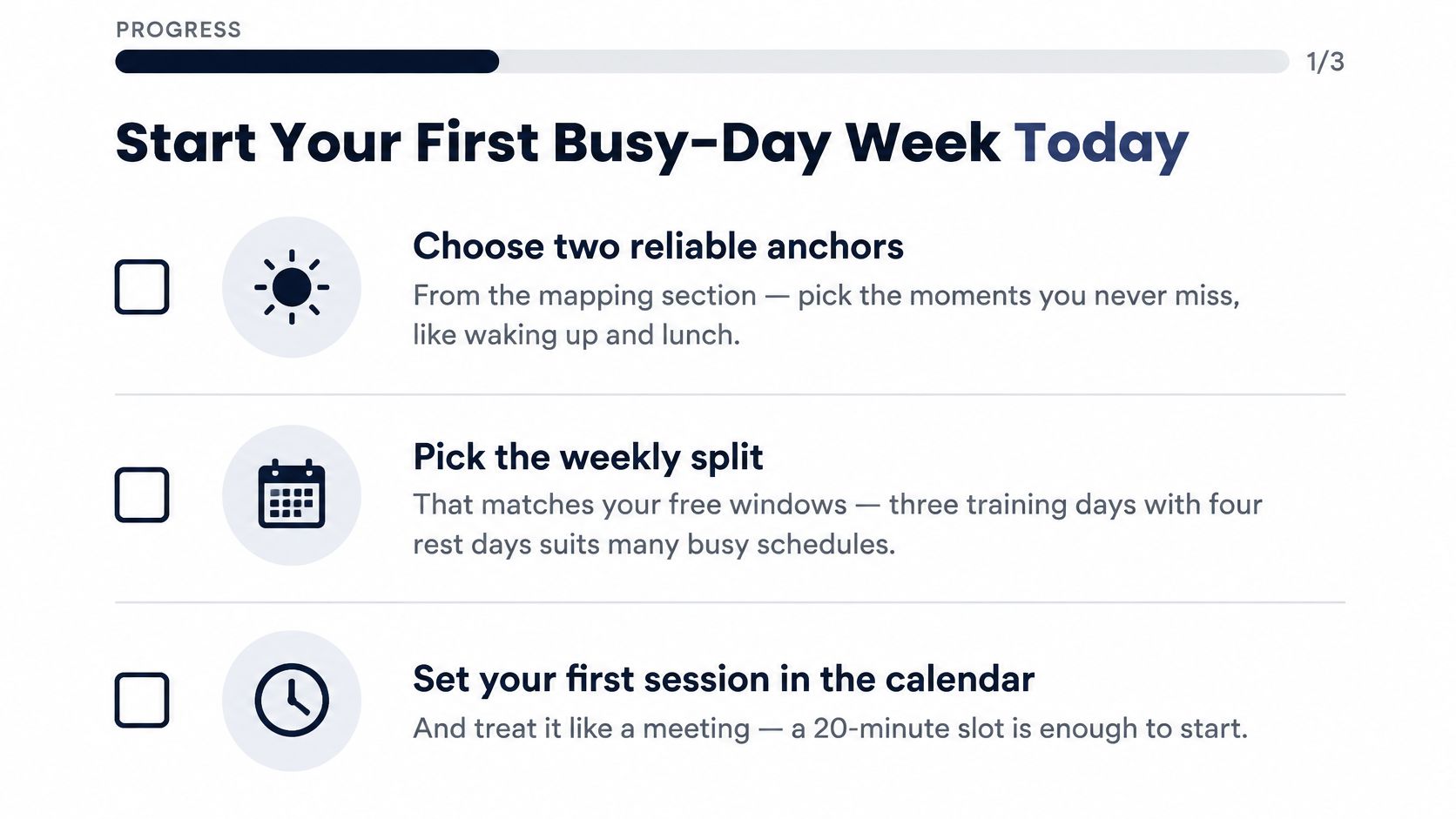
- Choose two reliable anchors from the mapping exercise. Keep the two that held for two weeks, and drop the rest for now.
- Match the split to the windows you counted. Five 15-minute gaps do not support three 50-minute sessions.
- If a three-day training week with four rest days suits you, set one small goal on each training day and keep the rest days restful. Beside each training day, write the minimum move you will still do if that window collapses: one set, not the full goal.
- Choose one bodyweight movement and write its starting reps. One movement done on schedule beats five movements done twice.
- Log the first set within 24 hours. Do it today.
I treat a missed window as a smaller set, not a cancelled day. That minimum move is what keeps the week intact when a call runs long. Short, hard bouts of a few seconds to a minute have shown fitness benefits in small studies, and activity of any length can still add to health. Those snacks belong inside the three training days. They do not stand in for the week. On a bad day, the logged minimum is the day's work. On a clear day, do the small goal you set. Move to a harder week only when the current week feels easy.
Logging takes seconds. SuperStrong is an iPhone app that records bodyweight sets as tiles on a wall you share with up to four friends: tap the big key, pick an exercise, set the reps or the seconds for a hold, confirm, and the tile lands on the wall. Eight push-ups make a small tile and thirty push-ups make a big one. The daily goal is a suggestion drawn from your own past sets. The challenges offered are 0 to 10 push-ups, Full body balanced, Core / abs focus, Stronger legs and Build your engine, which helps when choosing the first movement is the stall. SuperStrong is a log, not a coach and not medical advice, so check with a doctor before starting an exercise programme.
A five-minute day stays on the wall next to the training days, visible to those friends, and the tiles grow as the reps do. Open SuperStrong, lock the two anchors and the minimum move for each training day, and log the first set in the next 24 hours.