How Many Squats a Day? What Research Actually Says
 17 min
There's no evidence-based number of squats that everyone should do each day. For most beginners, the practical target is one to three sets that stop with two to four repetitions left in reserve, on two or three nonconsecutive days a week.
The number you've seen quoted most often, 100 squats a day for 30 days with no rest, is a challenge format rather than a training prescription. It never says how hard each rep should feel, how deep you should sit, or what you're supposed to do on day 31 when the calendar runs out and the habit usually runs out with it. Squats earn their place in a week because they load the legs and hips with nothing but floor space and a few minutes. So the useful question isn't how many squats a day. It's how much squatting your week contains, how close to failure each set runs, and how much recovery sits between sessions.
Table of Contents
- Why No Single Daily Squat Number Works
- Daily Squat Targets by Fitness Level
- How to Spread Squats Across the Day
- Progression Without Adding Daily Reps
- Warning Signs and Safer Squat Variations
- Log Your Week and Choose Your Target
Why No Single Daily Squat Number Works
No public health body publishes a daily squat quota, and that's not an oversight. The CDC's physical activity guidelines for adults recommend muscle-strengthening activity on at least 2 days per week, alongside 150 minutes of moderate-intensity aerobic activity or 75 minutes of vigorous activity weekly. The same guidance describes a typical strength session as 8 to 12 repetitions per activity for one set, with one set as the minimum and two or three sets offering additional benefit. Squats count toward that because they train the major lower-body muscle groups, particularly the legs and hips.
What changes the right dose for you is a short list: your current fitness, your technique, how much range of motion you own, how well you recover, and whether the movement is hard enough to drive adaptation. That last item does most of the work, and it's the one the challenge posts leave out.
Counting squats without noting effort is like counting steps without knowing pace, distance or terrain. Ten thousand steps shuffling around an office and ten thousand steps on a hill climb register the same number and produce very different training. A daily squat total has the same blind spot.
The evidence makes this concrete. A 2025 controlled study put 29 healthy sports-science students through squat sessions of either three sets of 12 repetitions at 75% of one-repetition maximum or three sets of 30 repetitions at 50%, measuring energy expenditure, oxygen consumption, heart rate and movement velocity, as reported in the published study on squat protocol demands. One protocol totalled 36 repetitions, the other 90, and the physiological strain differed by design rather than by count. Energy expenditure, oxygen consumption and heart rate also tended to fall as successive sets went on, showing how much the body adapts mid-session.
The shift to make: judge your squatting by weekly dose and effort, not by a number you repeat every morning.
Once you frame it that way, a hard session and a heavy week stop competing with a daily tally, and the number of rest days per week you actually need becomes part of the plan rather than a failure of willpower.
Daily Squat Targets by Fitness Level
Two sets of ten squats on Monday and two sets of ten on Thursday add up to a full week of leg training, with two rest days in between. Read the table that way: each row describes one training day that repeats a few times a week, not a quota to hit every morning. Most weekly squat plans run on two or three nonconsecutive days, which is the cadence the numbers below assume.
| Level | Training days per week | Sets per session | Stop point per set |
|---|---|---|---|
| Beginner or returner | 2-3 nonconsecutive days | 1-3 sets of 6-12 controlled reps | 2-4 reps in reserve |
| Comfortable with 15+ reps | 2-3 days | 2-4 sets of 6-20 controlled reps | 1-3 reps in reserve |
| Strength focus | 2-3 days | 2-3 sets with heavier relative load | 1-3 reps in reserve |
| Muscle growth focus | 2-3 days | Enough hard sets across the week to keep progressing while you still recover | Near failure, 1-3 reps in reserve |
Beginner or returner. One to three sets, 6 to 12 controlled reps, stopping with two to four reps in reserve. The reserve is the whole point: 20 easy squats and 10 slow, near-fatigue squats are not the same stimulus, and only one of them builds anything. The World Health Organization's guidance on muscle-strengthening activity asks for work involving all major muscle groups on at least 2 days per week, which means daily squats aren't required for the health benefit.
Comfortable with 15 or more reps. Two to four sets of 6 to 20 controlled reps, stopping one to three reps short of failure. If 15 bodyweight reps already feel routine, the set needs more difficulty rather than more days.
Strength focus. Two or three sets with a heavier relative load. The American College of Sports Medicine resistance-training guidance recommends training major muscle groups at least twice weekly, with strength-oriented work commonly using heavier relative loads for 2 to 3 sets per exercise.
Muscle growth focus. Judge the week, not the day: accumulate enough hard sets per muscle group each week to keep progressing while you still recover, taken near failure with one to three reps in reserve. Daily repetition targets are misleading because bodyweight squats only approximate progressive resistance once the movement gets difficult through tempo, pauses, range, single-leg versions or added load.
The rule for moving between rows: stay on your current row until it feels easy for several sessions, then step up one row. Not two.
The worked example at the top shows why this framing matters. A beginner who treats Monday and Thursday as the plan finishes the week recovered and ready, while the same person chasing a daily number would stack fatigue onto sessions that were never meant to be daily. Nothing about resting five days out of seven is a compromise.
How to Spread Squats Across the Day
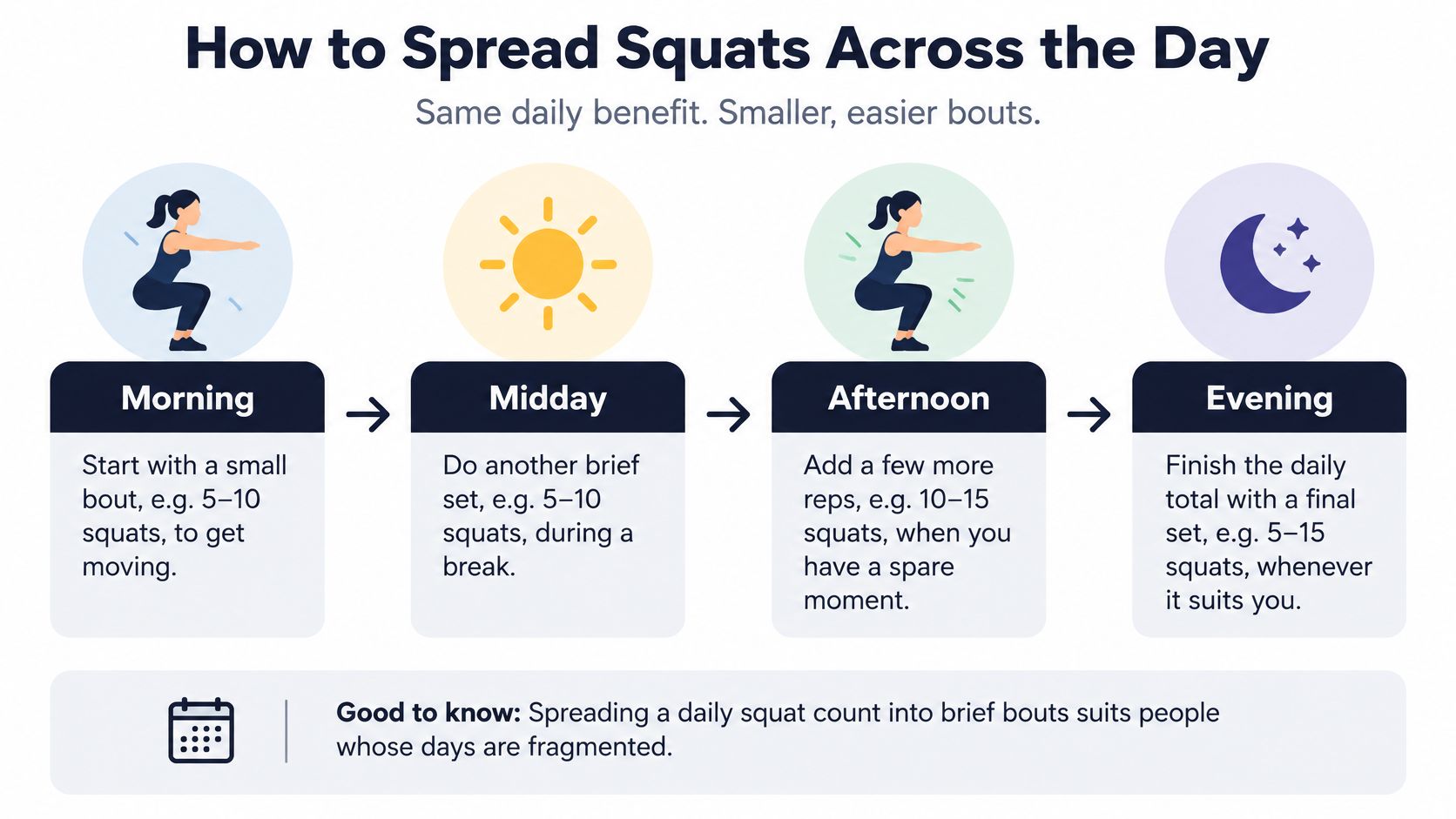
Spreading volume into brief bouts suits people whose days arrive in fragments, such as those balancing a job, a commute and a family. Short bouts through the day are well studied for fitness, and the changes that show up most consistently are in fitness and physical function rather than body composition, blood pressure or blood lipids.
Here's the rhythm a fragmented day can follow.
- Choose a training day from a three-day rhythm. Three training days and four rest days is the cadence our plan runs on, with a small goal sitting on each training day. The common slip is stacking sessions on consecutive days out of momentum, which eats the recovery that makes the next set productive.
- Take your session total from the row you chose. If the beginner row says one to three sets, start at one set. The slip is grabbing the top of the range before the base is steady, then interpreting normal soreness as a sign you can't tolerate squats.
- Split the work into two or three bouts spaced hours apart. Ten reps before a morning call and ten more after lunch is the same session, just distributed. The slip is cramming all the bouts into one block and calling it a spread.
- Warm up with three to five easy squats at reduced depth. Cold legs make the first working set feel heavier than it is, so an unplanned warm-up turns a moderate set into a hard one.
- Use a controlled tempo and stop at two to four reps in reserve. Grinding out the final reps is the slip that turns a strength set into a fatigue test, and fatigue is where technique leaves first.
- Check depth, knee tracking and trunk control each set. If any of the three slips, end the set early rather than finishing the number. Those three checks matter more than the count.
- Log the session, and take the next day off if soreness is still there. A log tells you what happened; memory tends to round up.
One useful lead-in before your first session: watch the movement once with fresh legs so the pattern is familiar before you add volume.
The evidence for distributed bouts is encouraging but narrow. A 2025 systematic review and meta-analysis covering 27 studies and 970 participants found meaningful improvements in maximal oxygen uptake, with no statistically significant effect on body mass, and results varied by bout frequency, duration, intensity and participant characteristics, according to the meta-analysis of exercise snacks. Read that as support for brief, repeated movement, not as a licence for maximal leg work every single day.
A good session has a feel to it. The last rep is controlled, the knees track over the toes, and the soreness the next morning is mild enough that you could repeat the set if you had to, even though you won't.
Progression Without Adding Daily Reps
The trigger for progress isn't a date on the calendar. It's the moment a set stops being hard. When you exceed your chosen ceiling, say 20 reps, without real effort, the movement has to change. Adding daily volume to an easy exercise mostly builds local muscular endurance.
You have five levers: repetitions, sets, tempo, range of motion and load. Move one per week while holding one to three reps in reserve, because two simultaneous changes tell you nothing about which one worked.
Change one variable per week. Two at once and you've learned nothing about the cause.
Harder versions of a bodyweight squat, in rough order of difficulty: a slower lowering phase of three to four seconds, a two-second pause at the bottom, a deeper range within comfort, a split squat stance, or holding a loaded backpack against your chest. Any of these turns a routine set into a stimulus again without touching the calendar.
Short repeated work does build capacity when effort is pushed. A 2025 randomized study of resistance-exercise snacks reported that participants increased bodyweight squat-to-failure performance from 27.87 repetitions at baseline to 32.53 repetitions after the intervention, as published in the resistance-exercise snack trial. That's roughly a five-rep gain in capacity from brief, repeated effort, not from a longer daily tally.
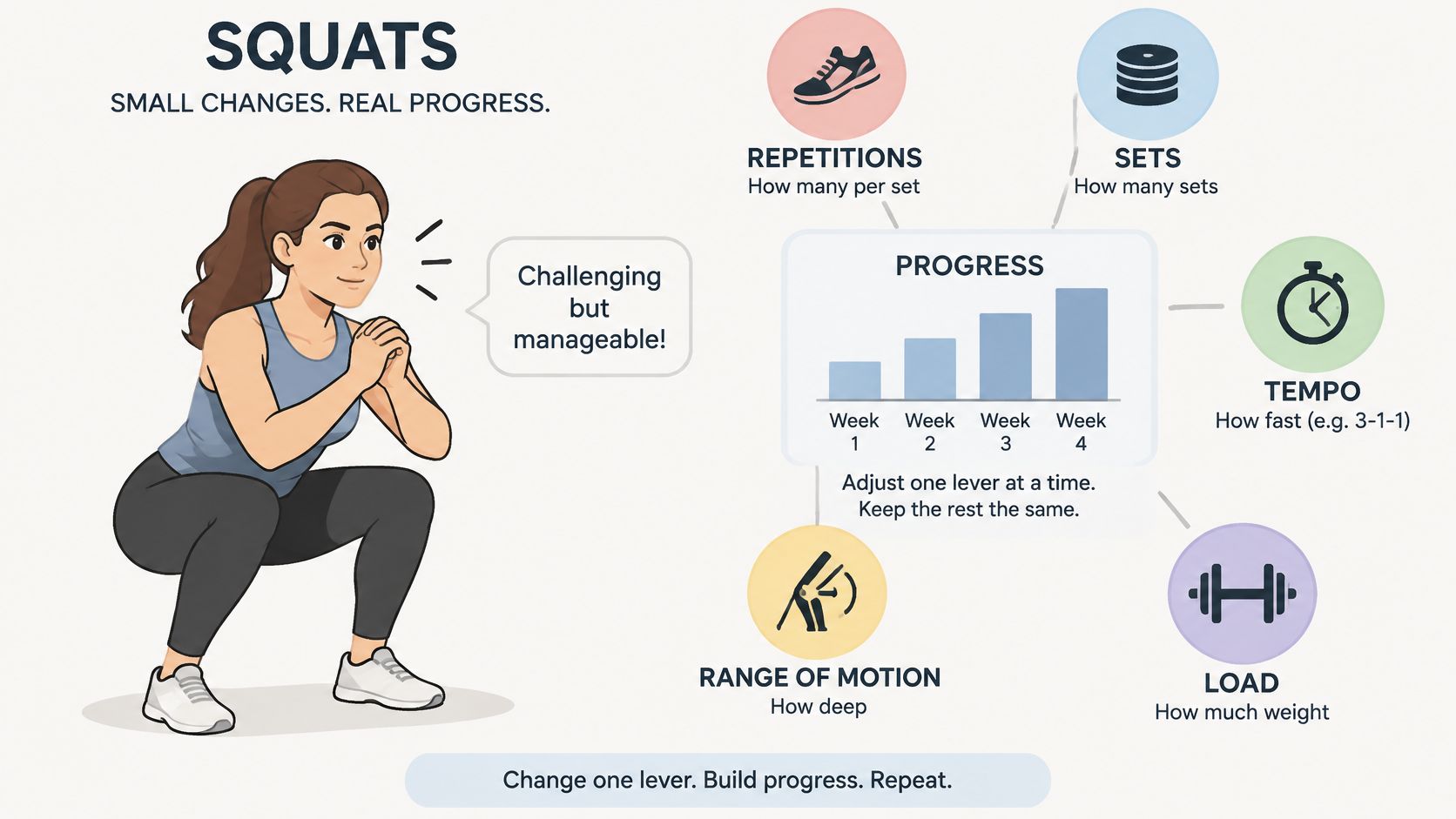
A three-week example with one change per week.
- Week one: three sets of ten bodyweight squats, stopping with two reps in reserve. Effort level recorded as controlled.
- Week two: same three sets of ten, same stop point, with a three-second lowering phase added. The reps didn't change; the demand did.
- Week three: same sets, same tempo, plus a two-second pause before standing. If the pause makes the set too hard to hold two reps in reserve, keep week two's version for another week.
Three weeks, three sessions a week, and the total daily count never moved. What moved was difficulty, which is the variable that drives adaptation.
In our plan, you move up to a harder week when the current week feels easy, not when the schedule says so. That single rule prevents the two failure modes people fall into: adding reps forever on a movement that stopped challenging them months ago, and jumping to a version they can't control.
Warning Signs and Safer Squat Variations
Every day is not automatically better. A daily maximal squat test erodes technique and outruns recovery, and the soreness that follows is usually blamed on the exercise rather than the schedule. The targets in the table assume healthy knees and normal mobility. If either is missing, your starting point changes.
Learn to tell training stress from a warning. Muscle burn and general fatigue that fade within a day are the expected cost of a set taken near failure. Pain that's sharp, joint-specific or getting worse across sessions is a different category, and it ends the set.
| What you notice | What it usually means | What to do |
|---|---|---|
| Muscle burn that fades within a day | Normal training stress | Keep the planned sets |
| Soreness lasting two to three days | Load has outpaced recovery | Take an extra rest day and drop one set |
| Sharp or worsening joint pain | Possible overload or injury | Stop the set, use a regression, and see a clinician if it persists |
| Swelling, instability or recent injury | Needs medical evaluation | Do not add repetitions; get clearance first |
Stop signal: sharp, joint-specific pain ends the set. Muscle burn doesn't have to.
Regressions that keep the same tempo rules. A chair-assisted squat or sit-to-stand gives you a built-in depth check and a handhold if you need it. Reducing depth by a few centimetres often removes knee discomfort entirely. Slowing the reps makes a shallow squat harder than a fast deep one. If you're working through knee sensitivity, the chair squat progression guide walks through set-up and depth.
The rest decision is simpler than many believe. If soreness lasts two to three days, or your performance drops across two sessions in a row, take an extra rest day and cut one set from the next session. You're not losing progress; you're restoring the conditions that produce it.
Get a medical opinion before you assign yourself any repetition target if you have persistent swelling, a joint that feels unstable, significant pain, or a recent injury. The same applies to returning after a long layoff with existing joint problems. Recent reporting on exercise snacks and joint-friendly movement has been encouraging, but as NBC News coverage of the exercise snack research notes, outcomes depend on modality, frequency, duration, intensity, accumulated volume, timing and population. That's a long list, and it doesn't add up to unlimited daily leg work for everyone.
One honest limit: our app is a log, not a coach and not medical advice. Anyone starting an exercise programme should check with a doctor first, especially with joint pain in the picture.
Choose the variation that keeps pain at zero. Resume the plan only while it stays there.
Log Your Week and Choose Your Target
A training log does one job well: it replaces your memory of the week with a record of it. That matters here because effort is the variable you're managing, and effort is exactly what people misremember.
Four taps and the set is on the wall
Logging a set takes four actions. You tap the big key, pick the exercise, enter the reps (or seconds, if it's a hold), and confirm, and the tile lands on the wall. The whole sequence fits between two tasks, which is the point of a micro-workout.
Two things to note while you log. Tile size tracks repetitions rather than effort, so an eight-rep set makes a small tile and a thirty-rep set makes a big one; the height of the tile tells you volume, not difficulty. Because of that, add a word about how hard the set felt, either in your own notes or by keeping the effort level consistent so the wall stays comparable week to week.
A NEW PR badge marks a progression event, which is worth watching for precisely because it should be occasional rather than constant.
Reading the wall across a week
Pull back and the week has a shape. Three training tiles and four empty rest days show the rhythm at a glance, and the gaps are as informative as the tiles. Zoom views for day, week, month and year let you look at the same wall across time scales, the way a photo library lets you find one afternoon or one entire summer. If you also keep a paper record, the same habits carry over to a bodyweight workout journal.
Repeated small tiles at the same effort are the signal that the level needs changing. That pattern says the movement stopped being a stimulus, not that you need more days.
Bigger tiles with no effort note are the other trap. Volume climbed, difficulty didn't, and the training effect is probably endurance rather than strength.
After each week, check three things: did the training days happen, did effort stay controlled, and did one variable change. Two out of three is a decent week. One out of three means the plan needs simplifying, not intensifying.
The app itself is an iPhone app that logs bodyweight sets as tiles on a shared wall for up to four friends, and the daily goal it shows is a suggestion drawn from your own past sets rather than a fixed prescription. If you want a leg-focused starting point, the built-in challenges include Stronger legs alongside options such as 0 to 10 push-ups and Full body balanced.
Your first week, decided in advance
Pick the level row that matches your current ability, schedule three training days with four rest days between them, and set a starting total from that row. Decide now what "easy" will look like, so you're not negotiating with yourself mid-week.
Log it or lose the thread: the week you don't record is the week you'll reconstruct from wishful thinking.
Then log the first session this week. After seven days, look at the wall and your effort notes together and answer one question: did the sets feel easy, about right, or too hard? Easy means one variable goes up next week. Too hard means one set comes out. About right means repeat the week as written.
The app records the work. You decide the dose, and that division of labour is why logging beats another daily target you'd eventually ignore.
SuperStrong is built for exactly this kind of week: an iPhone app that turns bodyweight sets into tiles on a shared wall with up to four friends, so three training days and four rest days stay visible instead of abstract. You can log squats in four taps, see whether a set got harder, and let the daily goal follow your own past sets rather than a number someone else picked. Start with one session this week at SuperStrong and let the wall tell you what next week should look like.